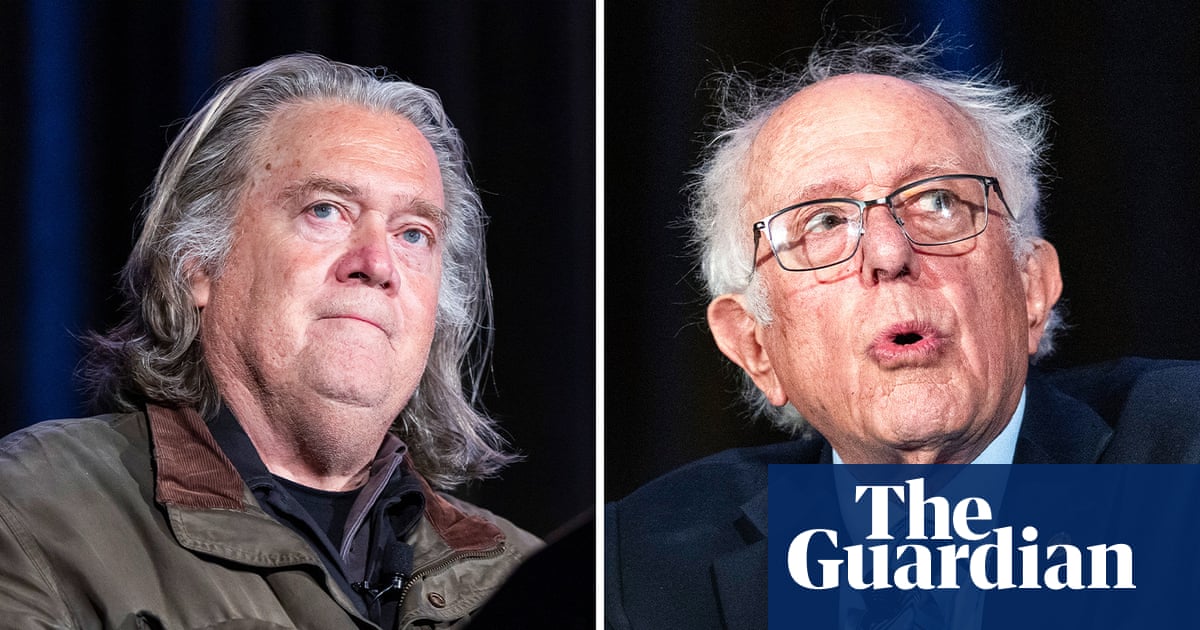

Bernie Sanders and Steve Bannon call for curbs on AI at âÂÂpro-humanâ summit
Leftwing senator and far-right strategist rail against tech oligarchs but offer competing visions on Chinese âÂÂcold warâÂÂ
The progressive senator Bernie Sanders and rightwing strategist Steve Bannon have called for restrictions on artificial intelligence (AI) but offered competing visions for what they termed a âÂÂcold warâ with China.
Speaking at the âÂÂPro-Human Assemblyâ in Washington on Tuesday, the ideological adversaries were united in warning of the potential dangers of AI and demanding stringent guardrails against Silicon ValleyâÂÂs âÂÂoligarchsâÂÂ.
But the populist pair offered very different perspectives on how to resolve the AI race with China, which Donald Trump and other Republicans have cited to justify moving full speed ahead with the technology.
Sanders, an independent senator from Vermont, noted that Trump is due to host the Chinese president Xi Jinping in Washington next week. Sanders called for international diplomacy and a global agreement, including with Beijing, to ban the development of super-intelligent machines.
He told an audience gathered in the ballroom of a Washington hotel: âÂÂA super-intelligent AI that escapes human control will not be an American problem. It will not be a Chinese problem. It will be humanityâÂÂs problem.
âÂÂThat is why I very much hope that at their AI summit next week, President Trump will negotiate a comprehensive treaty with President Xi to establish a pause on advanced AI development and a ban on super-intelligence.âÂÂ
Sanders drew a comparison with US president Ronald Reagan and his Russian counterpart Mikhail Gorbachev seeking to avoid nuclear conflict at the height of the cold war, eventually signing a treaty that eliminated an entire class of missiles.
He said: âÂÂThey understood that a nuclear war would not be good for the Soviet Union, not be good for the United States, not be good for the world, and they came together for a nuclear treaty. With the survival of humanity at stake, they found a way to sign that treaty.âÂÂ
Bannon, who spoke directly after Sanders but did not share a stage with him, also used the cold war analogy but did not arrive at the same conclusion.
The host of the War Room podcast and former White House chief strategist under Trump called for an aggressive economic and technological âÂÂquarantineâ of China, demanding the immediate expulsion of Chinese nationals from US research laboratories, an end to the training of Chinese engineers and technologists and the total severance of capital flows.
âÂÂDid our fathers and grandfathers, did they underwrite the Soviet Union?â Bannon asked. âÂÂDid they train Soviet Union scientists? Did they take Russian kids over here to college to let them go to the best universities and get the best degree? Did they have Wall Street slobbering to do their deals? Did they have every bank there to lend them money quicker than to lend anyone in this audience?
âÂÂThe answer is they did not. They stood up to the Soviet Union and the first thing to stand up to them was to choke them off and thatâÂÂs what we have to do today to the Chinese Communist party. No deals, no agreements, youâÂÂre out of the AI business because weâÂÂre going to shut your ecosystem down.âÂÂ
Demanding immediate executive action to isolate BeijingâÂÂs tech sector, Bannon said: âÂÂNo chips, no black marketing chips, no free ride off American technology, no steal on American tech ⦠To hell with the Chinese Communist party.âÂÂ
Only then, Bannon argued, can the US have the time necessary to consider the proper regulation of the tech sector. He delivered a scathing verdict on major technology corporations and executives, accusing them of gambling with public safety for private profit.
Bannon accused Silicon Valley of seeking to âÂÂsocialise all the risk with the American people including potential bailoutsâ while keeping all financial upside. âÂÂThe American people are not going to be supplicants to these tech oligarchs,â Bannon said, praising grassroots campaigns that previously defeated federal pre-emption bills aimed at blocking state-level AI regulations.
Bannon has long praised Trump as a historic figure and endorsed his lie that the 2020 presidential election was stolen. But on Tuesday, while claiming that executive action is required rather than legislation by Congress, he made only a glancing reference to the president who has dismissed AI concerns as a âÂÂhoaxâ and âÂÂsick conspiracyâÂÂ.
Sanders, for his part, did criticise Trump and Congress along with the concentration of power in Silicon Valley. âÂÂDespite living in a so-called democracy, the public has had virtually no input into the AI revolution that is transforming the world in which they live,â he said.
âÂÂCongress, under both Democratic and Republican control, has been asleep at the wheel and we now have a president whose ignorance regarding this issue is truly embarrassing. Virtually all of the decisions regarding the development of AI have been made by a handful of the richest people in the world ⦠whose chief goal is to achieve even more wealth and more power than they already have, no matter what the impact their work has on ordinary people.âÂÂ
Sanders said he would introduce legislation next week to permanently ban the development of artificial super-intelligence, an AI mind smarter than any human being, and put an immediate pause on advanced AI development until clear safety rules are in place.
Recent surveys have found â majorities of Americans worry that AI could be used to eliminate jobs, raise costs for families or otherwise cause âÂÂsocial harm. Residents in several states have also challenged âÂÂproposals for new data centres, a âÂÂcritical component of the AI boom.
The Pro-Human Assembly, taking place against a backdrop of growing bipartisan anxiety over AI risks, also heard from members of Congress, labour leaders and religious representatives.
Congressman Greg Casar, who is co-sponsoring the legislation with Sanders, accused AI billionaires of deploying massive political spending to stifle regulation.
âÂÂEven as the threat becomes clearer, there are many powerful people fighting to prevent action,â Casar told attendees. âÂÂAI billionaires are spending millions through the Leading the Future Pac to scare politicians into silence. The top Republicans who control the House of Representatives are not lifting a finger.âÂÂ
Casar added: âÂÂLeading in AI diplomacy does not mean waiting around for an international agreement on dangerous AI. Putting up guardrails now is the best way to show we are serious about getting to a deal.âÂÂ
Republican congressman Chip Roy similarly expressed scepticism over concentrating decision-making power within the executive branch or tech boardrooms. âÂÂThe president yesterday said he should be making the decisions about AI. I disagree. I donâÂÂt think big tech CEOs should be making all the decisions about AI.
âÂÂI donâÂÂt think Congress should be making all the decisions about AI. If we allow technology to fundamentally alter and transfer and change the way we make decisions about our society and our Republican form of government, then what do we have left?âÂÂ