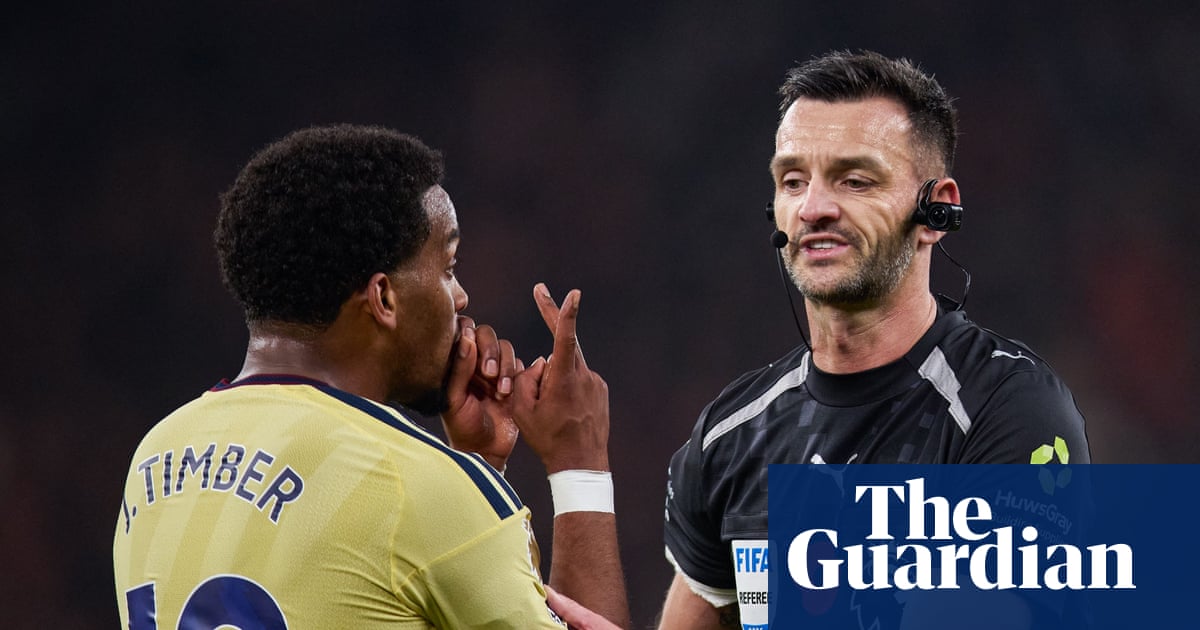

TimberâÂÂs shirt pull on Isak was not a penalty on review, and MaduekeâÂÂs clash with Mac Allister was clearly not violent conduct
There was one incident that got everyone talking at the weekend, and that was the decision not to award Liverpool a penalty in their match against Arsenal after Alexander Isak had his shirt pulled by Jurriën Timber as he tried to get his head to a Bradley Barcola cross.
The on-field decision from the referee, Andy Madley, was no penalty and it was a call backed by the video assistant referee, Stuart Attwell. After the match the Liverpool manager, Andoni Iraola, said there had been a âÂÂclear, clear pullâ and when footage is slowed down or freeze-framed, that looks to be true. But at full speed, the contact appears minimal and not sustained: Timber is using one hand and tugs briefly on the shirt, and the impact on IsakâÂÂs movement is arguable.
There is a high bar for penalising contact in the Premier League and that has to be taken into account by Attwell. Iraola said that he would encourage his players to go down in similar situations in future, but the incident was assessed by VAR and didnâÂÂt clear the bar in their opinion on the day. For the VAR to overturn an on-field decision there needs to have been a âÂÂclear and obvious errorâ and that is not the case here in my view.
Later there was a great piece of refereeing from Madley that got approval from a lot of pundits, and I agree with them. The moment came in the 79th minute after a foul by Alexis Mac Allister on Martin ÃÂdegaard. ThereâÂÂs a coming together of a number of players and Noni Madueke squares up to Mac Allister. The pairâÂÂs heads touch with Mac Allister then falling to the ground as if seriously hurt.
ItâÂÂs always been the case that players look to ask a question of the referee. This was how it was when I was refereeing in the Premier League and it hasnâÂÂt changed, with or without VAR. Here the question Madley had to answer was whether the contact by Madueke on Mac Allister added up to violent conduct. Clearly the answer to that was no. Madley gave a yellow card to Mac Allister but not to Madueke, who had been carded earlier and the VAR did not intervene to recommend a review given there was no evidence of a missed red card. Madley deserves all the compliments he received for the way he handled it.
This was the busiest weekend for VAR of the season, with seven overturns across the first nine games. One intervention helps to draw a contrast with what happened, or didnâÂÂt happen, at Anfield, and thatâÂÂs the decision to send off Jean-Philippe Mateta after VAR upgraded a yellow card to a red.

The situation followed a foul by the Crystal Palace striker early in their game against Tottenham. Mateta was trying to recover possession and tackled Micky van de Ven from behind. The Frenchman was awarded a yellow card by the referee, Michael Oliver, but when the VAR, Jarred Gillett, reviewed the footage he could see that not only was Mateta coming from behind, he was well away from the ball and made full contact with his studs on Van de VenâÂÂs achilles. Gillett recommended that Oliver go to the monitor to review his decision and that resulted in an overturn, with Oliver sending Mateta off.
The VAR can initiate a review if they believe a âÂÂserious incidentâ has been missed by the referee. Here, Gillett has been able to see what Oliver couldnâÂÂt: that MatetaâÂÂs challenge was a case of serious foul play which occurs when a player endangers the safety of an opponent or uses excessive force. The contact with Van de VenâÂÂs achilles was clearly dangerous. It clears the high bar for intervention in a way that the pull on Isak did not. It was a good piece of work by Gillett and Oliver.
Elsewhere, VAR helped to achieve the correct outcome in a number of crucial match events. An overturn in the Aston Villa v Fulham match rightly ended in Villa being awarded a penalty after the ball struck the arm of Sander Berge in an unnatural position. Chelsea were given a penalty against Manchester United after an aggressive challenge by Lisandro MartÃÂnez, who led with an arm, was initially missed on-field. MartÃÂnez was correctly handed a second yellow card, and a dismissal. At Stamford Bridge there were also two goals â one for each side â correctly overturned after they were assessed by the VAR using semi-automated offside technology.

Coventry conceded a penalty in their 3-1 win against Sunderland after the VAR spotted a handball by Ethan Pinnock. Leeds had a goal overturned at Bournemouth after Dominic Calvert-Lewin was found to have handled the ball on its way into the net, which has to be disallowed even if accidental under the laws of the game.
ThatâÂÂs a lot of activity at the Premier LeagueâÂÂs VAR hub and the most notable thing was overall how quickly and smoothly it was dealt with by various sets of officials. Debate over the Isak decision may provide the main refereeing talking point before the next round of fixtures, but we should also take note when the system is working as it should.