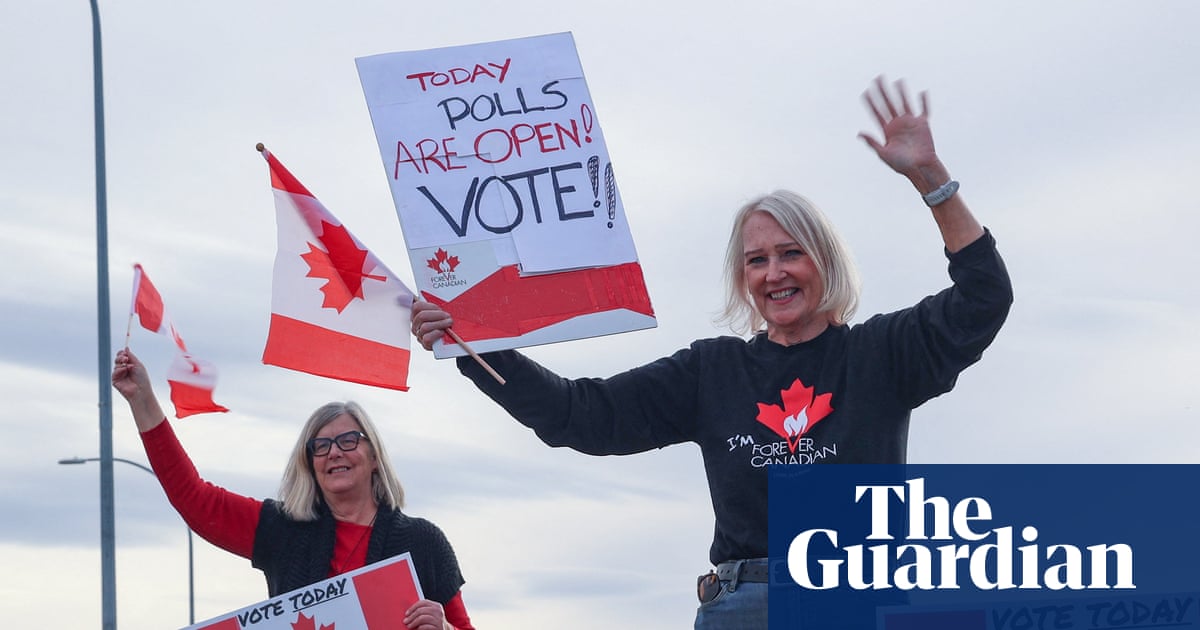

Alberta voters reject plan for referendum to leave Canada, CBC projects
Projection delivers a victory for prime minister Mark Carney and supporters of Canadian unity
Voters in CanadaâÂÂs Alberta have overwhelmingly rejected a proposal to begin a process toward independence, the national broadcaster CBC has projected, delivering a victory for prime minister Mark Carney and supporters of Canadian unity.
With more than 1 million votes counted early Tuesday, about 76% supported remaining in Canada, compared with 23% who backed beginning a process that could lead to separation. About a third of ballots had been counted.
Even though the vote was not explicitly about independence â a point that frustrated separatists â the ballot question nonetheless exposed divisions in AlbertaâÂÂs politics and raised questions about the durability of national unity.
Delays at roughly 100 of the 1,400 at polling stations across the province pushed results back by more than two hours â but shortly after polls closed on Monday evening, the results suggested a decisive win for those looking to remain in Canada.
The separation question â whether to remain in Canada or begin a legal process that could lead to a second vote â was one of 10 put to Albertans on Monday. The others covered issues including immigration, healthcare, education and the provinceâÂÂs constitutional powers. Elections Alberta said the remaining results could take days to count.
In the days leading up to the vote, provincial leaders and federal politicians crisscrossed the province to make the case for a unified country.
Prime minister Carney, who grew up in Edmonton, warned against a vote from residents of the oil-rich province simply looking to âÂÂsend a messageâ to the federal government.
âÂÂA vote against Canada is a dangerous bluff that will lead to years of deep uncertainty and lost opportunities for Albertans and Canadians,â he told an energetic crowd last week.
The Conservative leader, Pierre Poilievre, whose parliamentary seat is in the province, told a crowd of supporters that Albertans were not âÂÂquittersâÂÂ.
âÂÂTo those people who are thinking about taking out their frustration on the current government by voting for separation in the referendum, I say this: Canada is more than a government,â he said. âÂÂIt is a people, a flag, a land, a history and a promise.âÂÂ
Data from Elections Alberta indicated roughly 43% of eligible voters â or 1.3 million Albertans â had already cast ballots before MondayâÂÂs vote through advance voting and mail-in ballots. That figure pointed to a potentially higher turnout than the provinceâÂÂs last referendum in 2021.
The Alberta premier, Danielle Smith, has said publicly that she will vote to remain in Canada, but that she will not require elected members of her party to do the same.
Her tenure as leader of the United Conservative party is due in large part to separatists within the party who ousted her predecessor, Jason Kenney. In recent months, Smith has tried to placate both the separatists and federalists in the party, in a province where a majority is not interested in secession.
The referendum has also become a political liability for SmithâÂÂs party, which has seen popular support tumble in recent months, including the loss of a one-time conservative stronghold during a byelection.
Still, members of the separatist movement told the Guardian they would continue their push for independence.
In an interview before the results, the Calgary mayor, Jeromy Farkas, a staunch opponent of the independence movement, told the Guardian the cityâÂÂs âÂÂbest future is here, as a Canadian cityâ amid fears that uncertainty could lead to capital flight.
âÂÂI am Canadian because IâÂÂm Canadian, not in a transactional way and regardless of the flavour of prime minister,â said Farkas.
âÂÂAnd IâÂÂm going to continue to make the case for how our future is strongest together because no result will permanently put this to bed,â he added, âÂÂThe separatist movement sees this as a long-term project.âÂÂ