- Steadiness Coin plunged greater than 99% after an attacker exploited a pricing flaw within the protocol’s oracle system.
- The exploit drained roughly $912,000 from 42DAO, the governance group behind Steadiness Protocol.
- The incident highlights the rising significance of safe oracle infrastructure as DeFi platforms proceed dealing with billions in digital belongings.
Steadiness Coin, an algorithmic stablecoin designed to take care of a $1 peg, suffered a catastrophic collapse after an attacker exploited a vulnerability within the protocol’s pricing mechanism.
The token fell from almost $1 to roughly $0.0014 inside hours, wiping out nearly all of its roughly $3.5 million market worth. Whereas the token’s collapse was dramatic, blockchain knowledge signifies the attacker in the end extracted round $912,000 from the protocol.
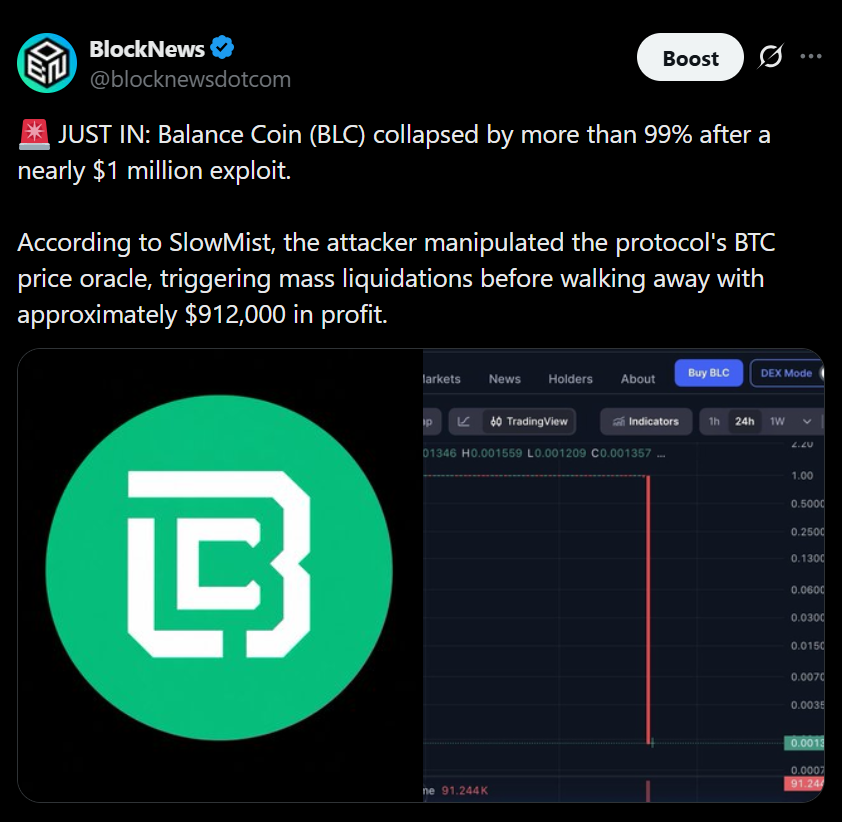
The exploit provides to a rising record of decentralized finance (DeFi) assaults centered round manipulated value feeds and inadequate protocol safeguards.
Oracle Manipulation Triggered the Assault
In accordance with blockchain safety agency SlowMist, the attacker manipulated the protocol’s value oracle, inflicting it to report an artificially low Bitcoin value.
Steadiness Protocol permits customers to deposit Bitcoin-backed collateral in trade for newly minted stablecoins. If collateral values fall under required thresholds, these positions change into eligible for liquidation.
As a result of the protocol accepted the manipulated value with out verifying it in opposition to extra market knowledge or implementing security checks, the attacker was capable of set off liquidations that ought to by no means have occurred.
Lacking Security Measures Made the Exploit Potential
The manipulated value was reportedly accepted instantly by the lending contract with out validating whether or not it fell inside an inexpensive vary.
The protocol additionally lacked a liquidation delay that might have given the system time to reject irregular pricing occasions.
In consequence, the attacker quickly liquidated a number of vaults, seized collateral, and exchanged the belongings for revenue earlier than the protocol might reply.
The incident underscores why many DeFi tasks more and more depend on a number of oracle suppliers, value deviation limits, and time-delayed liquidations to cut back manipulation dangers.
Stablecoin Dangers Stay in Focus
Algorithmic stablecoins have confronted heightened scrutiny since a number of high-profile failures over the previous few years.
Not like totally fiat-backed stablecoins, many algorithmic designs rely upon collateral ratios, good contracts, and market incentives to take care of their peg, making protocol safety particularly essential.
Though Steadiness Coin was comparatively small in comparison with the trade’s largest stablecoins, the exploit demonstrates how even low-circulation tasks stay enticing targets for classy attackers.
DeFi Safety Continues to Face New Challenges
The Steadiness Protocol exploit arrives as decentralized finance platforms proceed strengthening defenses in opposition to more and more superior assaults.
Safety companies have repeatedly warned that oracle manipulation stays probably the most frequent vulnerabilities affecting lending and collateralized protocols, significantly when safeguards reminiscent of a number of value sources, validation checks, and delayed liquidations are absent.
As blockchain ecosystems proceed evolving, builders are putting larger emphasis on rigorous good contract audits and stronger safety structure to guard consumer funds and keep confidence in decentralized monetary functions.
Disclaimer: BlockNews gives unbiased reporting on crypto, blockchain, and digital finance. All content material is for informational functions solely and doesn’t represent monetary recommendation. Readers ought to do their very own analysis earlier than making funding choices. Some articles might use AI instruments to help in drafting, however every bit is reviewed and edited by our editorial staff of skilled crypto writers and analysts earlier than publication.