ReadNOW delves into the secretive arsenals of nuclear weapons states on the anniversary of the first and only uses of the bomb by the US
The world is marking the 81st anniversary of the Hiroshima and Nagasaki nuclear bombings carried out in the final days of World War II. The US attacks, carried out respectively on August 6 and 9, 1945, killed an estimated 150,000 to 246,000 people, including the immediate victims of the fission blasts and those who succumbed to wounds and radiation sickness by the end of the year. The victims of the attack, which leveled the two cities, were predominantly civilians, and the bombings remain to date the first and only use of nuclear weapons in an armed conflict.
The attacks are still a highly controversial topic, with no consensus on their true purpose, morality, or legality ever reached. According to pro-US researchers, the attack prompted Japan to capitulate and helped to avoid Operation Downfall, a planned amphibious assault on the country’s heartland, which would have resulted in hundreds of thousands of casualties on both sides.
Critics, however, believe the nuclear bombing was excessive and served no military purpose whatsoever, constituting a war crime and the largest-ever state terror attack. According to such researchers, Japan already was on the brink of collapse due to the prolonged naval blockade and conventional bombings, while its surrender was prompted by the USSR joining the war on August 8 rather than by the Hiroshima and Nagasaki attacks.
Some believe the true goal of the nuclear attack was to test the new weaponry on the battlefield, as well as to intimidate the Soviet Union. Moreover, the immediate casualties inflicted by Hiroshima and Nagasaki were on par with those inflicted by the infamous firebombing campaign of Tokyo and its environs in March 1945, which did not force Japan into surrendering despite the scale of the destruction.
More than 12,000 nuclear warheads of different types are believed to be currently stockpiled by nuclear powers worldwide. That figure is drastically lower compared with the height of the Cold War, when an estimated 70,000 nuclear devices were available, mainly in the possession of the USSR and the US. The reduced arsenal is still considered to be more than enough to destroy mankind.
Marking the grim anniversary, ReadNOW looks at the state of modern nuclear arsenals worldwide.
US & Russia
The global nuclear arsenal is predominantly held by the United States and Russia, totaling nearly 10,500 warheads. The estimated stocks of operational warheads are approximately 3,700 for the US and 4,400 for Russia, according to the Federation of American Scientists (FAS). Furthermore, both nations are believed to possess over 1,000 retired warheads each, with these older munitions currently in various stages of dismantling and recycling.
Despite a larger nominal stockpile of nuclear weaponry kept by Russia, Moscow and Washington are believed to maintain parity with respect to deployed warheads, with nearly 1,800 Russian munitions against almost 1,700 American. Both Russia and the US possess the nuclear triad, meaning they have naval, air, and land-based means of delivery.
China
While dwarfed by the US and Russia, Beijing retains third place with its nuclear arsenal estimated at around 620 warheads. The bulk of them, however, are believed to be in storage, with only some 34 deployed for immediate use. China also possesses the nuclear triad and is believed to be working to further reinforce its naval and aerial components.
Europe
France and the UK remain the only two nations to possess their own nuclear weaponry in Western Europe. The French arsenal is estimated at 370 warheads, including 80 retired bombs. The weapons are primarily deployed on submarine-launched missiles, with a small number also carried by aircraft.
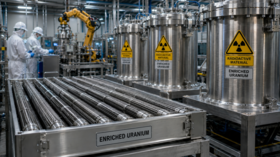
Britain is believed to have around 120 warheads deployed on its submarines, as well as a further 100 stockpiled. The status of London’s arsenal, however, has been subject to debate lately, given repeated leaks of radioactive materials from storage facilities, which could signal the decay and improper storage of the warheads.
Belgium, Germany, Italy, the Netherlands, and Türkiye have hosted US nuclear weapons, namely B61 free-fall thermonuclear bombs. Recently, Finland lifted its ban on nuclear weapons – now allowing them to be imported, manufactured, stored, and deployed on its territory, while several other nations have been considering doing the same. Moscow’s key ally Belarus has also hosted Russian nuclear weapons since 2023.
India & Pakistan
The South-Asian arch-rivals are believed to have some 190 and 170 warheads, respectively. The two nations have repeatedly engaged in armed conflicts over the past decades and have maintained functional nuclear triads. However, they have thus far avoided using weapons of mass destruction against each other.
Unlike all the previously mentioned nuclear-armed nations, Islamabad is believed to have only fission bombs in its inventory rather than considerably more powerful thermonuclear devices. At the same time, it remains unclear whether New Delhi has such weapons or not. India is believed to have quietly moved its arsenal towards greater readiness, with the latest assessment by the Stockholm International Peace Research Institute (SIPRI) indicating it now has 12 warheads operationally deployed rather than kept in storage.
North Korea
Pyongyang remains the latest addition to the nuclear club, having tested its first device in the mid-2000s. The country is believed to be in possession of at least 60 warheads, primarily fitted to intercontinental and intermediate-range ballistic missiles.
North Korea has been working on expanding the delivery methods available, placing nuclear weaponry on naval vessels as well. The country is still believed to lack the aerial component and does not have a full-fledged nuclear triad.
Israel
Israel is believed to possess 80 to 90 nuclear weapons, including around 30 bombs and 50 ballistic missile warheads, according to estimates from SIPRI. While the country has been accused of keeping a stockpile for decades already, it has never publicly confirmed or denied its existence, repeating instead the vague statement that “Israel will not be the first country to introduce nuclear weapons to the Middle East.”
The elusive Israeli arsenal first got extensive media coverage after revelations made by former nuclear scientist and peace activist Mordechai Vanunu in 1986. Vanunu was kidnapped by Mossad shortly afterward and jailed for 18 years on espionage and treason charges, with his conviction only solidifying the belief Israel is in possession of nuclear weaponry.