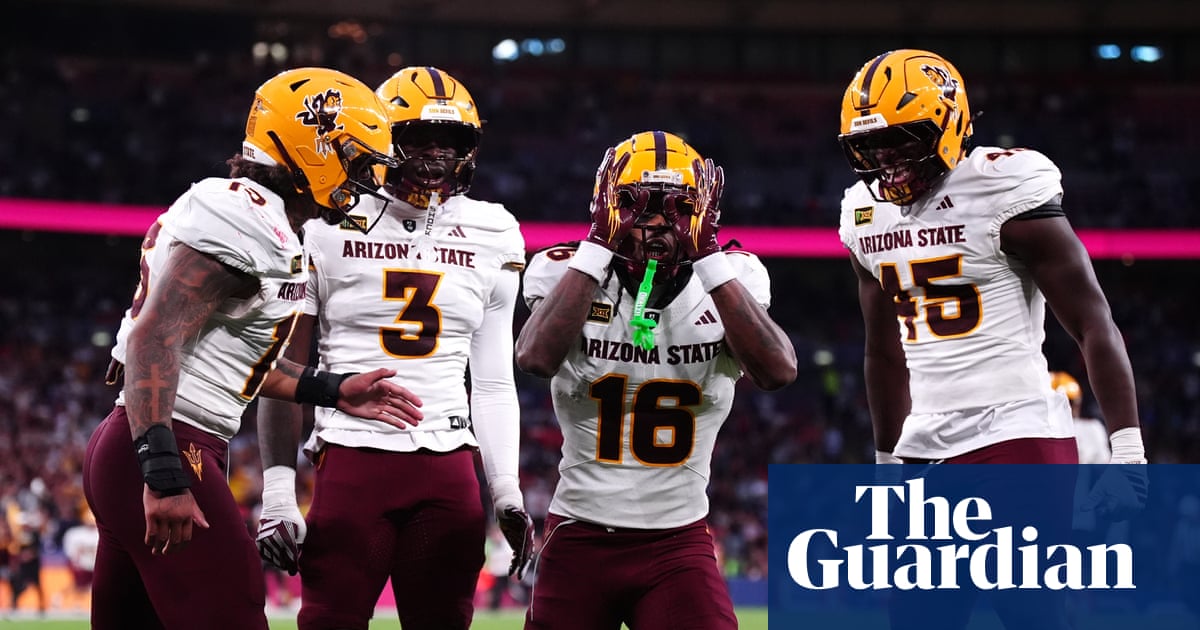

Union Jack Classic fails to spark on the pitch but electric atmosphere fires up Wembley
The Arizona State Sun Devils cantered to victory in the first ever Union Jack Classic in front of a noisy crowd â despite thousands of empty seats
You sensed that BritainâÂÂs first US college football game in nearly 40 years was going to be a very different experience when Wembley Way began to reverberate to the sound of steel, muscle and a few whoops long before kick-off.
The noise came from the Arizona State Sun Devilsâ marching band, who were so energetic their horns and trombones swished from left to right like air raid lights hunting a target as they played.
Soon afterwards there came a risposte from the Kansas Jayhawksâ marching band, along with more cheers from the large crowd outside the stadium.
Watching on, two relaxed police officers were taking it all in when they were approached by a fan, Ian Taplin, from Milton Keynes. âÂÂI bet youâÂÂre glad you are not at Millwall,â he told them, leading them both to smile.

It was a scene that lingered during a humdrum match, played out over a long three hours and 37 minutes. Because, even in the lulls, those marching bands never let the atmosphere drop. The Jayhawksâ band played the Beatles Twist and Shout and CameoâÂÂs Word Up. The Sun Devilsâ band responded with Salt-N-PepaâÂÂs Push It. It made for a great â and unique â atmosphere.
And the game itself? Well, letâÂÂs just say the Union Jack Classic did not live up to its billing. It was not a classic. The Arizona State Sun Devils won 24-17, a scoreline that was nowhere near as close as it sounds. Especially as, until the final minutes, the Jayhawksâ offense was as stodgy and uninspiring as suet pudding.
Before the game, the Fox Sports analyst Chris Fallica suggested to the Guardian that this match was the equivalent of a lower-tier Premier League or upper-tier Championship match. Think Nottingham Forest versus Coventry. He was soon proved correct.
Little happened until the game turned decisively in the space of a minute either side of half-time. At that point Kansas were leading a dull game 7-3, following a 72-yard punt return from Taty Nagy. But then everything changed.

First the Jayhawksâ punter Matthew Gill sliced a kick 17 yards. Then, on the following play, ASU quarterback Cutter Boley found Reed Harris for a 25-yard touchdown to make it 10-7.
Then, to rub vinegar into the wound, Jaren Hamilton dropped a shoulder, evaded a tackle, and ran in a 100-yard kick-off return to increase the lead to 17-7. âÂÂI had a feeling deep in my soul,â said the man they call Turbo. âÂÂI knew something was going to happen.âÂÂ
The game was in effect over when 305lb defensive lineman Hyrum Vaeono recovered a fumble and ran 77 yards to set up a score that made it 24-7. There was a late comeback attempt from Kansas. But it was largely window dressing.
Meanwhile as the casual observers left Wembley they had more questions than answers. Was the 46,532 attendance a decent first effort, given the posh seats and executive boxes were full? Or was it a forced fumble, given that organisers had promised a 60,000 crowd?
It also seemed strange not to stage the game next weekend, during the three-week Premier League international break. Either way, it wasnâÂÂt the greatest of looks to see WembleyâÂÂs upper tier empty.

Then again, the atmosphere was good. And this was the start of what the Big 12 conference hopes will be a significant piece of brand-building in Europe.
âÂÂThese schools are obviously getting rewarded financially to come over,â Fallica told the Guardian. âÂÂBut itâÂÂs also about exposure. All these schools have international branches. They want international students to come over. So they are getting their brand out there.âÂÂ
That much was clear as early as the gameâÂÂs first timeout, with adverts telling the crowd that ASU has launched a London Campus and provides an âÂÂeducation unlike anything in the UKâÂÂ, pumped on the big screens.
Brett Yormack, the commissioner of the Big 12, said that they wanted to follow the NFL by having more games in Europe â and said he hoped to announce next yearâÂÂs Wembley game soon. âÂÂWeâÂÂre not there yet, but IâÂÂm confident weâÂÂll be back,â he said. âÂÂItâÂÂs been fantastic.âÂÂ

That message was echoed by ASU coach Kenny Dillingham, who described the experience of coming to London as life changing,
âÂÂWeâÂÂve had multiple players saying: âÂÂMan, I want to come back now. I love this place. London is awesome. I want to come back and spend summer or Christmas out hereâÂÂ.
âÂÂWhen they asked me to do this game I said thereâÂÂs a few things that are just mandatory for me. WeâÂÂre bringing all 105 players. And our families are going to have a once in a lifetime experience. And our team didnâÂÂt flinch. They stepped up, they covered the cost, and they made it an experience that I think everybody and every family member, every player will remember for the rest of their life.âÂÂ
His team clearly bought into the London experience. But whether the feeling is reciprocated between college football and BritainâÂÂs capital is likely to remain an open question.