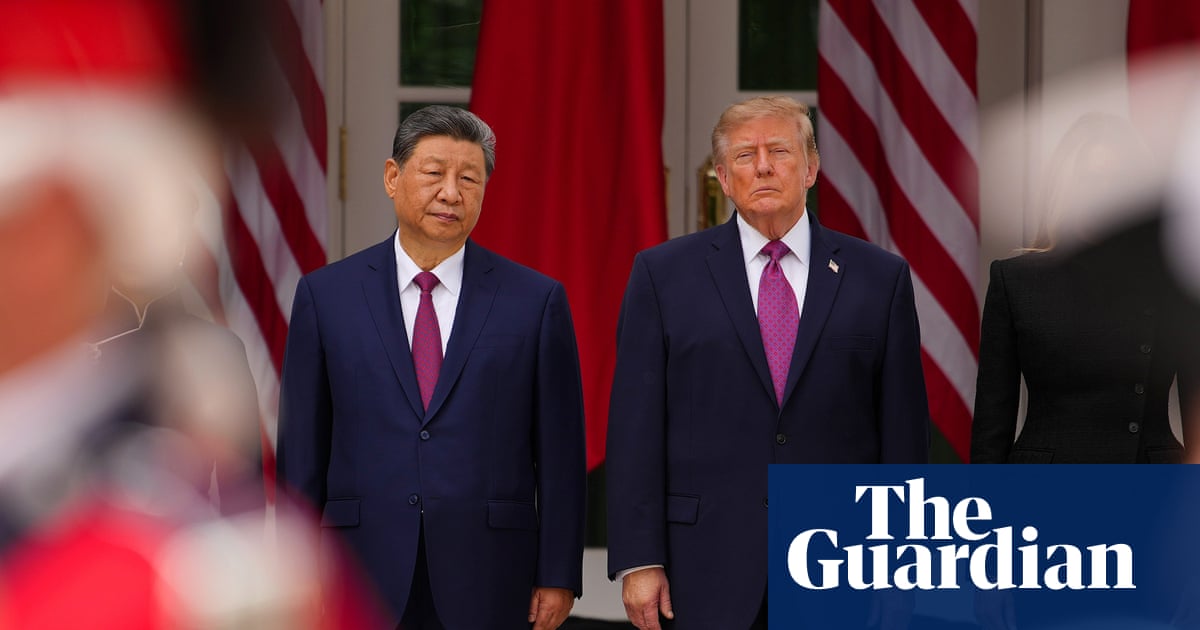

The US-China trade war seems to have subsided â but the sense of calm is misleading
A truce has cooled the trade conflict, but neither country has done anything to limit the outbreak of new hostilities
Donald TrumpâÂÂs trade wars have largely fallen off the headlines. Fears of new tariffs flare up from time to time when the US president goes off the rails â for instance, threatening to end US trade with countries with which it has a deficit unless the Federal Reserve cuts interest rates. But the sense that the worldâÂÂs two largest economies are plowing ahead into an overt economic conflagration has taken a back seat to other, more salient fears, about Trump ending American democracy, AI killing us all and stuff like that.
The sense of calm is misleading. Under the radar, the world is marching toward an economic war of potentially epic proportions, one that, history suggests, could well spill over into the real thing.
The truce reached by Washington and Beijing last year in their escalating trade conflict, which has been extended until next January, lowered the heat between the two â putting an end to the escalation of tit-for-tat tariffs and opening a door to some as yet undefined future trade deal.
But neither China nor the US has done anything to establish the mutual assurances that could limit the outbreak of new hostilities. Rather, they are both focused on gaining the upper hand in what seems like an inevitable next round, in a standoff that both sides have defined as a national security priority, essential to ensure economic, technological and military supremacy.

The new arms race is different from those in the past. Rather than building weapons to blow each other up, China and the US are focusing on ensuring the resilience of the international supply chains on which they rely and figuring out how to constrain â and if push comes to shove, throttle â the supply chains essential to the economic and technological progress of their rival.
The paired strategies go back at least to the Covid pandemic, when ChinaâÂÂs Xi Jinping called on the nation to âÂÂtighten international production chainsâ dependence on China, forming a powerful countermeasure and deterrent capability against foreigners who would artificially cut off supply [to China]âÂÂ.
Early in the Biden administration, national security adviser Jake Sullivan articulated the American goals: to limit ChinaâÂÂs access to a narrow set of advanced technologies with military applications without upending the global economic order. He described the strategy as building a âÂÂsmall yardâ of forbidden tech surrounded by a âÂÂhigh fenceâ of trade and investment controls.
By now, the conflict has breached the bounds of these initial rationales. Restrictions on American tech exports, investments and technology transfers to China have proliferated over the last half decade. And they are hitting not only ChinaâÂÂs military capabilities but slowing its technological progress writ large. And TrumpâÂÂs wanton deployment of tariffs is not helping.
China, on the other hand, is becoming increasingly assertive, leveraging its overwhelming dominance over the supply of critical minerals that are essential to high-tech industries for civilian and military uses. Last year, it stunned the Trump administration by throttling exports of rare earths and magnets made from them to retaliate against US tariffs and efforts to restrict ChinaâÂÂs access to high-end semiconductors and the lithography machines needed to make them.

It has relaxed some of these controls, but it maintains many other restrictions. While they have largely been imposed to retaliate against American actions, they have also been used to hit other countries for a variety of policies it dislikes. The stakes are high. The International Energy Agency has estimated that if China were to block the USâÂÂs and EuropeâÂÂs access to rare earth magnets, it could cost their economies about $1.5tn per year.
Where does the supply chain war go from here? The Trump administration is pouring hundreds of millions into projects to mine and process rare earths and other critical minerals, hoping to close ChinaâÂÂs lead. It is also doubling down on efforts to limit ChinaâÂÂs access to frontier semiconductors and to bar it from buying the machinery needed to make them.
China, on the other hand, has announced a range of high-tech export restrictions, covering things such as artificial intelligence chips and solar power technology. Moreover, it has threatened to punish countries that work to reduce their dependence on its mineral inputs.
One hopes there is a path to a peaceful entente. This would probably require some shared understanding of what constitutes a legitimate national security risk that may warrant actions to block supply chains. Defining the âÂÂyardâ is essential. Frustrations of standard commerce should not be dealt with on a wartime footing.

China will probably dominate renewable energy technologies, especially the solar power industry, into the foreseeable future. It may also dominate the electric vehicle industry. This might hurt in Brussels and Washington, but itâÂÂs not worth a war. China, on the other hand, will have to accept that its mercantilistic economic strategy is not tenable for the rest of the world. Its combination of massive export growth with zero import growth is not sustainable.
This might seem doable. And yet the odds that the world economy will remain at peace seem slim. One might recall the Axis powersâ efforts to seize territories as the League of Nations curtailed their access to raw materials in the early stages of the second world war. Or FDRâÂÂs blocking of sales of American scrap steel and oil to Japan, which likely contributed to TokyoâÂÂs decision to attack Pearl Harbor. Today, American fighter jets, submarines and missiles use rare earth magnets. What would happen if China blocked access to these materials?
The moment is strange. ItâÂÂs not that long ago that trade was proposed as perhaps the most powerful tool to deliver world peace, building positive-sum interdependence among nations. ThatâÂÂs over. Interdependence has become a vulnerability. As China and the United States fight over who will control the next generation of technology, trade has become a theater of war.