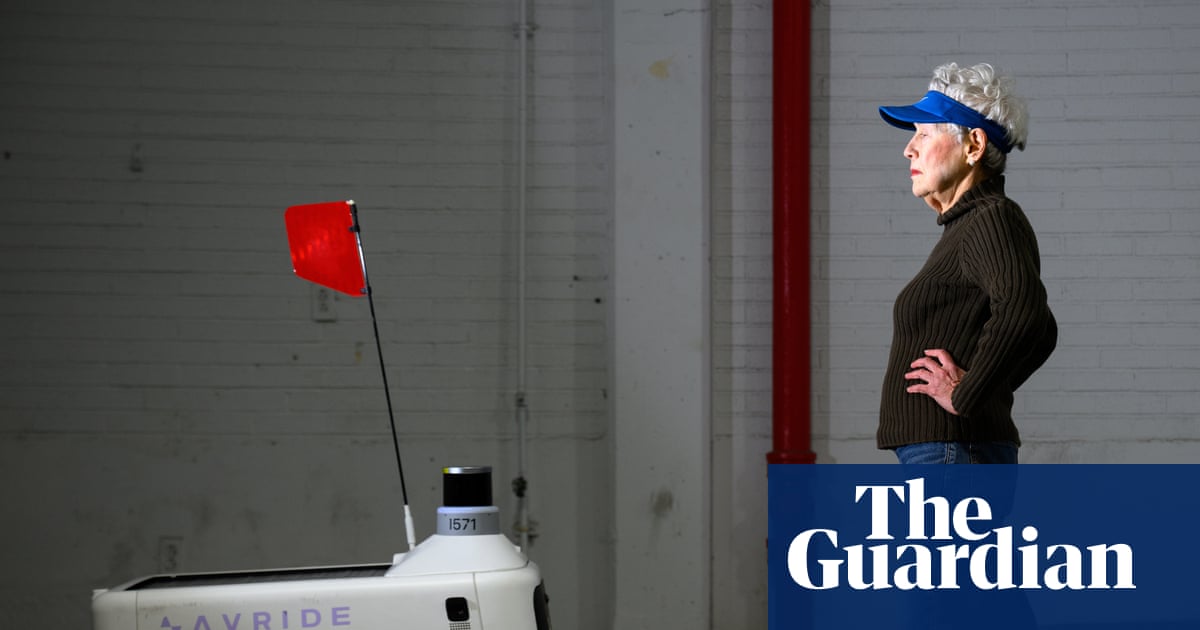

Standing in the way of slop bowls: the woman blocking food delivery robots
Semi-retired professor Carolyn Marvin became a local celebrity facing down PhiladelphiaâÂÂs growing robot delivery army: âÂÂItâÂÂs my first amendment right to protestâÂÂ
âÂÂOne of you needs to be on the lookout for cops, while I block the robot, OK?âÂÂ
It is a crisp fall morning in Philadelphia. Tucked away in a dingy alley, opposite a garage called Patriot Parking, 78-year-old Carolyn Marvin is laying out some ground rules for a robot-disrupting expedition. Once a suitable target is identified, we will follow it to a busy sidewalk and Marvin will stand in front of the robot, blocking its way. The photographer and I will take turns ensuring weâÂÂre not all carted off by the police.
If Marvin sounds like sheâÂÂs done this before, itâÂÂs because she has. Many, many times. The semi-retired University of Pennsylvania (UPenn) communications professor has become something of a local celebrity after taking it upon herself to block the UberEats food delivery robots which have become a ubiquitous presence in the cityâÂÂs downtown. She doesnâÂÂt do this every day â âÂÂI have a lifeâ â but whenever a robot crosses her path sheâÂÂll stare it down as a protest against their incursion into public spaces.
Her antics have gone viral: so much so that some Philadelphians dressed up as Marvin and the robot for Halloween. But while she may have supporters, her protesting isnâÂÂt universally admired: a few weeks ago it got her in trouble with the law.

âÂÂI was coming back from my flu shot and I saw a robot,â she recounts. âÂÂSince I had some time, I stayed in front of it as it was a very highly trafficked area.â A crowd amassed and a spirited debate occurred. Some people agreed with MarvinâÂÂs argument that, along with taking peopleâÂÂs jobs, the delivery robots pose a hazard to people with mobility issues. Others were concerned that she was stopping someone from getting the food theyâÂÂd ordered and paid for. Eventually the cops were called about âÂÂcriminal mischiefâ involving a delivery robot and three officers showed up.
âÂÂThey asked me to move and I said âÂÂno, itâÂÂs my first amendment to protest against corporations in the same public space the robots are occupying.â So I donâÂÂt see any reason to stop that.â The police officers, presumably a bit befuddled by the small but serious professor, who was dressed in her trademark blue visor, continued to try to get her to move along. Marvin just kept staring at the robot.
âÂÂSo then they came up from behind me, took the food I was holding out of my hands, handcuffed me and hustled me over to a police car,â says Marvin. âÂÂI tried to make it hard for them but there were three of them and one of me. But I kept arguing with them. I think they werenâÂÂt sure what they could arrest me for because itâÂÂs all brand new stuff. And they hesitated a long time because I think the first amendment argument probably made some sense to them.âÂÂ
The police ended up writing Marvin a ticket for disorderly conduct, with the rationale that she was blocking a business. She is still waiting for her court hearing date, but intends to contest the charges vigorously. âÂÂThe wheels of justice grind slow, but IâÂÂll go make my arguments,â she says. And one imagines these arguments will be convincing. Marvin has written a celebrated book, When Old Technologies Were New: Thinking About Electric Communication in the Late Nineteenth Century, about the social impact of electronic media. She is a formidable thinker who, in 1985, became the first woman to receive tenure at UPennâÂÂs Annenberg School and now has an endowed chair named after at the Ivy League university.
*
A pending court date has not slowed Marvin down. Which is why she agreed to allow me to shadow her today, while she goes about her robot-disrupting business. IâÂÂve picked our rendezvous spot because IâÂÂve noticed that a number of the delivery machines congregate here while waiting for orders. We can trail them the moment they set off on their mission.
ItâÂÂs unclear exactly how many food delivery robots there are in Philadelphia. Avride, the Texas-based company behind the machines, would only tell me that the number fluctuates according to demand. But there are only two in the alley when we arrive around brunch time. One of them is flashing Halloween graphics on the screen that operates as its âÂÂfaceâ and another has little zzz on it, indicating that itâÂÂs sleeping. IâÂÂve got to admit, they look cute. And, of course, thatâÂÂs by design. âÂÂHumanizing the robots is important, because they are a completely new entity,â a spokesperson for Avride told me when I called them for an interview a couple of days earlier. âÂÂWe want people to feel comfortable around the robots and not to feel scared about some weird box travelling down the sidewalk.âÂÂ
The humanization didnâÂÂt fool Marvin, but it seems to have worked on other people. Avride, which operates almost 1,000 food delivery machines on more than 25 different college campuses and a growing number of urban locations including Jersey City and Austin, says it used to get concerned emails from people whoâÂÂd see a robot in hibernation mode and assume it was lost or broken. Avride then added the zzz visuals to communicate the robot was waiting for an order, and now the emails have stopped. I ask the Avride spokespeople if they have they heard about Carolyn Marvin? There is a little pause. âÂÂWe are all well aware of this lady, yes.âÂÂ
As we wait for the robots to get moving, I start to wonder if the professorâÂÂs notoriety might have prompted Avride to install Marvin-mode software which disables the machines if they detect her presence. WeâÂÂve been hanging around for about 40 minutes and nothing is happening. Eventually, I hear a beeping noise and one of the robots whirs into an action. Someone had put an order in and robot 1617 was going from its holding pen to a nearby restaurant to pick up the food and deliver it.
While it may be equipped with all sorts of sophisticated cameras, sensors, and AI-powered software, the poor robot didnâÂÂt have the instincts to realize its mission was about to be thwarted. We chase it down the alley and, as soon as 1617 turns on to Walnut Street, a main thoroughfare, Marvin blocks its pathway and stares it down.
For the first few minutes people politely ignore the professor-robot standoff, although I do notice one woman rolling her eyes as she passes. But then the compliments and questions start rolling in. One elderly woman thanks Marvin profusely. A middle-aged man dressed in a nice suit cheers her on and says âÂÂsomeoneâÂÂs got to do it!â Another man says he appreciates the efforts and âÂÂthe gig economy sucks for everyone.âÂÂ

âÂÂOMG,â a young passerby called Cadence says as she recognizes Marvin and her trademark blue visor. âÂÂItâÂÂs the queen! I feel like I met a celebrity!â Cadence, a 22-year-old recent graduate, is on board with the professorâÂÂs protest. âÂÂAI and robotics are supposed to make life easier for us and help us do the things we enjoy, not take the jobs of other people,â she effuses. âÂÂI will support any small business that doesnâÂÂt use AI. I appreciate what is made by humans.âÂÂ
Passing kids, meanwhile, seem less concerned about the gig economy, and more interested in the robotsâ cute faces. Every toddler who goes by points at them with delight. A couple of kids who pass have a heated discussion about whether the robot looks like a dog or a cat. (It looks like neither.) The only child we come across who isnâÂÂt enthralled looks around seven years old and yells âÂÂclanker!â at it. âÂÂIâÂÂve watched enough movies to know that these things are going to hunt us down!â he says.
The people cheering Marvin on arenâÂÂt outliers: these protests have struck a chord with people because of a growing distrust around AI and automation. According to a recent study by Pew Research, a majority of Americans are deeply skeptical of AI; more adults are expecting it to have a negative impact than a positive one. And while IâÂÂm not sure if other people are blocking food delivery robots, weâÂÂre certainly seeing a rise in protests against datacenters and other symbols of automation. A few weeks ago in Philadelphia I passed a woman standing in front of a Waymo self-driving taxi (which is being tested in the city with human safety drivers) blocking its path and yelling âÂÂLAME-OâÂÂ.
Despite this antipathy, robots are gradually being normalized. Pennsylvania legalized delivery robots via Act 106 of 2020, defining them as âÂÂpedestriansâ and theyâÂÂre slowly becoming part of the landscape. When AvrideâÂÂs robots first appeared in Philadelphia back in March people would gawk at them and take selfies. Now most people just ignore them. And this same phenomenon is happening all across the world. While it isnâÂÂt clear exactly how many food delivery robots are in operation there are a number of companies besides Avride which operate these machines in the US, including Serve Robotics, which is one of the biggest players, with a fleet of 2,000 deployed robots.
While the automation industry has big plans to grow their fleets of robots, Marvin stages these protests because she wants to remind people that they have a say in all of this. They have a right to weigh in on whether private robots should be allowed on public streets.
âÂÂIâÂÂm very supportive of the kinds of things that AI is doing in terms of medical breakthroughs,â Marvin says. âÂÂAnd I think robots are fine on factory floors, but they donâÂÂt belong in public space. I take the position that this isnâÂÂt inevitable. But you have to have the will to do something. In Toronto they banned delivery robots from sidewalks in 2021. And I think, you know, the question is: who is public infrastructure designed to serve?âÂÂ
The robot in front of Marvin isnâÂÂt (yet) smart enough to answer to this question. But it does seem to have clocked that itâÂÂs not going to be able to get to the restaurant to pick up its food today. After repeatedly trying to get around the professor it seems to have gone into hibernation mode. Eventually Marvin, who has to go to campus and prepare for a class, steps aside. The robot powers back up and trundles home to its garage. I know itâÂÂs only a computer with wheels, but I could swear it looked dejected. Marvin, on the other hand, looks triumphant.