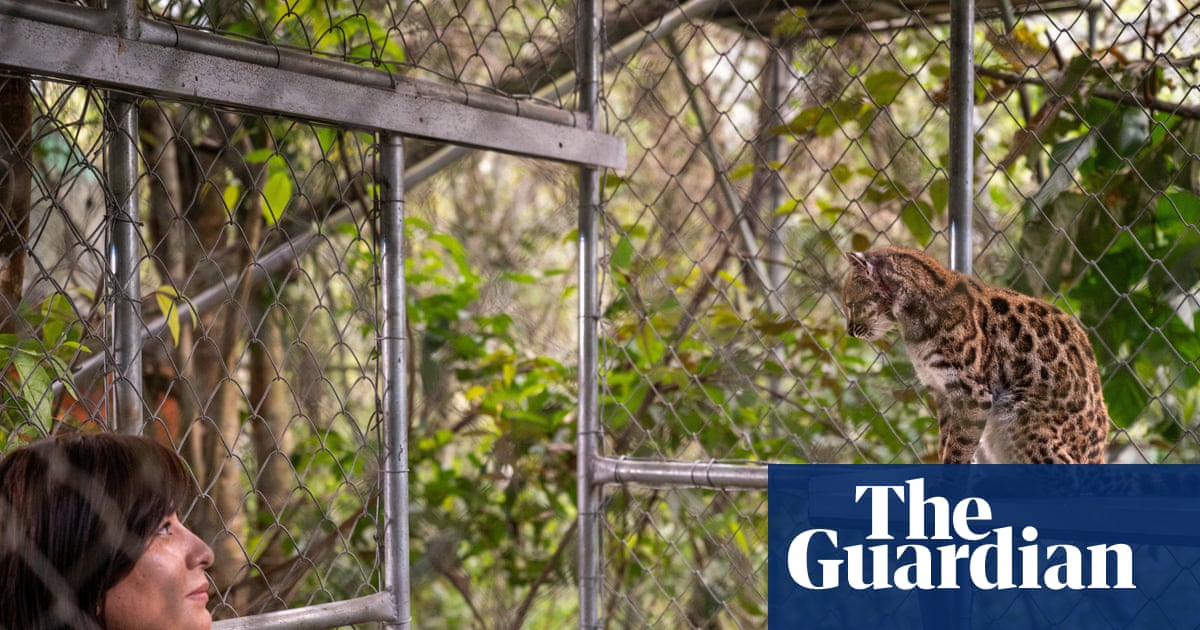

New cat species identified in Bolivia for first time in more than a century
New species of wild cat was discovered in BoliviaâÂÂs Yungas forest and is smaller than the average domestic â cat
A diminutive wild cat that inhabits BoliviaâÂÂs â cloud forest has been identified as a previously unknown species, marking the first time a new living cat species has been formally named and described in more than a century.
The cat, called Tilcayo by local communities, is part of a group called tiger â cats found across much of South â America. It was found in BoliviaâÂÂs âÂÂlush Yungas forest, a mountainous region where forests are often covered by clouds and surrounded by high humidity, according to researchers. It measures about 18in (46cm) long and weighs about 3lbs (1.4kg), making it smaller than the average domestic â cat.
Researchers used genetic data to confirm that the cat is a new species, and gave it the scientific name Leopardus tilcayo, retaining its local name.
âÂÂIts fur is light brown ... with irregularly shaped rosettes across its body,â said Paola Nogales-Ascarrunz, a National Geographic explorer and one of the authors â of the study describing the newly identified species published on Thursday in the journal Current Biology.
Little is yet known about the catâÂÂs biology and lifestyle. Remains of small rodents in scat âÂÂsamples suggest they may form part of its diet, while camera-trap evidence indicates it âÂÂcould be more active at night, Nogales-Ascarrunz said.
Tiger âÂÂcats are so-called cryptic species, meaning they cannot easily be distinguished merely by appearance, said evolutionary biologist and study co-lead author Jonas Lescroart of the University of Antwerp in Belgium.
Tiger âÂÂcats previously had been considered a single species, but genetic studies decades ago suggested the existence of multiple species.
Referring to the new species, Lescroart said: âÂÂOur information at this moment is limited to the two live individuals that we examined, and a small number of camera-trap records.âÂÂ
One of the live cats is a 10-year-old male that now lives in the Senda Verde Wildlife Sanctuary after being kept by a local family in their home.
Observing the Bolivian cat drew interest because âÂÂits characteristics did not match the descriptions, most of them based on Brazilian cats,â Nogales-Ascarrunz said. âÂÂThis made us wonder: what tiger cat do we actually have in Bolivia?âÂÂ
The team analysed DNA from 38 cats sampled across several South âÂÂAmerican countries, including eight museum specimens. The study found that tiger cats are in fact five genetically distinct species.
âÂÂWe never expected this Bolivian tiger cat to be a separate species, and no one had ever proposed it as a different animal, subspecies or otherwise,â Lescroart said.
Genetic analysis suggested âÂÂthat the Tilcayo lineage separated from other tiger cats about 1.4m years ago.
âÂÂThe more differences in their DNA, the longer the time that we estimate those lineages to have been physically separated,â Lescroart said, adding that such a gap is generally considered a species-level divide in cats.
The research team also described a new tiger cat subspecies in PeruâÂÂs Yungas, naming it Leopardus tigrinus antisuyo after Antisuyu, the region of the old Inca empire that included the area it inhabits.
The International Union for Conservation of Nature (IUCN) red list tracking the status of species currently treats â tiger cats as two âÂÂvulnerableâ species with declining populations.
The researchers have shared their findings with the IUCN, whose upcoming review will assess âÂÂthe five lineages separately. That could give a more accurate picture âÂÂof risk, Lescroart said, and species such as the Tilcayo âÂÂcould be considered endangered when assessed on their own.
The need for a clearer assessment is particularly acute in the Yungas, one of the âÂÂregionâÂÂs most threatened ecosystems.
The mountain forests âÂÂface growing pressure from deforestation, agricultural âÂÂexpansion, human-caused fires and mining, Nogales-Ascarrunz said. âÂÂRestoring forest patches damaged by fires, protecting remaining native forest and maintaining connections between habitats are urgent priorities, Nogales-Ascarrunz added.
âÂÂShowing the general public that even in a flagship group such as cats ... there are still new species to be discovered may transmit an important message,â said Eduardo Eizirik, an evolutionary biologist at the Pontifical Catholic University of Rio Grande do Sul in Brazil and senior author of the study. âÂÂThere are many undiscovered species out there in the world, and they are at risk of disappearing before we even discover them.âÂÂ