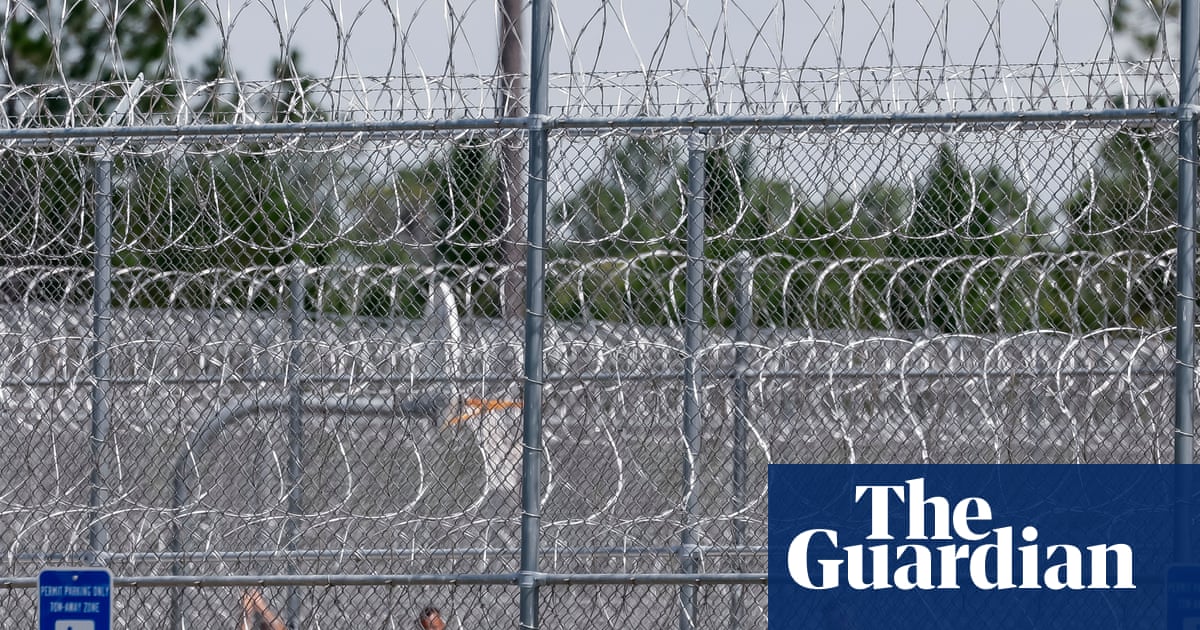

Man detained at Georgia immigration detention center dies as hunger strike continues
Death inside Folkston facility comes as officials allegedly threaten hunger strikers there with force-feeding
An immigrant detained at a sprawling detention center complex in Georgia died on Friday, local and federal officials confirmed, after the facility has already faced national scrutiny for its response to an ongoing hunger strike inside.
The death inside the D Ray James facility in Folkston, Georgia, comes as federal immigration officials and private contractors are allegedly threatening hunger strikers there with force-feeding, a detained hunger striker, his wife, attorneys and advocates all said this week. Detainees are refusing food to protest prolonged captivity and bad conditions.
Immigration and Customs Enforcement (ICE) on Saturday confirmed the death inside the facility, which is adjacent to the Folkston ICE processing center. Together, both facilities make up a large detention complex. GEO Group, the private prison company that runs the facilities under contract for the federal government, referred all questions to ICE.
The Georgia bureau of investigation (GBI), a state law enforcement agency, confirmed in an email that the local sheriffâÂÂs office requested the GBI conduct an âÂÂin-custody death investigationâ at the D Ray facility, the Guardian can reveal. ICE and the Department of Homeland Security (DHS), its umbrella agency, did not respond to requests for comment about the death or the hunger strike.
âÂÂThis was a preventable tragedy,â said Azadeh Shahshahani, the legal and advocacy director for Project South, a social justice organization based in Georgia. âÂÂWe hold ICE and the private prison corporation fully responsible for any harm that migrants suffer at Folkston. We call for an immediate independent investigation into this tragic death and for accountability. Folkston must be shut down immediately.âÂÂ
The man, Luis Sandoval, was 48 and from El Salvador, ICE said in its statement, adding that at about 1.46am on Friday, facility staff found Sandoval with a ligature around his neck. He was pronounced dead less than an hour later.
Sandoval was arrested by ICE officials earlier this month, and transferred to the Folkston facility on 8 October. In its press release, the agency said Sandoval had prior convictions for aggravated assault and other crimes, and that his death was under investigation.
It was unknown on Saturday whether Sandoval had participated in the hunger strike. The GBI said it could not share more details because of its active investigation.
Sandoval is the 60th person to die in ICE custody since the start of the second Trump administration, as ICE continues with its aggressive anti-immigrant crackdown.
Austin Kocher, president of Relevant Research, which studies the immigration enforcement system, and who is a research fellow at American University, said that this year, there have been an average of one death every 10 days in the custody of ICE. That figure includes people dying in detention centers or in nearby hospitals while still in the custody of ICE.
âÂÂEven in the past, there has not been such an overt dehumanization and overt view that migrantsâ lives are expendable,â Kocher added. âÂÂI worry that that tone [from the Trump administration] has a tendency towards neglect and viewing migrants as disposable.âÂÂ
Tens of thousands of people have been arrested and detained by ICE, leading to prolonged detention, as immigrants and asylum seekers fight their cases, and the agency has been stepping up its offensive in recent months despite a less showy presence on the streets.
One man currently in the Georgia detention center is Andrei Gerdiukov, a Russian asylum seeker who is participating in the hunger strike.
Nearly three weeks ago, Gerdiukov and dozens of others launched a hunger strike to demand their legal cases be processed more quickly through the US immigration system and to protest the conditions of their confinement. The hunger strikers were placed in solitary confinement, according to Gerdiukov and attorneys.
âÂÂI feel tired, I feel dizzy. Every move, it is hard,â Gerdiukov said in an interview by phone on Saturday from detention. âÂÂThey threatened us that they were going to force-feed us.â He had heard about the death but did not know Sandoval.
Gerdiukov and his wife, Polina Chertushkina, came to the US from Russia to seek asylum after they faced persecution for their opposition to the war in Ukraine, Chertushkina said. Their cases are ongoing, but as the couple were driving through Florida this February, they were pulled over and detained by immigration officials. Chertushkina was released, but Gerdiukov was taken to Folkston eight months ago.
âÂÂI am so worried about him, I donâÂÂt know what to do,â Chertushkina said about the force-feeding threats, speaking on Saturday by phone. Chertushkina is asking lawmakers to assist her husband.
At least 12 hunger strikers are still participating, despite the threats of force-feeding, Gerdiukov said, adding that several had been fainting.
On Friday, the hunger strikers were moved to a nearby unit, where medical officials âÂÂwearing combat bootsâ took their vital signs, raising fears of imminent force-feeding, Gerdiukov said.
It was not clear on Saturday whether or when the authorities intended to use force-feeding.
The process to force-feed hunger strikers is secretive, with court records often sealed.
A judge has to approve the procedure, and then detention guards restrain a hunger striker while medical staff push tubing up the nose and down the throat to pump nutritional liquid into the stomach. Medical ethicists and human rights organizations have called the practice torture.
ICE generally says in court filings that force-feeding is necessary to maintain âÂÂgood orderâ in detention centers as well as to keep detainees alive.
Kocher decried the contradictions.
âÂÂOn the one hand, theyâÂÂre trying to force-feed people [to keep them alive],â Kocher said. âÂÂAnd yet at the same time, in that same [Folkston] facility, you have someone who died and possibly was able to kill themselves.âÂÂ
The Guardian has been tracking force-feeding cases nationwide. From January 2025 through August 2026, ICE sought court permission to force-feed at least 19 detained hunger strikers. One Afghan man was force-fed for nearly six months. A Kurdish man was force-fed for nearly eight months.