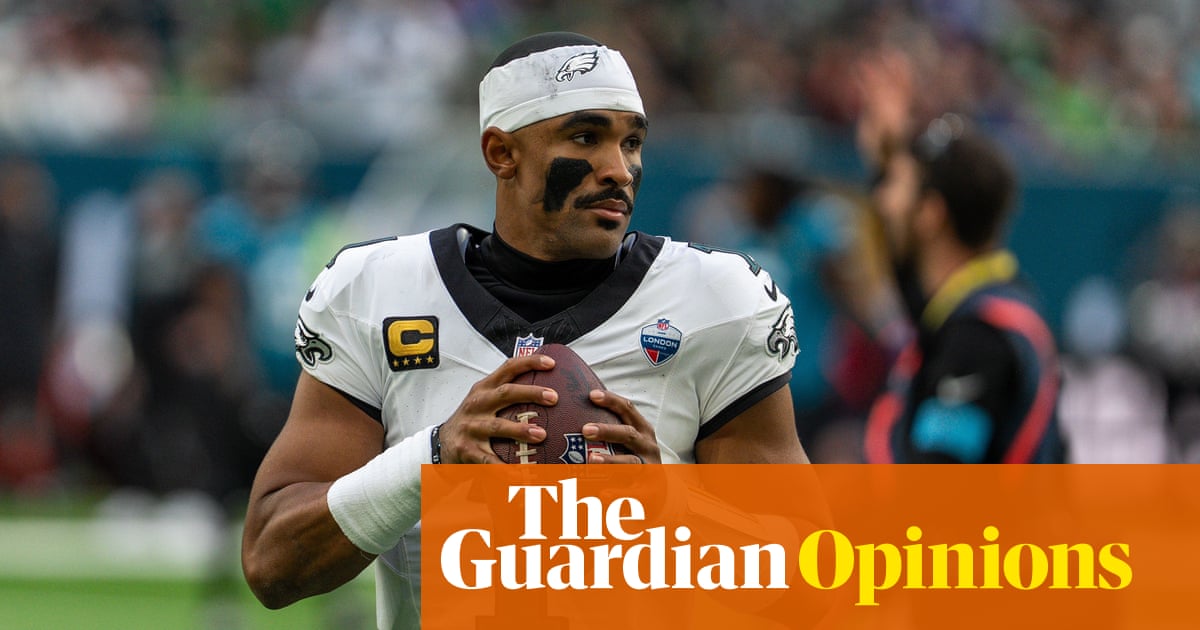

Jalen Hurts played through a blood clot. Are NFL players cattle?
The Eagles quarterbackâÂÂs recent health issues highlight how footballâÂÂs toughness culture puts its players at risk
Jalen Hurts is likely to miss the rest of the season after an ultrasound revealed blood clots in his lungs. Thankfully, heâÂÂs now restricted from playing for the immediate future, meaning he wonâÂÂt be risking serious complications â or even his life â as he did when he played in their Week 5 loss to the Jacksonville Jaguars in London.
Hurts complained to the Eagles medical staff of calf pain on 8 October, according to ESPN. The Eagles say that Hurts flew to London with the rest of the team and, out of an âÂÂabundance of caution,â was given an ultrasound. The test found a superficial clot in his calf. Doing the ultrasound before the flight wouldâÂÂve been the most prudent thing. The same for making him inactive after the clot was found. But instead, he played in the game on 11 October, as the medical staff and doctors in London agreed âÂÂthat activity and mobility were important.â Hurts also practiced all last week before a follow-up ultrasound also found clots in his lungs.
Some have celebrated HurtsâÂÂs performance against the Jaguars as a feat of virility; to many it looks more like putting a player in real danger. His blood clots could have caused serious health issues during the flights or game (one sports medicine doctor told NJ.com that Hurts was âÂÂa walking riskâÂÂ). If his condition was dire enough that doctors reportedly told him in the early hours of Sunday morning not to sleep before the Jaguars game, he shouldnâÂÂt have been playing. HurtsâÂÂs agent, Nicole Lynn, clarified that he did get some sleep before facing the Jaguars, but the question remains: Was the NFLâÂÂs London showcase so important that it was worth risking HurtsâÂÂs life?
Asked about his decision to play Hurts, Eagles coach Nick Sirianni told reporters that he relies on advice from medical staff. âÂÂIâÂÂm a football coach. I lean on our medical experts in every situation,â he said. âÂÂI have full trust and full faith in them. ItâÂÂs not just me that has major care for our players. ItâÂÂs them as well.âÂÂ
The Super Bowl LIX MVP is on blood thinners and hopefully on the road to healing, and is expected to make a full recovery. But his ordeal is the latest example of how football players are put in danger season after season. One piece of research from 2017 found that a college player took hits to his head during a single game that were equivalent to multiple car crashes. A study published this year found that 215 of 235 brains of former NFL players donated for research showed signs of CTE, a degenerative brain disease that can only be diagnosed after death. The NFL has said that it âÂÂcontinuously strives to make the game of football safer, including by implementing â strategies to reduce concussions and head impactsâ but players keep on suffering concussions, and others like Hurts find themselves in a football culture where playing through injury is commonplace.
Last Wednesday, Hurts told reporters that his last week had been a âÂÂvery unique experienceâ but declined to reveal the blood clot. No one has reported that he received any undue pressure from the Eagles or the league to play against the Jaguars. But it wouldnâÂÂt be shocking; this isnâÂÂt even the Eaglesâ first controversial injury in London. In 2018, former Eagles tackle Lane Johnson was reportedly âÂÂberatedâ by general manager Howie Roseman for saying he was unsure about playing because of a high ankle sprain. After suiting up, Roseman reportedly told him, âÂÂGood, you have your mouthpiece in, now you canâÂÂt say anything stupid.â Neither man has commented on the matter, but it appears to offer a glimpse of life in the good olâ NFL, where admitting youâÂÂre impaired is stupidity. Johnson aggravated the ankle injury and suffered a knee injury during the game.
Football culture demands that players âÂÂtough it outâ and get on the field. As former NFL receiver Bernard Berrian has said, the tension âÂÂisnâÂÂt verbalâ but is still âÂÂthereâ because, âÂÂas we say, you canâÂÂt make the team in the training room.â Former running back Clinton Portis echoed Berrian when he spoke about playing through 10 concussions in his career and rarely getting treatment: âÂÂYou canâÂÂt make the club in the tub.â Portis said he was âÂÂreally scaredâ of undergoing testing to assess his neurological health.
You can see how the culture of the NFL makes players behave this way. With only 61% of NFL contracts containing guarantees, and an average 56% year-to-year retention, the pressure to stay active and keep the checks coming in is rampant. Pretty much every job pressures its employees to perform in some capacity; only one entails 300-pound men running full speed to tackle you for 17 games a year. Players shouldnâÂÂt be made to feel like they need to be on the field, but the irrational âÂÂwin nowâ pressure that they face trickles down and paints them in two colors: an asset or expendable. ItâÂÂs inherently inhumane.
The NFL has attempted to address injuries, and the threat of concussion and CTE in particular, but those efforts donâÂÂt seem to be enough. The league has changed kickoff rules and introduced oversized Guardian Caps to mitigate concussions, but footballâÂÂs physical risks persist. A 2018 study in the Brain Neurology Journal revealed that subconcussive hits also contribute to CTE. And a 2025 Wisconsin School of Medicine study concluded that Guardian Caps did not reduce concussion rates in a sample of high school players. ItâÂÂs unclear what seismic changes could actually address footballâÂÂs inherent brutality. And the NFLâÂÂs struggles to stop it shows theyâÂÂre unsure â or donâÂÂt care enough â too.
HurtsâÂÂs case also raises the specter of medical racism. Multiple studies have shown that Black people and other minorities in the US are less likely to receive adequate medical care than white people. ItâÂÂs impossible to say whether the staff who treated Hurts looked at a strapping Black athlete and believed he could play a brutal game while suffering from blood clots. But the incident nonetheless conjures historical patterns and lived experiences of Black people not receiving proper care.
Hopefully Hurts gets back on the field and has a long, healthy career. Regardless, the Eaglesâ handling of his treatment should be a demarcation point for the league. From the top down, the league needs to stop treating their labor force like cattle on a farm, as if their sole worth is in putting their bodies at risk.