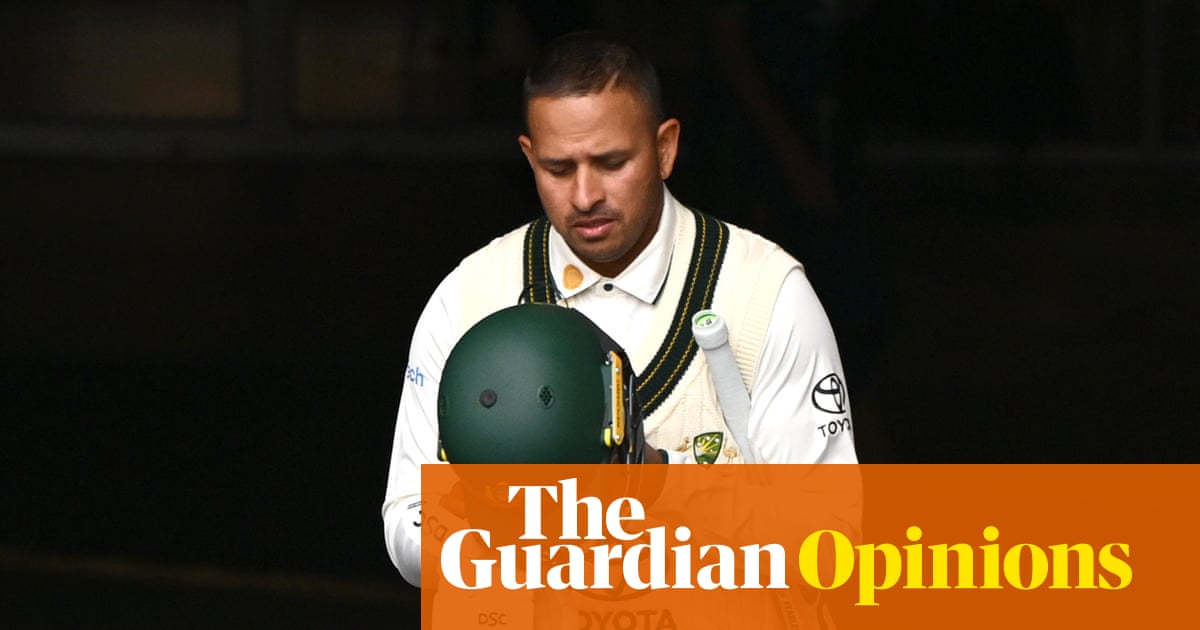

It has been a tough week for Australian cricket, but itâÂÂs time to get a grip â and show a bit of sabr
To demand further inquisitions now about Sandpapergate following Usman KhawajaâÂÂs retelling is simply self-indulgent â and some observers will never be satisfied anyway
The greatest shame of the controversy inflamed by Usman KhawajaâÂÂs memoir Sabr is that 99% of those opining about it will never read it. They will experience it by quotes and summaries, magnified and distorted, elided and exaggerated, shaped by voyeurism and schadenfreude.
In fact, Sabr is a readable, surprisingly revealing, sometimes painfully frank book about a unique career. Usman is like every boy who dreamed of a baggy green â and also not. He describes making a wish aged 10: âÂÂPlease, please, please, please, God, let me play for Australia.â But he prefaces this with the incantation âÂÂAllahu AkbarâÂÂ, because his family at this stage is living temporarily in Saudi Arabia: he is at the Kaaba in Mecca and too young to grasp how unusual his yearning makes him in an Australian cricketing monoculture. Nor can he know exactly what playing international cricket will entail â for all its satisfaction, prestige and rewards, what a brutal, baneful, exposing and lonely environment it can also be.
Khawaja was among the most talented batters in an Australian generation when it was not in oversupply, yet he played in only 22% of the national teamâÂÂs total fixtures over that period. In particular, he appeared in barely half the Tests in the 15 years from his debut to his retirement. If he developed a carapace to deal with such endless disappointment, should that surprise anyone? Sabr might mean patience or resilience in Urdu, but a strength of KhawajaâÂÂs testament is that he allows the impatience to show through. It is a cranky book because, perhaps, a degree of crankiness is what it takes to come back and back and back, when one is never sure oneâÂÂs abilities are appreciated and oneâÂÂs face fits.
Importantly, rather than provide the usual self-promoting, self-protecting pap primped for sale on behalf of retired athletes, Khawaja decided not to employ a formal ghost writer. Sabr lacks the emollience such an intermediary might have introduced. There are flashes of ego and entitlement. He can be obtuse and dogmatic. But overall the story is better for its rawness. âÂÂI still have demons from all the times IâÂÂve been dropped from Australian teams,â he confesses towards the end. âÂÂI felt like IâÂÂd experienced way more downs than ups. And even though IâÂÂd practised for so long trying to achieve gratitude and mindfulness, life and cricket have a funny way of dragging you back down.âÂÂ
What cricket has dragged Sabr back down to is the bookâÂÂs âÂÂSandpapergate chapterâÂÂ, which has all heaven in a rage. This is understandable, but also ridiculous. Understandable because the events were a watershed in Australian cricket; ridiculous because a concentration on that chapter alone ignores the candid and comprehensive way Sabr explores the cricket culture that arguably rendered some kind of reckoning inevitable.

Yes, itâÂÂs satisfying to have guilty parties to name and shame in adverse circumstances â indeed, it seemed to gratify most everyone when Steve Smith, David Warner and Cameron Bancroft were frogmarched out the dressing room door. But it is also, always, an easy out. People donâÂÂt go to sleep straight and wake up crooked. The path to malpractice is long, full of exogenous pressures, perverse incentives, self-justifications and self-exonerations. Little things have huge consequences. The guilty are not easily sorted from the innocent. Life does not revert to normal afterwards.
Think of it this way: the success of the Australian menâÂÂs cricket team is about more than simply making us feel good. It props up, as perhaps in no other sport, a sprawling commercial organisation, and a network of state cost centres servicing lower levels of the game. Winning thereby assumes an outsize, arguably unhealthy, importance â it is interpreted as a vindication of the system and reinforcement of its philosophies. Failure calls those things into question. It cannot be tolerated.
Ten years ago, after a succession of key retirements, Australia lost five consecutive Test matches. Out of that emerged a conviction that Steve SmithâÂÂs relatively callow team needed to be tougher, more relentless, and frankly meaner. The way Khawaja describes it, much of that mantle fell on Warner, despite his own ambivalence in the role. When Australia experienced some success playing in this way, there was a mandate to go further and harder. What was done to the ball in South Africa was where the team had been steadily taking their game â to the limit of propriety and legality.
Fundamental to KhawajaâÂÂs retelling of this story is that he doesnâÂÂt exculpate himself. He could feel the team lose touch with external reality and ethical boundaries. He identifies himself as part of the conversations around sandpaperâÂÂs use in ball tampering, which began as a joke before â as the teamâÂÂs predicament worsened â becoming a final desperate measure. Yet, perhaps out of insecurity stemming from his sense of being an outsider, perhaps out of that clannishness characteristic of elite teams, he didnâÂÂt speak up. When he says of Sandpapergate âÂÂwe were all in on itâÂÂ, many have heard it as an allegation against others; it can also be heard as including himself.
After Cape Town, Khawaja did think of speaking up. He did not. It is easy to say he should have. But at the time, with events careering out of control, he was probably right to imagine it would have made things worse. He considered it again five years ago; again the time, amid Covid, did not seem ripe. Still, it has gone on nagging him. There is nothing like carrying a sense of prior wrongs to oneself to stir a sensitivity to wrongs one perceives inflicted on others.
Khawaja now finds himself wedged, between senses of responsibility and regret arising from 2018, and the self-inflating ragebait morality of 2026. A reasonable inference of Sabr is that the current Australian captain Pat Cummins was not unaware of coachesâ exhortations to be the most obnoxious team on the block and the corners being cut in preparing the ball to swing reverse. Yet the content of Sabr also makes clear how much Khawaja esteems Cummins, crediting him, Justin Langer and Andrew McDonald for nurturing a more inclusive and less brittle team culture, conscious of responsibilities wider than winning. One glimpsed his conflict in that Tuesday interview on 7.30; one also sensed the vulnerability because, unlike a politician, Khawaja lacked their facility with obfuscation and dissembling. Current affairs television could make Jesus Christ look like the dodgiest geezer going. âÂÂMr Christ, many have noted your resemblance to Russell Brand ⦠âÂÂ
In the book, Khawaja calls Cummins âÂÂa natural leader, an intellect with high emotional intelligence, and someone with a very kind heartâÂÂ. He describes McDonald as âÂÂmy favourite coach of all timeâ and George Bailey as âÂÂthe best selector I ever dealt withâÂÂ. You could accuse Khawaja of naivete in the circumstances; you cannot accuse him of mala fides.
It has been a tough week for Australian cricket. Everyone wants to know what should be done, everything from âÂÂmove onâ blithely to a full-on star chamber with truth serum and polygraphs. This is an age of conspiracy, with a taste for the histrionic and the punitive. What do I think? After a week that has shed far more heat than light, I think cricket should grow the fuck up.
In 2018, in an extremely hostile environment, some insecure and suggestible young men made a bad decision, abetted by older men who should have known better, in pursuit of a sporting advantage that might help achieve the exorbitant expectations of them. Most other countries at the time were working along similar lines. We had normalised ball tampering with the euphemism âÂÂball maintenanceâÂÂ. The general supervision was desultory. The official sanctions were minimal. The covert use of sandpaper, dramatised by a surveilling camera, lent it all an air of the furtive, even if the effect of a bottle cap or wire brush would have been the same.
People were scared. People panicked. Smith and Bancroft gave an ill-advised press conference. WarnerâÂÂs chequered reputation, not undeserved but in which the team hierarchy had also invested, was held against him. Some extremely heavy penalties were conceived in haste to assuage public anger, which was acute, while the cricket team began the quiet work of years to mend their ways, for which they arguably deserve more credit. ItâÂÂs arguable that authorities might have returned for a supplementary look, but the day-to-day demands of running a sport that never stops precluded it, while extensive personnel changes at Jolimont meant that it ceased to be anyoneâÂÂs problem in particular. It did stand, and still does, as a cautionary tale, to which, even if no version can be considered definitive, KhawajaâÂÂs perspective is a useful and instructive addition.
To demand further inquisitions now is simply self-indulgent. It is also to misremember the context of the original offence, which was a more general objection to a style of play, but which the passage of time has left standing, absurdly, as a kind of crime of the century. Precise gradations of knowledge would after all this time be unascertainable, genuine candour has been rendered all but impossible, and weâÂÂre at the stage where some observers will never be satisfied anyway. Might be time for us all to get a grip, develop a sense of proportion, and show a bit of sabr.
-
Gideon Haigh writes at Cricket Et Al, where this article was originally published