
Football comes together across Spain to honour Jesús de Miguel: âÂÂWeâÂÂve seen how fragile life isâÂÂ
Across La Liga and beyond this weekend, footballers took to the field knowing it could have been them
In the final few minutes before stepping into the arena once more, heading out for his 199th Osasuna match on Saturday evening, the man who has scored more first division goals than anyone in their history stopped his teammates for a moment and told them what it meant to wear the shirt. âÂÂThis is very important,â Ante Budimir began as the dressing room, their sanctuary, fell silent around him. âÂÂWe donâÂÂt have this shirt today for the sake of it. He was not chosen, and nor are we. It could have happened to anyone, anyone. Let us go knowing that weâÂÂre grateful to be on the pitch: playing, watching, warming up, sitting on the bench, whatever it may be. Boys, we were not chosen: not us, not him. Let us go, gratefully. Without thought. We have a grand day before us.âÂÂ
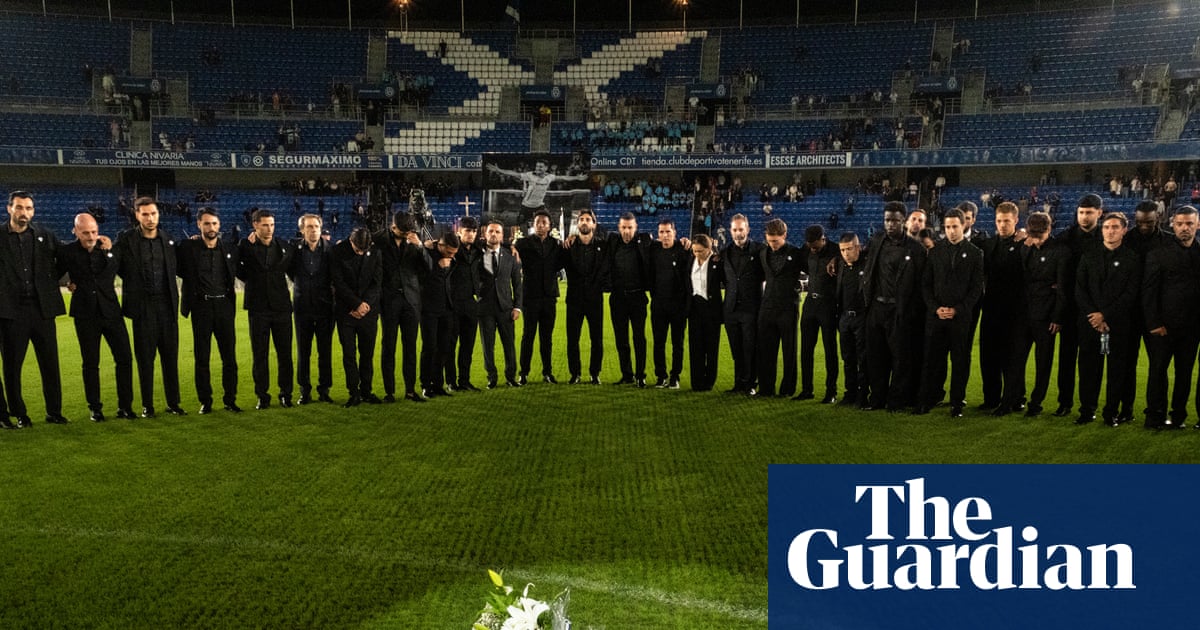
With that, OsasunaâÂÂs players turned left out of the room, where they were joined in the tunnel by footballers from Athletic Club, rivals from the north, and together they went out past the little shrine of Saint Fermin on to the field. They carried white lilies and all wore the same white shirts with a No 9 on the back, a black ribbon and the name of Jesús de Miguel, the Tenerife striker who died after a collision on the pitch five days earlier at the age of 30. At almost exactly the same time, 2,000km away to the west, TenerifeâÂÂs squad were walking out at the Heliodoro RodrÃÂguez López in Santa Cruz. They did not have anyone alongside them, wore black suits not white shirts and did not have a game to play either, not this week.

Two days earlier Tenerife had been in Navahermosa, La Mancha, the tiny village their teammateâÂÂs family are from, carrying the coffin of the friend their captain called âÂÂour DemigolâÂÂ. They were supposed to be in Granada on Saturday; instead, they were back on the island, in their home ground, to say goodbye and pay homage. Publicly, this time. Lilies had been laid on the pitch there too, a Tenerife shirt with them, and a stage built at one end. âÂÂWeâÂÂve seen how fragile life is,â the captain, Enric Gallego, said, offering words he said could never be enough, carrying the burden for all of them. âÂÂWe think of the journeys, the wins, the losses, and hold on to those moments that seemed normal, but that now ⦠a few days ago we shared that with you. To talk of you in the past tense is unfair. None of us are prepared to live what weâÂÂre living through.âÂÂ

No one ever could be. Across Spain this weekend, footballers took to the field knowing it could have been them. That, Budimir had told his teammates, was something they must think about but not think about too. The playersâ union in which De Miguel had a role, a footballer there for others, had asked for the competition to stop. Respect demanded that it did, they said, requesting a judge intervene when the league did not hear them. But it had gone on. The only matches postponed were those involving Tenerife; Andorra, whose goalkeeper Jesús Owono had crashed into De Miguel; and Castellón, who he had taken to the second division, delivering them to segunda for the first time in 16 years and himself for the first time at all, aged 27.
On the eve of the game that opened this weekendâÂÂs fixtures, the Sevilla head coach, Luis GarcÃÂa, said he thought they should wait. It was too soon, too raw, too theirs. His midfielder Giorgi Kochorashvili had missed training the day before: a former Castellón player, Kochorashvili had asked permission to go to the funeral, leaving early and returning late, his mind elsewhere. Of course he could, GarcÃÂa had replied, âÂÂwe are humans above all elseâÂÂ. And it was not just him. GarcÃÂa had worked with Owono â âÂÂletâÂÂs not make two victims, we have had enough; he is in hell, for sureâÂÂ, he had pleaded â and now he said: âÂÂIf thereâÂÂs a play thatâÂÂs similar ⦠what do I say to my goalkeeper?
âÂÂWe need time,â GarcÃÂa had said. âÂÂWe need to reflect.âÂÂ
Instead, they played. From Seville on Friday night to Madrid on Sunday, via stadiums everywhere. It was, some suggested, the best way to pay homage to De Miguel but no one truly knew. âÂÂWe canâÂÂt ask him what he would have wanted,â José Mourinho said before Madrid went to Valencia and won 3-0, TenerifeâÂÂs flag flying at half-mast at Mestalla. He might not have wanted anything at all. âÂÂYou never wanted any attention,â Gallego said, but this weekend he was on all their minds.
âÂÂForever in our memories,â the leagueâÂÂs line read. At every game in the first and second divisions, the ritual was repeated. Teams came out together wearing the same white shirts bearing his name. Flowers were laid, a little uncomfortably, on the spot inside the centre circle where he had fallen and there was a minuteâÂÂs silence, players and officials gathered around the wreath. As they stood before Cádiz-Oviedo, tears ran down the cheeks of the Tenerife-based referee Marta Huerta de Aza. On stadium screens, an image of De Miguel appeared. On television screens, a QR code did: a link to a crowdfunding campaign for the young family he left, set up by the former Tenerife player Fran Sol.

The games began and then, in the ninth minute or as near as the referee could manage, they paused again: the teams stopped, looking up to the screen, where a video of his best moments played out. It was not always an easy watch, and some preferred not to.
At Sevilla, where fans saw Antonio Puerta collapse on the pitch and pass away, applause still offered in the 16th minute every game, Kochorashvili stood by the bench, eyes lost somewhere his mind was not. At Espanyol, where in the 21st minute they applaud Dani Jarque, the captain who died during a pre-season and to whom Andrés Iniesta dedicated the winning goal at the 2010 World Cup final, ÃÂlex Calatrava and ÃÂlvaro González, teammates at Castellón and Tenerife respectively, looked about to break. In the ninth minute at the Metropolitano, the place was still rocking, the timing out of sync: Giuliano Simeone had just scored, so the referee Javier Alberola Rojas allowed a couple of minutes to pass, choosing his moment, Diego Simeone helping him impose silence on the stands when he finally stopped it. Then they started again, expected to carry on regardless.
In Pamplona, Alejandro Catena, who scored the late equaliser in a 1-1 draw with Athletic, raised an Osasuna shirt with De MiguelâÂÂs name and number on the back. Theirs was the game that felt most out of place, attention drawn from where it should have been, where it was. It would not be true to say that it did not matter, the Osasuna head coach, Jagoba Arrasate, admitting he had been carried along with it like everyone else, the calmness he thought they had found in the months out of the game soon abandoned again.

As they played, grateful for the grand day that they had before them, all the days they did, the tribute continued in Tenerife. The Heliodoro had filled early, access by every gate except eight and nine, engulfed by flowers and candles. De MiguelâÂÂs shirt lay on the turf where he had, lilies to one side, a spotlight on it. Another wreath occupied the bench. A giant shirt stretched across one end where the stage was, a lectern awaiting the speakers. A cross presided over it. Staff and players wore No 9 badges on their lapels. Supporters came in Tenerife shirts. And in the yellow shirts of rivals Las Palmas, whose president and captain Kirian, who had recovered after cancer, came. âÂÂThis is the Canaries I want,â said TenerifeâÂÂs majority shareholder, Rayco GarcÃÂa.
In the seats set up on the pitch, TenerifeâÂÂs players and De MiguelâÂÂs family sat, their eyes heavy. The archbishop, Eloy Alberto Santiago led a mass. The clubâÂÂs president and majority shareholder spoke. He promised they would never allow MarÃÂa, De MiguelâÂÂs widow, to be alone. He also announced they would adopt Carla, his 14-month-old daughter, supporting her economically until she is 18. Gallego addressed her, football as family meaning something. âÂÂI hope one day you can look back and see who your dad was, be proud of him, not just for the footballer he was but the person: for his humility, his goodness,â he said.
Sniffing, his voice breaking, the captain paid homage to his teammate, his strike partner, his friend. The kind of person, he said, who did not seem to be there, and definitely did not demand that people notice he was, but always was. A man, he noted, so disinclined to put anyone out that when his car broke down he walked home from training rather than bother anyone for a lift. That, he insisted, might not seem like much, but it said much. âÂÂToday we donâÂÂt want to talk only of the player; we want to talk about you, Jesús, about the person that was behind the shirt,â he had begun. âÂÂAbove any game, any team, what really remains is the person and the impact you leave. And you were a very special person.âÂÂ
Gallego gave way to the archbishop, orations led by Tenerife staff, and as the act came to a close, difficult days ahead, the spotlight taken elsewhere, the drums began and the fans belted out a familiar tune, once more with more meaningful than ever before:
We have to sing with even more strength if youâÂÂre losing
Even those who left us sing, from heaven
This will never stop
We will sing to eternity.âÂÂ
Then TenerifeâÂÂs players departed. They have training on Monday and next week they play.