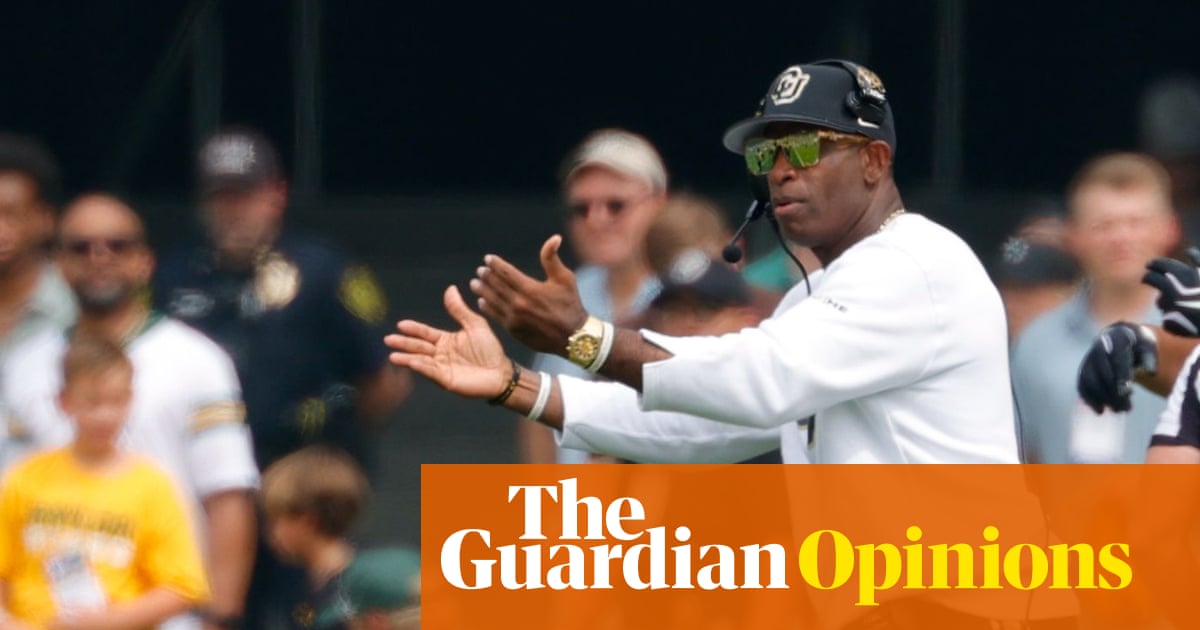

Deion Sanders created Prime Time so he could get paid. Why deny college athletes the same chance?
The Hall of Famer says his successful college career helped him and his family thrive. Now he appears to be backing legislation that would help others
Last week, journalist Rob Parker called Deion Sanders a âÂÂselloutâ for taking part in an advert promoting the Protect College Sports Act (PCSA). The âÂÂselloutâ label is harsh, but reflects how disappointing it is for many people to see Sanders stumping for a bill that will hurt athletes.
The major points of contention around the PCSA, which the Senate passed last week and now awaits approval from the House, are a ceiling of around $49m that schools can direct to athletes, as well as a new transfer rule that would, except in a few specific circumstances, restrict players to one âÂÂfreeâ transfer (if they move schools again, theyâÂÂd have to wait a year to play for their next team). Former NFL player Domonique Foxworth has said that âÂÂthe core of [the PCSA] is about reestablishing the power the NCAA had in the past â that the court system determined was illegalâÂÂ.
Sanders takes a different approach. In his pro-PCSA ad, he notes, âÂÂAs a coach and father, IâÂÂm helping the next generation find their spotlight. ThatâÂÂs why I support the Protect College Sports Act. It gives student-athletes a chance to shine on and off the field, strengthens historically Black colleges and universities, and keeps both menâÂÂs and womenâÂÂs sports strong.âÂÂ
That feels like a vague word salad used to shroud his true intentions. Sanders, like PCSA booster Nick Saban and other coaches, appears to be trying to take back control from players. Student-athletes have more freedom than ever with name, image and likeness (NIL) deals and the transfer portal. In June, Sanders told reporter Baker Machado that, âÂÂI do believe that college athletes should be compensated for their name, image and likeness. But itâÂÂs not about name, image and likeness right now. ItâÂÂs just about pay-per-view.â Four years earlier, when he was coach at Jackson State, he had lamented that NIL deals turn NCAA athletes into âÂÂprofessionalsâÂÂ, saying âÂÂyou donâÂÂt have staffs large enough and equipped enough to handle a young man with money.â The PCSA would not end or cap NIL, but it would mean players would have to prove the deal was worth approximately what a figure of the same standing would earn for a similar endorsement. Deals would need to be proven to have a genuine commercial purpose, something that could end deals that effectively pay students athletes to play.
SandersâÂÂs comments echo SabanâÂÂs assertion that NIL âÂÂcreated an environment with no control, no guardrailsâÂÂ. The former Alabama coach added: âÂÂNow youâÂÂve got transfers that are out of control. YouâÂÂve got salaries that are out of control. YouâÂÂve got budgets that are out of control.âÂÂ
But Saban said nothing about coachesâ salaries being out of control; he made more than $121m during his 17-year tenure at Alabama. Sanders, who earns $10m a year, is the highest-paid head coach in the Big 12. Meanwhile ColoradoâÂÂs athletic department had a $27m deficit in the last fiscal year, partly due to SandersâÂÂs huge salary. While the PCSA has a âÂÂLane Kiffin ruleâ that keeps coaches from jumping teams in the same season, thereâÂÂs no cap on coaching salaries or buyouts. The players are the reason why the NCAA grosses more than $1bn in revenue a year, but this act unfairly targets athletesâ earnings potential.
ItâÂÂs disappointing to see Sanders, who is idolized by Black athletes after his brilliant football career, appear to be such a hypocrite. In his 2011 NFL Hall of Fame induction speech, the former cornerback was candid about his motherâÂÂs financial woes when he was growing up. He added that his brash âÂÂPrime Timeâ persona came from economic necessity: âÂÂCornerbacks, running backs, linebackers, defensive backs werenâÂÂt paid a lot. And in my dormitory room at Florida State, I created this image ⦠You could love him or you could hate him, but he was Prime Time.â He now laments that NIL has turned the NCAA into âÂÂa businessâÂÂ, but âÂÂPrime Timeâ was a business decision. Does he expect anyone to believe that he would have passed on an endorsement deal to support his mother when he was at college?
SandersâÂÂs stance reminds me of Michael Jordan, then owner of the Charlotte Bobcats, reportedly advocating for NBA players to get just 47% of the leagueâÂÂs basketball-related income during the 2011 lockout. (The final figure ended up being 51.2% for the 2011-12 season.) Years before, he told then-Washington Wizards owner Abe Pollin, âÂÂIf you canâÂÂt make it work economically, you should sell the team,â during the 1998 lockout. (Jordan didnâÂÂt take his own advice until 2023 when he sold his majority stake.) The reverence for Sanders among athletes isnâÂÂt far off the respect paid to Jordan. ThatâÂÂs why it was particularly disappointing to see Jordan, and now Sanders, lose solidarity with their peers once they became part of the management machine. Deion âÂÂPrime Timeâ Sanders made a braggadocious 1994 rap song called Must Be the Money. But âÂÂCoach Primeâ wants to rein in player compensation.
In May, Sanders made his intentions clear: âÂÂAt Colorado ⦠I want to win. I want to win it all. It ainâÂÂt no negotiation. No side steppinâÂÂ. ThatâÂÂs my No 1 goal.â The NIL boom has hampered those efforts at Colorado, who lack the finances of the biggest football programs. Recruitment at Colorado, who have lost three straight games, has proved difficult for Sanders. In April, Sports IllustratedâÂÂs Andrew Hughes wrote that, âÂÂThe Buffs no longer spend enough to truly be relevant on a national scale.âÂÂ
Whatever SandersâÂÂs stated reasons, the bill could also benefit him competitively. Sanders says he is pro-PCSA to âÂÂhelp the next generationâÂÂ, but complicating NIL salaries and restricting transfers benefits him as a coach more than it helps athletes. Sanders can accept as many transfers as he wants, but the players would no longer be able to move freely without restriction themselves. If a post-PCSA NCAA results in less player movement, and âÂÂblue bloodâ programs canâÂÂt just buy up every top prospect, Sanders will be able to better leverage his Hall of Fame bona fides as a recruiter, and could theoretically have more continuity on his roster. All of these developments serve his No 1 goal. But itâÂÂs a shame that he appears so focused on wins that heâÂÂd work against the very student-athlete he used to be.
At Jackson State, SandersâÂÂs star power gave him a recruiting edge no coach could compete with. Travis Hunter, the top-ranked high school player in the country, signed with the school towards the start of SandersâÂÂs reign. His success at Jackson State proved five-star recruits would go to HBCUs. Then, he abruptly left for the brighter lights (and bigger paycheck) of Colorado.
He could be content like other former NFL stars who have become college coaches at HBCUs. Michael Vick (Norfolk State), DeSean Jackson (Delaware State) and Marshall Faulk (Southern University) are unlikely to lead their teams to national championships, but theyâÂÂre getting the chance to be mentors to young men while staying competitive in their respective conferences. It seems like that happy medium wonâÂÂt satisfy Sanders, though. ThatâÂÂs why he left another HBCU, Jackson State, to take the Colorado job in 2023.
The chase for success has him stumping for what amounts to a federally protected salary-cap and employment framework imposed without collective bargaining. With the PCSA, a power circle of legislators, leading figures at college institutions and influential boosters would collectively roll back playersâ labor rights without a single NCAA athlete having a meaningful representative role in the actâÂÂs framework. The changes will disproportionately work against Black players, who make up 66% of the football rosters at ACC, SEC and Big 12 conferences.
In a letter to Congress opposing the PCSA and opposing attacks on Black voting rights, NAACP president Derrick Johnson wrote, âÂÂPublic institutions cannot depend upon Black athletes to fill their stadiums, secure television contracts, attract donations, and build nationally recognized brands, then claim neutrality when the political rights of those athletes, their families, and their communities are under attack.âÂÂ
Sanders is dead wrong for working against those rights. Instead of using his voice to tell the pro-PCSA faction that the NCAA wouldnâÂÂt make a dime without its athletes and shouldnâÂÂt be trying to police their movement, he is doing their bidding. Why would he betray young Black athletes like this? Must be the glory.