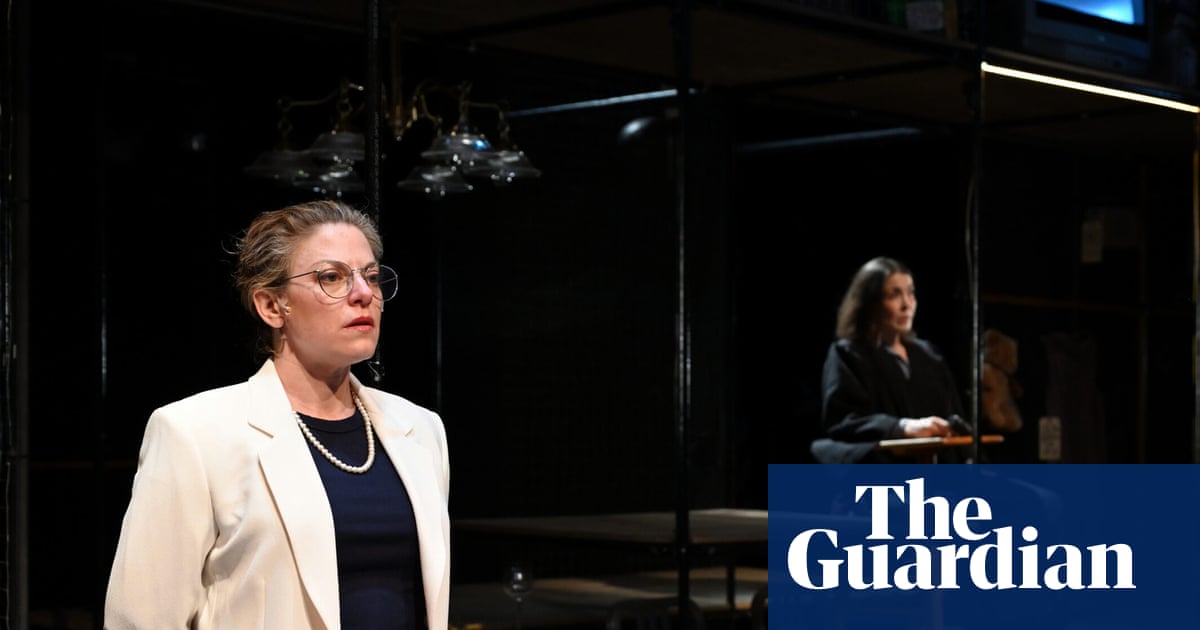

Boston play âÂÂgives equal weight to storiesâ of notorious female fugitive and daughter of policeman she killed
The Getaway Driver brings Katherine Ann PowerâÂÂs story to stage, and amplifies a lesser heard voice: Clare Schroeder, daughter of officer who was killed in 1970 by activist group
It is not every day that you can buy a home from a realtor who was a notorious fugitive.
Katherine Ann Power, a 77-year-old grandmother in glasses and grey bob, is more than an agent who can cut you a deal for a condo in Boston: She spent 23 years on the run from the FBI, from 1970 until 1993. The longest of any woman in American history.
Speaking from her house on a cul-de-sac in sleepy, historic, Concord, Massachusetts, Power said: âÂÂWhen we are wrapping up some of the house purchase documents, some people say to me: âÂÂOh I know your whole story, by the wayâÂÂ.âÂÂ
Now, with repeated clashes between institutions, students and academics, a new play, The Getaway Driver, opens at Central Square Theater, in Cambridge, on 29 October. It brings PowerâÂÂs story, and its lessons, to a new generation, while also amplifying a lesser heard voice: Clare Schroeder, the daughter of the policeman she killed.
There was a time in the 1970s when Power was a household name in America.
For many parents she was a bogeyman of what a college education and liberal politics might do to their own children.
For others, she was a counter-culture myth from the anti-Vietnam war movement, where student protests boiled on campuses across the United States.
Or, as the New Yorker romanticised in 1994 after Power was jailed: âÂÂThe warrior who represented the moral outrage of a generation.âÂÂ
But before the wanted posters, she was a bespectacled, Catholic, Girl Scout from Denver, Colorado, who arrived at liberal arts Brandeis, in Massachusetts, in 1967, hoping to become a science teacher. It was a dangerous moment in American history.
Professor Julie Reuben, who studies student protest at Harvard Graduate School of Education, said: âÂÂThat early optimism that students could have massive change, faded.âÂÂ
Between 1967 and 1970, Reuben explained, the country fell into severe crisis: Martin Luther King Jr and Robert Kennedy were assassinated, the war expanded into Cambodia, students were getting drafted, there were fatal shootings by law enforcement at South Carolina State College, Kent State University in Ohio, and Jackson State College in Mississippi. Reserve officer training corps offices on campuses were torched.
She added: âÂÂIt was the spark of when it became militant. Some students broke off and got involved in underground, violent activities.âÂÂ
Power said: âÂÂWe felt utterly powerless. A student [Stanley Bond] who was older, on furlough from prison ⦠said: âÂÂIâÂÂm putting together a gorilla revolutionary cell. Do you want to join it?âÂÂâÂÂ
In September 1970, Power, Bond, William âÂÂLeftyâ Gilday, and two others, stole weapons from a Massachusetts national guard armoury. A few days later, they robbed State Street bank in Boston, making off with $26,000 [an estimated $200,000 today].
Power, who was 21 at the time, was the get-away driver of the âÂÂswitch carâÂÂ, half a mile away, only learning over the radio that a police officer had been shot in the back, by Gilday.
The Harvard Crimson reported in 1970 that Boston police commissioner Edward McNamara vowed to bring them to justice, calling them: âÂÂDamned radicals and damned revolutionariesâÂÂ.
Power ran and didnâÂÂt stop for 23 years.
There is a voice nearly always conspicuously absent from this story: The Schroeder family. That is what The Getaway Driver, opening on 29 October at Central Square Theater, in Cambridge, hopes to correct.
âÂÂWe wanted to give equal weight to their stories,â said playwright Charlie Thurston who wrote the play with Deborah Salem Smith, based on hours of historic testimony from both women. The project was inspired by parallels with the 3,000 student arrests in spring 2024, in the wake of the 7 October Hamas attacks in Israel in 2023, followed by the war in Gaza.
Thurston added: âÂÂClare was 17 when her father was killed. We wanted to show that one single tragedy affects people in profoundly different ways. That was very hurtful to the family that often Walter was a side-note to âÂÂKatherineâÂÂs storyâÂÂ.âÂÂ
Walter Schroeder was a 42-year-old second world war veteran, and decorated police officer of 19 years. He was also the father of nine, the youngest of whom, Erin, was only 11 months. His family lived in the Boston projects. Three years later, his brother Robert was also killed. The Boston police department at One Schroeder Plaza is named after them.
To this day, the family give few interviews about what life was like for a widow and nine kids on a police pension, unfairly portrayed in the media as uneducated, working-class. And despite granting the play her blessing, Clare declined to respond to the Guardian.
But decades after the murder, Clare did look Power in the eye, and recount the pain it brought them: âÂÂâÂÂHe wasnâÂÂt there to teach my brothers how to throw a football, or how to change a flat tireâÂÂâÂÂ, reported the New York Times. âÂÂNor was he there to comfort them at the funeral of one of ClareâÂÂs brothers, Walter, who was hit by a truck and killed at age six. And he was not there to celebrate when four of his children were sworn in as police officers.â Including Clare, who became the first female officer in Waltham in 1978.
The family always denied PowerâÂÂs claim that the war radicalised her. Clare told a local TV station: âÂÂI was a senior in high school and I thought the Vietnam War was wrong but I donâÂÂt recall going out and robbing banks and killing people to express myself.âÂÂ
While the Schroeder family were quietly struggling, Power, however, became a new woman: Alice Metzinger.
While her accomplices were all arrested within five years, Power roamed around, giving birth to a son in 1979, before settling in Oregon. She married a man named Ron, who had no idea of her criminal past, and co-owned an Italian American restaurant called Napoli in Eugene that donated to soup kitchens.
Power said: âÂÂI was a successful fugitive because of the way I fit into our society [as a white woman]. You know, I had a liquor license and a bank loan for my business.âÂÂ
By the 1990s, however, she was clinically depressed. Seeking medical help, a therapist asked the 44-year-old: âÂÂWhere is your soul in all of this?âÂÂ
âÂÂMy access to the reality of my actions was really blocked by shame,â said Power. âÂÂIt took a lot of work to unblock that so that I could really see the impact it had on Clare and her family.âÂÂ
She asked her 13-year-old son, who didnâÂÂt know his motherâÂÂs real name, what he thought if she âÂÂwent away for a whileâ and then she picked up the phone and negotiated her surrender.
But if the Schroeder family thought they might finally get justice, they were wrong.
Power said: âÂÂOn the day of the surrender [in 1993], I had to be walked past a bunch of men who were also in holding cells, and they were like, hailing me as a hero. I knew that was wrong.â Her photo appeared on the cover of Newsweek.
From Butch Cassidy to Luigi Mangione, America loves an outlaw.
The idea of challenging the system, avoiding consequences and leading double lives. MangioneâÂÂs week-long run was applauded by many, after he shot Brian Thompson, CEO of United Healthcare, and father of two, in New York City in 2024.
At PowerâÂÂs sentencing in 1993, Clare Schroeder voiced that pain: âÂÂFor reasons that I will never comprehend, the press and the public seem far more interested in the difficulties that Katherine Power has inflicted upon herself than in the very real and horrible suffering she inflicted upon my family.âÂÂ
She added: âÂÂWe did not ask to have our father murdered. We did not choose this life ⦠But Katherine Power chose to flee and for 23 years my family has had to live with the open wound of her unresolved crime.âÂÂ
Inmate 9309307 served just six years at medium-security, MCI Framingham, far less than African American Black Panther members, some of whom are still serving time.
Professor Ken Heineman, author of Campus Wars on the 1960s and 1970s student protests, said Power benefited from being a white woman negotiating a deal for faded crimes committed in Massachusetts. âÂÂIf she had done it in Texas, I can pretty much guarantee she would have been executed,â he said.
In the 20 years since her release, Power went through a second metamorphosis, from convicted felon to local realtor, remarried to a woman who remembers seeing her Wanted posters as a teenager, with grown grandchildren who know that âÂÂgranny was a fugitiveâÂÂ. She self-published a book and gives talks in community colleges. Life is quiet. âÂÂI went to a block party last week,â she said. Though you can still buy her Wanted poster on Ebay, for $149.
And then came the invitation from Thurston and Salem Smith to watch the play.
Power said: âÂÂWhat I felt was a release from an entanglement that had begun all those years ago. Through statements, Clare and I have been âÂÂin dialogueâ for 50 years, but we have never actually met. I felt witnessed.âÂÂ
Thurston added that students in the audience have been asking big questions about how they should show up as activists today.
Earlier this month, pro-Israel protesters targeted a Boston venue over its plans to host Mahmoud KhalilâÂÂs book event for No Land to Stand On: Notes from Detention, on the Palestinian studentâÂÂs arrest by ICE in 2025. Just a few miles from where Turkish Tufts student, Rümeysa ÃÂztürk, was snatched off the street.
Amy Binder, professor of sociology at Johns Hopkins University, who studies modern student protest, said: âÂÂSince the 1960s there have been many periods of student protest that have gone off without a hitch, anti-apartheid, police force on campus. The Trump administration came out the gate and did such shocking things. Everyone was caught off guard.âÂÂ
Earlier this year, Sang Kil, the first tenured full professor to lose their job over their support of student protests in 2024, was reinstated, and filed a civil lawsuit against her school, San José State.
Speaking from California, the justice department scholar called herself âÂÂdead faculty walkingâÂÂ, a campus pariah but âÂÂun-hireableâ elsewhere. She added: âÂÂIt is under this severe weight of political oppression that students have had to try and transform [their activism]. They are swimming upstream. Using their graduation walk outs and social media. The chilling effect on academic freedom and free speech is huge.âÂÂ
Power said of todayâÂÂs political climate on campuses: âÂÂA lot of whatâÂÂs going on now doesnâÂÂt surprise me. I feel like I came of age understanding the world in this way. For me, part of the important lesson is the story of the disastrous outcome of the politics of rage. Because, youth is the warrior stage of life. People would write to me when I was in prison and theyâÂÂd say: âÂÂYou know, that could have been meâÂÂ.âÂÂ