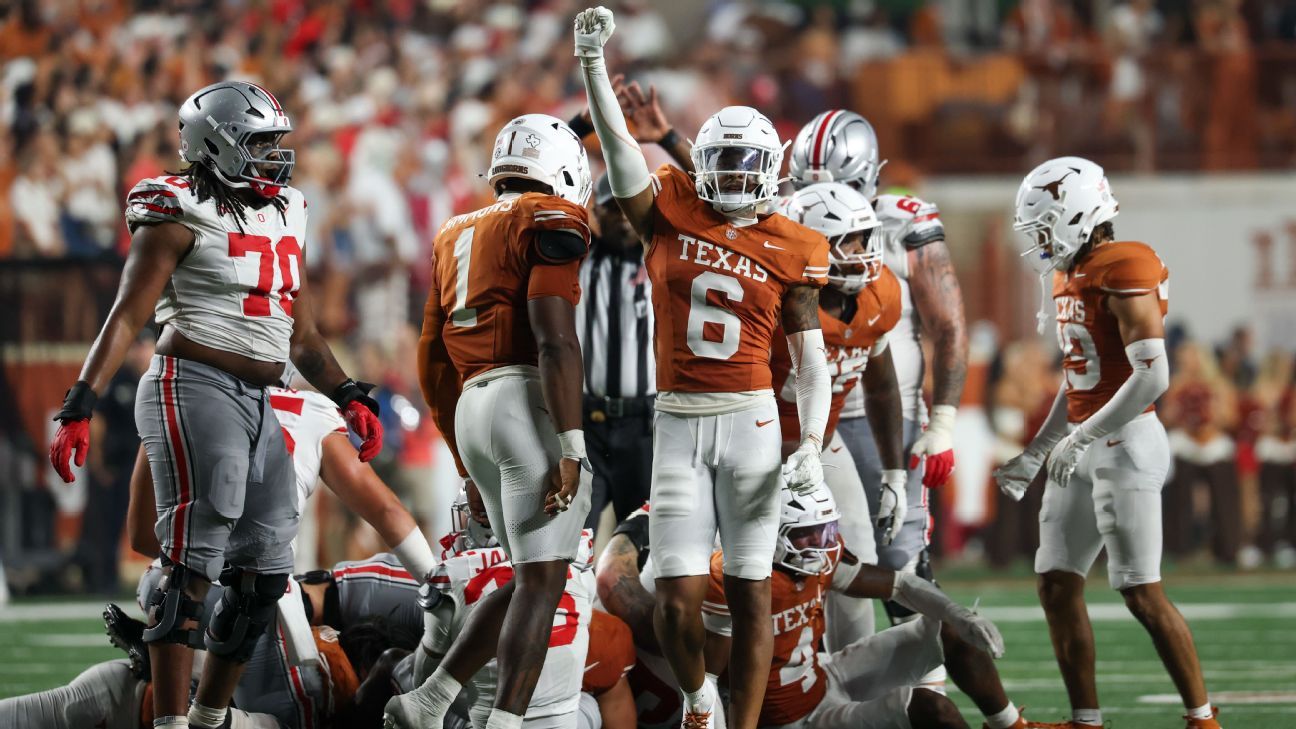
You could say that college football college football'd particularly hard in Week 2.
A week after Tulsa walloped Oklahoma State, the Cowboys beat No. 6 Oregon by eight -- Oregon was lucky to be even that close -- while the Golden Hurricane nearly lost to Sam Houston. After losing by two scores to Idaho State last week, Utah State came within a Hail Mary of beating Washington. Cal visited Syracuse with a minus-21 point differential for the season versus Syracuse's plus-63; the Golden Bears won. After humiliating Clemson, LSU found itself leading Louisiana Tech by only six late in the third quarter before accelerating.
Five teams -- Florida Atlantic, Kennesaw State, NC State, Oklahoma State and Utah State -- have already both overachieved and underachieved against SP+ projections by at least 20 points in a game, while 10 have done so by at least 14 points. And the season is all of 2 weeks old.
The sport has already left us with conflicting impressions about nearly every damn team in the country. But if seemingly everything has already happened once this year, what has happened multiple times? What truths can we potentially start to glean from this odd sample and, frankly, odd sport? At the very least, here are a few things I've started to believe.

Ohio State has a close-game -- and close-game-urgency -- problem
I keep coming back to tempo. It's probably a "me" thing at this point, but I can't get past it. In a world in which elite college football teams might play as many as 17 games in a season, Ohio State coach Ryan Day has made the decision to slow his offense down as much as humanly possible. And there's logic behind it: The difference between 60 and 80 snaps per game, over that many games, is over 300 snaps and, consequently, over 300 opportunities for injury or wear and tear. But there's a trade-off in that calculation: By shrinking games down into a much smaller number of plays and drives, you give yourself less of an opportunity to maximize your superiority.
In the first half against Texas on Saturday night in Austin -- a shocking 24-23 comeback win from the Longhorns, if you somehow weren't paying attention -- the Buckeyes were rolling. Texas had some deer-in-headlights moments, losing a fumble on the game's first play and suffering a fluky interception on an open deep ball to Cam Coleman and a dropped touchdown pass from Ryan Wingo. Ohio State averaged 6.5 yards per play to the Horns' 3.1 and generated five red zone trips to Texas' one. Jeremiah Smith would finish the half with six catches for 110 yards. But until a failed fourth-down conversion attempt in the final minute of the half gave them a free scoring opportunity, the Buckeyes had possessed the ball just four times and led just 13-3. They were taking 28.5 seconds per snap, a faster tempo than last season but still very slow. Even when Smith scored with 10 seconds left in the half to make it 20-3, the score didn't quite reflect reality.
The casual nature only increased to start the second half. Day elected to punt on fourth-and-4 from the Texas 39 on the Buckeyes' first drive after halftime; with the way Texas' offense was struggling, you can see the logic in wanting to make the Horns drive the length of the field, but when Smith is unstoppable and Julian Sayin is flying high (he was 12-for-16 for 192 yards in the first half), 4 yards is nothing. The Buckeyes could have essentially ended the game right there, but they took the passive approach instead.
The cracks began to form from there, even if they were imperceptible at first. Sayin got hurried on three consecutive pass attempts on the Buckeyes' next drive, and while Smith reeled in an underthrown deep ball to set up a field goal and give them a 23-3 lead, Sayin would battle a damning period of inaccuracy, missing a wide open Devin McCuin for a likely touchdown on second down before the field goal and throwing behind Smith a couple of drives later. After a far-too-casual three-and-out late in the third quarter -- with a carry for backup Ja'Kobi Jackson and targets for McCuin and Phillip Bell instead of Smith -- Ohio State was still leaving the door open.
The major fissure required some Texas bounces. Perhaps the Longhorns were due good fortune after the aforementioned fluky pick, but they got three incredibly lucky breaks on their first touchdown drive: First, Ryan Niblett muffed a punt, and the deflection hit Ohio State's Inky Jones in the chest, but he couldn't corral the ball, and Texas recovered. Then, on second-and-14 from the Texas 26, Devin Sanchez was called for an incredibly weak pass interference penalty. And after a clutch fourth-down pass from Arch Manning to Emaree Winston, Emmett Mosley V made his first catch of the evening but fumbled after a gain of 13. Safety Earl Little Jr. literally fell on the ball but couldn't actually secure it, and Cam Coleman did instead. Finally, after three great breaks, Manning hit Wingo to cut the deficit to 23-10.
Once Texas got the burst of luck, the Horns played brilliantly. Ohio State went three-and-out, with Rutgers transfer Bo Mascoe breaking up a pass to Smith. Day burned a timeout before a crucial fourth-and-6 that Manning converted, and Hollywood Smothers scored to cap a 13-play drive and make it 23-17. Sayin made his best play of the second half in finding Nate Roberts for a big gain, but he couldn't connect with a well-covered (by Mascoe) Smith on a third-down end zone bomb, and Connor Hawkins shanked the ensuing field goal attempt.
From there, everything felt preordained. Mosley, suddenly the go-to guy*, made a huge, 19-yard catch-and-run down to the Ohio State 1, and after the Buckeyes used both remaining timeouts, Texas scored on third-and-goal with 25 seconds left. The Horns did Ohio State a massive favor there -- the clock was running, and there were 17 seconds left on the play clock at the snap -- but it didn't matter.
(* Manning's adaptability is his greatest strength at this point. Wingo and Coleman combined for just seven catches and 57 yards, but he found fortune throwing to tight ends and Mosley, so he kept right on doing it. Mosley finished with five catches for 65 yards, all during the three touchdown drives.)
You can't point to any one thing and say, "This right here is why Ohio State lost." They were too casual early in the third quarter, Sayin performed poorly after taking a couple of shots, and Smith failed to reel in any of the last three targets thrown his way. (Two were well-covered, and one was a poor pass, and yet we still expect the best player in the country to grab them.) The defense was untouchable until a series of unlucky events, then it got fatigued and overpowered. Day, an accomplished timeout-burner, burned a timeout he could have used later. But one way or another, the Buckeyes have lost another close one.
It's becoming a thing. In their past five games decided by 10 or fewer points, the Buckeyes have lost four. Mind you, they've also won 17 games in this span by an average of 38-10, and this span also includes their four-game CFP national title romp in 2024. But it also includes the hapless, anxious 13-10 loss to Michigan that forced them to win four games in the first place. The Buckeyes' casual, plodding brilliance works out great most of the time. But when they've needed urgency of late, it just hasn't shown up for them.
They're projected favorites of double digits in each of their next four games, but in late-October Ohio State will embark on a run of three straight potentially close games, visiting Indiana and USC before hosting Oregon. They'll need to win at least two of those three to feel good about their CFP chances, but that might actually require them to execute in clutch moments for what seems like the first time in quite a while. Can they?
Oregon's offensive line is a problem (and not in the good way)
I didn't have many worries about Oregon heading into the season. Over the past three seasons, the Ducks had lost only to teams that made the national title game; they were seemingly upset-proof, and with quarterback Dante Moore returning I only had a couple of real questions: Was their defense disruptive enough, and was their offensive line good enough? The latter was my biggest concern, since the O-line was dominated in each of their past two CFP losses.
I didn't expect to need answers to these questions for a few more weeks -- such as when the Ducks visit USC in Week 4, for instance, or when they visit Ohio State in November. But although they survived a sloppy performance against Boise State last week, they did so with merely average rushing numbers and no run disruption on defense. And against Oklahoma State on Saturday in Stillwater, both question marks received the worst possible answers.
That a 24.5-point underdog pulled an upset in a game featuring a pick-six and nearly another one makes sense: Usually upsets require some funkiness. But in this case, Oklahoma State dominated Oregon so thoroughly that the Cowboys were able to overcome said picks and win by eight points anyway. In the first half, the Cowboys were shockingly dominant, outgaining the Ducks by a 353-101 margin, allowing zero tackles for loss, sacking Dante Moore twice and producing a 65% rushing success rate* to Oregon's 33%. Only the picks kept Oregon close, and when the Ducks improved in the second half, OSU was still able to fend off the comeback attempt.
(* Success rate = how frequently an offense is gaining 50% of necessary yardage on first down, 70% on second and 100% on third and fourth.)
Now, shocking results happen, and a terrible result doesn't have to be a referendum on anything; sometimes it's just a terrible result. But Oregon has reaffirmed my biggest concerns early this season, and the Ducks' assumed strengths -- Moore, a deep and diverse skill corps, a dynamite secondary -- haven't been as dominant as expected either. Now those trips to USC and Ohio State look a lot scarier, and that says nothing of upcoming home games against UCLA and Nebraska. The Ducks have a get-right game against Portland State this week, but their margin for error is now a lot smaller than anyone thought it would be in mid-September.
Oklahoma has solved none of last year's issues
Oklahoma reached the College Football Playoff thanks in part to a 4-1 record in one-score finishes last season, but that's a pretty unsustainable way of doing your business. With another brutal slate forthcoming -- the Sooners currently have the fourth-hardest regular-season schedule, per SP+ -- they needed to shore up last year's two biggest weaknesses to have a shot at another playoff run. The offensive line needed massive improvement, and quarterback John Mateer needed to learn to put some arc on some of his passes. He loves the fastball, but different occasions require different throws.
Mateer was as good as expected against UTEP in Week 1, but the run game was merely decent: The Sooners ranked 81st in FBS in yards per carry (not including sacks) heading into Week 2. After Saturday's 17-10 loss to Michigan, they're 87th. Players not named Mateer carried 16 times for just 55 yards (3.4 per carry), and though Mateer enjoyed rushes of 22, 12 and 10 yards, he also took three sacks, completed just 17 of 33 passes and averaged a paltry 4.8 yards per dropback. Arc on passes? Not so much.
OU's offense needed more power up front and more finesse in the passing game. The Sooners showed neither in Ann Arbor. Now, Michigan's defense is fantastic, as is Oklahoma's; this game was always likely to become a "punting is winning" affair. (And to be sure, both punters were unbelievable. Michigan's Cam Brown put six of seven punts inside the OU 20, while the Sooners' Grayson Miller averaged 48.6 net yards and put three of five inside the 20.) But after a week of awful headlines for Michigan quarterback Bryce Underwood and the Wolverines' offense, Underwood both outrushed Mateer and avoided the crippling mistakes that Mateer could not.
Now the Sooners are looking at a schedule that still includes seven more opponents ranked higher than Michigan in SP+ (Georgia, Texas, Texas A&M, Florida, South Carolina, Ole Miss and Missouri) and also features an away game against a suddenly terrifying Mississippi State (we'll get to the Bulldogs in a moment) and a Week 3 visit from a confident and upset-minded New Mexico. Current average projected win total for the Sooners, per SP+: 6.6. That isn't going to make Brent Venables' confusingly timed recent contract extension look any better.
The Big Ten is not having a very good time
Let's acknowledge up front that plenty of Big Ten teams have looked as good or better than expected early in 2026. UCLA (plus-15.2 points per game ahead of SP+ projections), Nebraska (plus-13.0) and Maryland (plus-10.8 have all exceeded expectations thus far -- granted, September games have never been Maryland's problem -- and defending national champion Indiana hasn't really given us anything to worry about either. Penn State and USC have handled their business just fine against cupcakes, too. We paint with a broad brush when talking about college football's enormous conferences, and we always lose some nuance by doing so.
But if we're talking about things that have happened multiple times, here's a ranking of conferences based on how much their teams over- or underachieved against projections on average in nonconference games in Weeks 0-1:
Sun Belt (+6.6 PPG)
SEC (+4.6)
Mountain West (+2.3)
American (+0.6)
Conference USA (+0.6)
Big 12 (+0.3)
MAC (+0.3)
ACC (-0.4)
Pac-12 (-3.4)
Big Ten (-3.9)
And here are the same averages for Week 2:
Pac-12 (+9.9)
Big 12 (+8.8)
ACC (+8.4)
Sun Belt (+6.7)
MAC (+1.3)
American (+0.6)
SEC (-0.3)
Conference USA (-1.3)
Big Ten (-5.0)
Mountain West (-7.4)
Even if you filter out games against FCS opponents, no conference has underachieved its projections more consistently than the Big Ten in the early going. Only six of its 18 teams have positive averages in this regard, and the poor performance was reinforced by losses in two of Week 2's head-to-head matchups with the SEC. Michigan did upend Oklahoma, but Kamario Taylor and Mississippi State ran circles around Minnesota on the road, and Texas' comeback win over Ohio State finished off the series. But even if Ohio State had held on, this would be an underwhelming set of results, most definitively from Rutgers (-31.2 PPG), Oregon (-24.0), Washington (-16.3), Minnesota Golden Gophers (-9.8) and Illinois (-9.4). Granted, no one's going to care if the conference still finds a way to win its fourth consecutive national title, but a poor start is a poor start.
Austin Simmons and Kamario Taylor are as good as advertised
This has been a pretty negative list so far, so it's time to inject some positivity.
Four Drives.
â Mississippi State Football (@HailStateFB) September 12, 2026
Four Touchdowns. @KamarioTaylor â¡︠@AnthonyEvansIII #HailState || ðº: @CBS https://t.co/AAUteQFaRU pic.twitter.com/Vo8LfXiB97
Let's Go, @frisco_magee! ðÂÂÂ#HailState || ðº: @CBS https://t.co/mCUZJAhWTq pic.twitter.com/aJ9hebbCK4
â Mississippi State Football (@HailStateFB) September 12, 2026
Week 4 is a mammoth affair, featuring four games between ranked teams, including a top-10er in Texas A&M at LSU. Although Missouri at Mississippi State wasn't exactly deemed must-watch in the preseason, it's suddenly becoming just that. The Tigers and Bulldogs scored exciting nonconference wins Saturday thanks to absurd quarterback play.
Mississippi State 38, Minnesota 13. In his first road game as MSU's first-stringer, Kamario Taylor threw for 227 yards and three touchdowns while rushing for 91 non-sack yards. He distributed the ball well to a pair of exciting skill corps options -- running back Fluff Bothwell rushed for 113 yards and two scores, and receiver Anthony Evans III caught seven passes for 121 yards -- and what seemed like a tossup became one-sided almost instantly. MSU went up 7-0 less than two minutes into the game, stretched the lead to 28-3 in the second quarter and cruised 38-13.
This is basically the first time since 2022 that the MSU program seems like it has some genuine momentum. Taylor isn't doing it alone, but he has been incredible as a controlled passer and a devastating runner. The Bulldogs must still face seven opponents ranked 21st or better, but SP+ hasn't caught up to how good they are yet. Here are the top five power-conference teams in terms of their average overachievement versus SP+ projections:
Mississippi State (+20.3 PPG)
Kansas State (+18.2)
Alabama (+17.3)
Utah (+16.7)
LSU (+16.3)
Granted, the Bulldogs play two of the other four teams in the top five, but even with the schedule at hand, MSU has massive potential and appears all but guaranteed to score at least a couple of upsets.
Missouri 38, Kansas 21. Missouri, meanwhile, showed major resilience and upside in Friday night's, um, let's call it spirited Border Showdown. Despite Kansas benefiting from two blocked field goals (one of which was returned for a touchdown) and the most YOLO completion you'll ever see, the Tigers methodically pulled away, finishing the game on a 31-7 run.
They got a pair of takeaways from one SEC transfer (former Auburn linebacker Robert Woodyard Jr.) and a second straight game of unflappable excellence from another. Ole Miss transfer Austin Simmons went 19-for-29 for 292 yards and three touchdowns; he completed six passes each to sophomore Donovan Olugbode (121 yards) and another former Rebel, Cayden Lee (120 yards). The knock on Simmons heading into this season was that, although he was a big-play creator in his short starting tenure in Oxford, he also threw five picks and took five sacks. Would the mistakes add up for the senior? Not so much. Who knows what the future holds, but through two games he has taken one sack and thrown no picks.
Missouri's forthcoming schedule has only gotten harder with out-of-the-gate explosions from both Week 4 opponent Mississippi State and Week 5 opponent Florida. But with Simmons eighth in QBR and Taylor 10th, we have one more late-September game to look forward to.
Texas Tech isn't
Above, I shared the list of power-conference teams that have overachieved the most against projections so far. Here's the underachievers list:
Rutgers (-31.2 PPG)
Oregon (-24.0)
Arkansas (-23.1)
Texas Tech (-17.1)
Washington (-16.3)
We covered Oregon above, new Arkansas coach Ryan Silverfield looked absolutely shell-shocked as he watched his Razorbacks get routed by Utah on Saturday night, and well, as former Ringer writer Rodger Sherman recently put it, "Rutgers invented college football in 1869 and has spent the last 160 years regretting the decision." Though the fourth team on the list remains unbeaten, there are red flags.
Thanks to the brilliance of not only linebacker Jacob Rodriguez and edge rusher David Bailey but also a number of other transfers and key contributors, Texas Tech leaped from 95th to third in defensive SP+ last season. Despite star departures, Joey McGuire reeled in another strong batch of transfers and held on to excellent coordinator Shiel Wood. Though the Red Raiders went the entire 2025 season without allowing over 400 yards in a game, they allowed 472 to Oregon State in Corvallis on Saturday night. They gave up gashes of 75, 41, 37, 25, 22 and 20 yards, and OSU's Braden Atkinson threw for 413 yards, 240 of which went to freshman Jesse Legree.
To their credit, the Red Raiders survived. Their offense scored on just two of their first seven drives and went through a 1-in-5 stretch in the second half, too. But J'Koby Williams ran for 116 yards, and recent addition Thomas Castellanos was a red zone difference-maker, throwing for one score and running for another. They were forced to scrape by and did so. But while they began the season well ahead of the pack, they've slipped from eighth to 15th in SP+, and their advantage over the other top Big 12 teams has shrunk considerably, thanks to BYU's solid early play (the Cougars are 18th in SP+) and early overachievement from Utah (22nd) and Kansas State (24th). This could end up being a much tighter Big 12 race than what we saw last season, though it would certainly benefit the conference if the Red Raiders were able to shift back into gear defensively at some point.
North Dakota State is doing just fine, thanks
James Madison set the bar for FCS transplants pretty high when the Dukes went 8-3 in their first season and reached the CFP in their fourth. But North Dakota State tends to clear whatever bar it wants to. The Bison reached the FCS playoffs in their third year of eligibility in 2010 and won the national title there the next season. And they're threatening to zip past JMU's success timeline as well. They moved to 3-0 with their first ever Mountain West win, a 38-32 defeat of Air Force on Saturday.
Down 35-13 heading into the fourth quarter, the host Falcons made things interesting with a late charge, but the damage of earlier quarters was too severe: Nathan Hayes completed passes of 51, 44, 41 and 23 yards, all to different receivers, and the Bison proved that even if they don't have the power advantages that they found in FCS, they have the speed to make up the difference.
NDSU is now a projected underdog in just one remaining game: the Week 8 trip to New Mexico. The Bison are serious Mountain West contenders, and if they handle their business as projected favorites -- a strange place to be for an FBS newcomer, but not at all strange for NDSU -- they could threaten to land in the CFP in their first try. Per SP+, only JMU, of all teams, has better odds from the G6.
They usually beat JMU when they put their mind to it, too.
This week in SP+
The SP+ rankings have been updated for Week 2. Let's take a look at the teams that saw the biggest change in their overall ratings. (Note: We're looking at ratings, not rankings.)
Moving up
Here are the five teams that saw their ratings rise the most this week after playing FBS competition:
Fresno State (up 6.8 adjusted points per game, ranking rose from 100th to 75th)
Oklahoma State (up 5.6 points, 69th to 50th)
North Texas (up 5.1 points, 115th to 107th)
Auburn (up 4.7 points, 43rd to 30th)
Utah State (up 4.5 points, 108th to 99th)
Fresno State and Auburn crushed overwhelmed competition, while Oklahoma State and Utah State rebounded from Week 1 duds to either beat (OSU over Oregon) or nearly beat (USU vs. Washington) Big Ten opponents. North Texas, meanwhile, might have something interesting going. With an almost entirely new roster, Neal Brown's Mean Green frustrated Indiana well into the second half on Sept. 5 and absolutely walloped UNLV 44-6 on Saturday. I'm surprised they didn't move up even more.
Moving down
Here are the five teams whose ratings fell the most:
UNLV (down 5.0 adjusted points per game, ranking fell from 62nd to 79th)
Minnesota (down 4.9 points, 34th to 55th)
Rice (down 4.7 points, 105th to 120th)
Bowling Green (down 4.6 points, 113th to 128th)
Navy (down 4.4 points, 55th to 74th)
I'm guessing the Jackson Arnold experiment is just about over. The intensely sack-prone former blue-chipper took another four sacks against North Texas, and the Rebels have averaged a paltry 16.0 points per game in his three starts. They were a top-five contender for the Group of 6's CFP bid in the preseason, and at 1-2 with a humiliating loss on their résumé, they're pretty much eliminated now.
My 10 favorite games of the weekend (plus 10 more because it was a great week)
1. No. 4 Texas 24, No. 1 Ohio State 23. I'm still a little stunned.
2. Oklahoma State 39, No. 6 Oregon 31. In two games as OSU's coach, Eric Morris has already experienced nearly every possible emotion.
3. Ohio 29, Jacksonville State 27 (4OT). The most college football game of the week. In sloppy, wet conditions, Ohio trailed by 10 heading into the fourth quarter, but Victor Rosa plunged into the end zone, capping an 18-play, 90-yard, nearly nine-minute drive to tie the game at 24, and JSU missed a field goal at the end of regulation. In overtime, with conditions getting sloppier, we got a full-fledged tarps off situation, with shirtless Ohio students running from one end of the stadium to the other to get behind the end zone, and they got to celebrate with the team when third-string QB Levi Davis converted a 2-pointer in the fourth OT and JSU couldn't match it. Delirium reigned.
4. D-III: Worcester Polytechnic Institute 22, University of New England 21. The official game recap says that after UNE took an intentional safety to allow WPI within 21-19 near the end of the game, "UNE then attempted a squib kick that was downed at its own 33-yard line, with just one second coming off the clock and leaving WPI six seconds to work with." I wish I could find video of this, the worst squib kick of all time, because it gave WPI's Nathan Napier a chance at a game-winning 50-yard field goal, and he absolutely crushed it.
The way this game ends is wild! WPI walks it off with a 50-yard game-winning field goal by Nathan Napier -- and it had plenty of distance! Final: WPI 22, University of New England 21. #d3fb @WPIAthletics https://t.co/Rm8qzEpqOW pic.twitter.com/Q3IArZXNQt
â D3football.com (@d3football) September 12, 2026
5. Wake Forest 38, Purdue 36 (2OT). Wake Forest used a 17-0 run to lead most of the way and held a 23-13 advantage into the final four minutes. But Fame Ijeboi (156 yards from scrimmage and three TDs) brought Purdue within three points, and Jacobo Echeverria Lozano's 20-yard field goal at the buzzer forced OT. The Boilermakers took the lead in the second OT and it appeared they had clinched the win when a fourth-and-15 pass to Carlos Hernandez was deemed just short. But replay gave Wake the first down -- the right call, I think, but it was really close -- and Gio Lopez scored the game-tying TD, then the game-winning two-point conversion.
6. South Florida 28, Army 24. USF's offense was almost nonexistent for most of 50 minutes in West Point, but the Bulls got off the mat late. Trailing 24-14 with under four minutes left, the Bulls drove 75 yards and got to within three with a Michael Van Buren Jr. touchdown. After an Army punt, USF faced a fourth-and-6 from the Army 38 with 25 seconds left; instead of attempting a 55-yard Nico Gramatica field goal, Brian Hartline decided to go for the win instead. Good call.
DID YALL SEE THAT????
â South Florida Football (@USFFootball) September 12, 2026
ðº: @CBSSportsCFB pic.twitter.com/e2q9bmMzgN
7. D-III: Randolph-Macon 28, No. 3 Johns Hopkins 21. Division III got pretty silly this week. WPI's win was the wildest result, but this one was the most surprising. Two Mitchell Johnson touchdowns helped to give Randolph-Macon, a 13-point underdog per SP+, a lead early in the fourth quarter, but JHU got three different chances to tie. The Blue Jays couldn't do it. They turned the ball over on downs at midfield with 2:39 left, and on their first play after a Yellow Jackets punt, Quentin Mankin picked off Luke Baker to seal the upset.
8. No. 21 Iowa 16, Iowa State 13. This could have been No. 1 in a normal week. For what felt like the 100th year in a row, Iowa-Iowa State went down to the wire. ISU couldn't make an early 10-0 lead hold up, and after Caden Buhr tied the game at 13 with 6:22 left, he nailed the game-winning 42-yarder with 15 seconds remaining.
9. UTSA 31, Texas State 26. Texas State led on three separate occasions, outgained visiting UTSA by 83 yards and produced a better success rate, more big plays, twice as many red zone trips and half as many three-and-outs. But three Bobcats turnovers and a missed field goal kept the Roadrunners in the game, and Brandon High Jr.'s 25-yard TD run with 14 seconds left pushed them to an unlikely 2-0.
10. D-III: No. 7 Mount Union 21, Grove City 17. A week ago, Mount Union made this list with a last-second loss to Wheaton; the hangover nearly gave the Purple Raiders a devastating second straight defeat. They trailed unranked Grove City 17-7 at home late in the third quarter, and it was 17-14 when they got the ball back with 45 seconds left and no timeouts. But Mikey Maloney completed passes of 4, 32 and 13 yards, then found Mason Ashby for a season-saving 21-yard score with 12 seconds left.
More great games:
11. FCS: Alcorn State 53, UAPB 51 (2OT)
12. D-II: Mars Hill 22, Catawba 16 (OT)
13. Tulsa 23, Sam Houston 17
14. Marshall 28, Middle Tennessee 26
15. D-II: Roosevelt 59, Southwest Baptist 56
16. D-III: UW-Stout 37, Augustana (Ill.) 34
17. Cal 21, Syracuse 18
18. FCS: No. 5 Tarleton State 27, McNeese 24
19. D-III: Curry 41, Coast Guard 35
20. D-III: No. 1 North Central 26, Wartburg 20