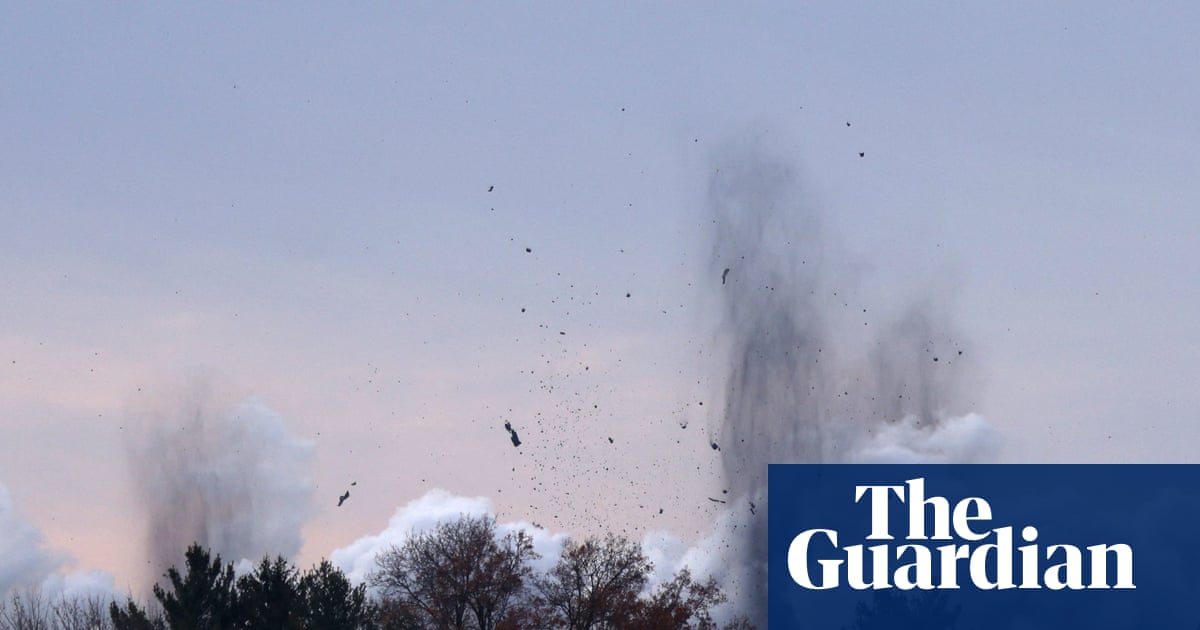

US army calls detonation of bomb chemicals in Iowa a success after fears of toxic plume
The army blows up US stockpile of lead azide, a chemical used for explosives, to avoid uncontrollable explosion
The US army blew up the nationâÂÂs entire stockpile of lead azide, a chemical used to make explosives, saying the first checks show WednesdayâÂÂs controlled detonation in Iowa didnâÂÂt spread toxic dust to nearby homes and farms.
Earthen barriers were put up and foam and water were poured onto a pair of bunkers holding the 5 tons (4,500kg) of lead azide, and officials said those measures appear to have absorbed much of the blast.
The US Environmental Protection Agency air monitors were detecting no lead in the air around the Iowa army ammunition plant in Middletown, and an alert sent to cellphones late Wednesday afternoon said it was safe to resume normal activities. Fema also issued an all clear around the plant, the US army reported.
Still, government agencies and independent researchers plan to do extensive environmental testing for lead â a heavy metal thatâÂÂs especially dangerous to children and pregnant women â in the weeks ahead on water sources, farms, homes and playgrounds.
The army said the safest option had been detonating the stockpile right away because it was degrading and might explode uncontrollably at any time as the weather got colder.
Some experts cautioned that itâÂÂs too early to know whether communities are in the clear.
But Maj Gen Eric Shirley, who led the army operation, said the risk was âÂÂreduced as close to zero as itâÂÂs absolutely humanly possibleâÂÂ.
Since the military announced and then delayed plans for the detonation over the past two weeks, residents and environmental groups have voiced concerns about potential health and environmental impacts and about a lack of information about what to expect.
The smoke after the blasts
An Associated Press reporter filmed the blasts from less than a mile away and upwind from the site. Following two loud booms around 9am local time, a pair of white plumes rolled high in the air before quickly dissipating.
The army attributed the smoke to the foam sprayed on the bunkers to tamp down any dust.
Bystanders who parked on the side of a road to watch came away unimpressed by the size of the explosion.
Burlington resident Tim Brandt said he wanted to feel the ground shake, but instead the detonation reminded him of the noisemakers that crack when thrown on the ground.
âÂÂIt was nothing,â he told the AP. âÂÂIt seemed like government put fear in a lot of people over nothing.âÂÂ
The army scheduled the detonation for Wednesday because the winds were blowing to the south-west and away from populated areas including Burlington, a city of just under 25,000 people along the Mississippi River.
The two controlled blasts destroyed all 68 barrels and didnâÂÂt set off any secondary explosions, Shirley said.
Donald Trump posted on social media that the army did a âÂÂgreat jobâÂÂ.
Acting secretary of the army Adam Telle along with the Republican governors of Iowa and Missouri also said it appeared to be a success and that the explosion was well contained.
However, the final results arenâÂÂt in yet, researchers said.
The EPAâÂÂs air quality data was promising, said Andrew Whelton, an environmental engineering professor at Purdue University who has helped communities recover from chemical disasters. Yet he stressed that samples need to be tested in a lab to determine if people face health risks.
âÂÂThis should take days to weeks,â Whelton said. âÂÂBut what we may see is different guidance issued to different communities based on how far they are from the detonation area and whether or not they were upwind or downwind.âÂÂ
Colin Wellenkamp, the executive director of the Mississippi River Cities and Towns Initiative, said water treatment facilities along the Mississippi and Missouri rivers will be testing periodically to make sure that there are no detectable spikes.
Safety concerns and weather condition delays
Government officials had encouraged residents closest to the site and in range of the plume to evacuate and others to stay indoors.
Schools not already closed for the upcoming Thanksgiving holiday canceled classes and many businesses closed. Some residents sealed their windows and doors as a precaution.
Doug Seyb, a livestock farmer from Donnellson, lives far enough away that he didnâÂÂt hear or feel the explosions. But he was still concerned about the accuracy of EPA air monitors.
âÂÂAll of these cows are pregnant,â he said, âÂÂand we just cross our fingers that we donâÂÂt have deformed calves and stillborns.âÂÂ
Army steps to quash the plume
A court ruling this week put the detonation, originally planned for last Friday, back on track. The army changed the date amid public backlash and to allow more time for safety measures and favorable wind.
The army set up âÂÂblast barriersâÂÂ, with concrete and sand barriers two stories high. Ballistic gels, foams and water were added to absorb the dust.
Environmental groups who sued to halt the detonation said on Wednesday that legal action and public pressure forced the army to take more protective measures.
Had the blasts happened last week as planned, many safeguards along with clearer evacuation plans and expansive monitoring wouldnâÂÂt have been in place, they said.
âÂÂIowa and neighboring states deserve a full accounting of why the situation was allowed to get to the point of crisis,â said Sarah Green, executive director of the Iowa Environmental Council.
The stockpile was brought to Iowa from bases around the country in 2009, according to Robert Cekada, director of the Bureau of Alcohol, Tobacco, Firearms and Explosives. The lead azide was stored just in case the military needed to use it again.
During an inspection in March, staff at the ammunition plant found the chemicals had partially crystallized, making them sensitive to friction and cold temperatures and creating the risk of spontaneous detonation.
Some residents said the timing could have been better, given that it was the day before Thanksgiving, but they acknowledged it needed to be dealt with now. Others worried about the potential impact down the road.
âÂÂI donâÂÂt think lead danger goes away any time soon,â said Lucy Giehl, who lives nearby in West Burlington. âÂÂIt seems someone might have thought about all of this a little sooner before it came to this.âÂÂ