
The desperate, failed attempt to keep one Florida district Black
Efforts to consolidate the Black vote here were frustrated, handing the Democratic nomination to a white party insider
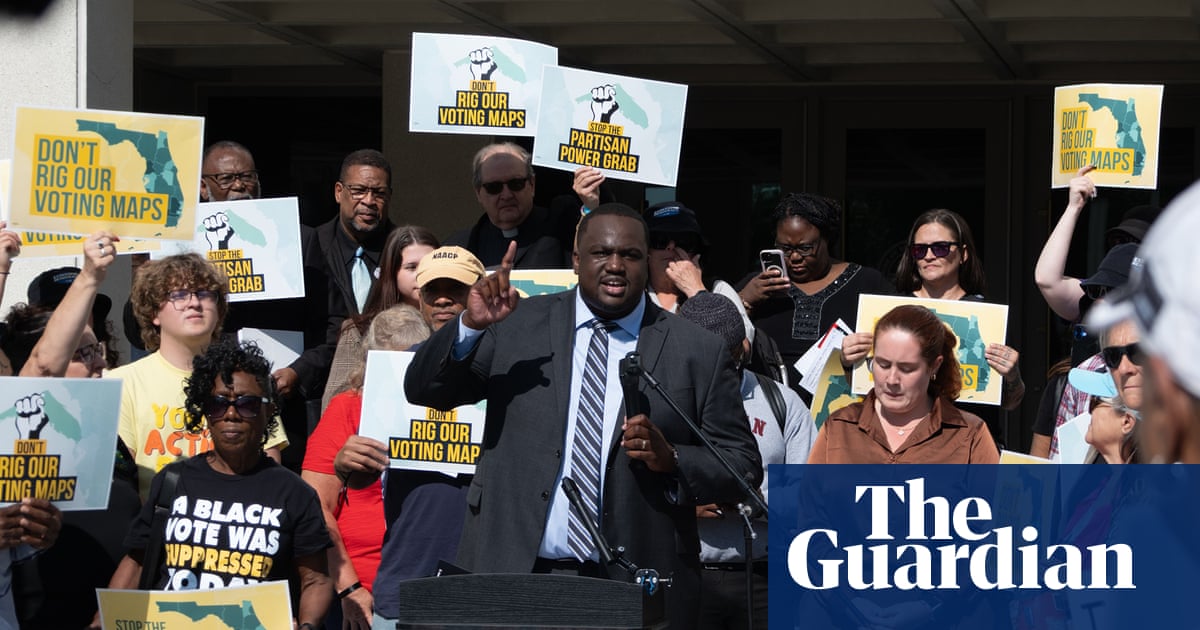
A major plot line of the hyper-partisan, mid-decade redistricting arms races â launched at the urging of Donald Trump â has been the elimination of traditionally Black congressional seats in the south. In the midst of that battle, a subplot emerged: a challenge to one of those Black seats from inside the Democratic caucus itself as the veteran congresswoman Debbie Wasserman Schultz, whose own district was splintered, chose to seek re-election in FloridaâÂÂs 20th congressional district, which had been represented for decades by a Black legislator.
Her candidacy and primary win raise prickly questions about the value of lived experience as a prerequisite for effective representation of minority communities, about how Black Democratic candidates should deal with friendly fire from non-Black opponents, and about internal economic vulnerabilities of so-called Black seats which are in districts where candidates generally raise less money than others.
On the evening of 1 June, the four Black candidates running to represent FloridaâÂÂs 20th district in Congress ascended the crimson steps of the African-American Research Library and Cultural Center in Historic Sistrunk, the oldest Black neighborhood in Fort Lauderdale.
Among them were Dale Holness, the Jamaican-born former mayor of Broward county; Luther âÂÂUncle Lukeâ Campbell, former leader of the raunchy rap group 2 Live Crew; Sheila Cherfilus-McCormick, the former congresswoman for the district who resigned over a money-laundering indictment and a House ethics investigation; and Elijah Manley, a 27-year-old substitute teacher and gay progressive who touted his hardscrabble upbringing, including a bout of homelessness â living in cars and couch-surfing.
TheyâÂÂd been convened by Broward state attorney Harold F Pryor, the first Black state attorney in the county, in hopes they would consolidate behind a single Black candidate in a desperate attempt to keep a Black representative in the seat, which had been the case since Alcee Hastings claimed it in 1992.
Hastings had been FloridaâÂÂs first Black federal judge in 1979, but he was impeached and removed by Congress on bribery charges a decade later. So, his comeback congressional win in the district took some by surprise. As a political consultant told the Miami Herald at the time: âÂÂAmong a certain population of Black voters, Alcee Hastings was symbolic of someone who had overcome. He fought the man and won.âÂÂ

But the candidates meeting that Monday in a research center conference room werenâÂÂt only fighting the man, they were battling a woman: 10 days earlier, veteran congresswoman Wasserman Schultz, who is white and Jewish and doesnâÂÂt live in the district, declared her intention to compete for the seat. She was the epitome of the party establishment, having been in Congress for 21 years, served as the chair of the Democratic National Committee and possessing a massive war chest that none of the Black candidates could match, particularly not two months out from primary day.
Following the Louisiana v Callais decision allowing partisan gerrymandering, FloridaâÂÂs legislature, at the urging of the governor, Ron DeSantis, redrew the stateâÂÂs congressional line, splintering Wasserman SchultzâÂÂs district, once a Democratic stronghold that had been 42% Hispanic, so she decided to run in the 20th district, which is 42% Black.
The Black candidatesâ meeting, which served as something of an introduction of the consolidation idea, ended after about two hours with no resolution, so a second meeting was set for a week later, this one at noon at a building owned by the local chapter of Omega Psi Phi, a historic African American fraternity.
Cherfilus-McCormick told the Guardian that she had entered the meetings with apprehension, believing that she and Holness were the only âÂÂreal candidatesâ in the race, and her antipathy for Manley only grew, as she described his behavior as âÂÂdeceitful, deceptiveâÂÂ, claiming he made up stories and leaked information.
Multiple ideas were tossed around, such as having the candidates run for other offices: a seat the Florida state legislature, a different congressional district or even governor. The meetings had been generally cordial, but as the candidates failed to reach consensus and the meeting dragged on for more than four hours, tempers flared, and voices were raised.
Eventually, Holness, Manley and Campbell agreed to the general parameters of a consolidation plan, but Cherfilus-McCormick balked, believing that Manley and Campbell intended to run for the district seat anyway and were taking steps to do so. âÂÂNo, IâÂÂm not gonna sit here and lie to you guys, you guys are lying. I know youâÂÂre lying. Elijah already sent in his paperwork,â she recalled telling the group. âÂÂIâÂÂm running regardless. This is my seat, and IâÂÂm running for my seat.âÂÂ

One of the steps a candidate must take under Florida law to qualify for federal office is to submit an oath swearing that they are qualified and will follow the US constitution. According to ManleyâÂÂs candidate form filed with the Florida department of state, he took the oath and signed it three days before the second meeting, and it was marked received by the state just 30 minutes before that meeting began. The other candidates submitted their oaths in the days that followed.
Holness said that in the meetings the consensus was âÂÂthat we would not attack each other throughout the campaignâÂÂ, but he added: âÂÂIn the end, Elijah did.âÂÂ
Ultimately pride, suspicion and distrust were hurdles too high to clear.
Anemic national Democratic response
When local Democrats caught wind of Wasserman SchultzâÂÂs intention to seek re-election in the 20th district, some tried to wave her off, seeking to keep in Black hands a seat they had come to see as inviolable political inheritance.
The Broward county Black Democratic caucus asked her not to run in the 20th district. Holness says that almost three weeks before Wasserman Schultz finalized her decision to run, he had, after a West Broward Democratic Club meeting where she spoke, personally âÂÂhanded her a folder with dataâ which he said demonstrated that âÂÂshe could win where she lives, in district 22âÂÂ.
Manley said he spoke to Wasserman Schultz in a parking lot after an event in Kings Point, telling her that he hoped she would not run in the historically Black district. According to him, she said: âÂÂI have a lot of options, and weâÂÂll talk more about it. You know how to reach me.âÂÂ
Holness said that about a week before she announced, he tried to talk to her about the issue at another Democratic club meeting but she âÂÂpretty much blew me offâ and said, âÂÂLook, IâÂÂm running. ItâÂÂs not personal.â A Wasserman Schultz spokesperson disputed HolnessâÂÂs and ManleyâÂÂs accounts, writing in a statement to the Guardian: âÂÂThese conversations either never took place or did not occur as described.âÂÂ
On 22 May, Wasserman Schultz announced her run for the the 20th district seat, saying in a video posted online that she was doing so simply âÂÂbecause we cannot let Trump destroy Broward countyâÂÂs powerâÂÂ, and touting her âÂÂseniority and cloutâÂÂ.

Some quickly accused her of carpetbagging, of using her money and clout to bigfoot her way into the race. Ten of the 15 elected members of the Florida DNC released a statement condemning Wasserman SchultzâÂÂs decision to run in in the 20th district, saying: âÂÂOur party cannot credibly denounce the dismantling of Black political power by Republicans while treating one of FloridaâÂÂs few remaining majority-Black districts as a political opportunity for an incumbent seeking a safer seat.âÂÂ
Absent from that statement was the Florida Democratic party chair, Nikki Fried, who would issue a more tepid statement to the Miami Herald weeks later, saying simply: âÂÂI am disappointed by the congresswomanâÂÂs refusal to engage in meaningful dialogue about her decision.âÂÂ
But perhaps most striking was the lack of a full-throated, public pushback from national Democrats, particularly the congressional Black caucus (CBC).
Days after she announced her run, Wasserman Schultz told a CBS affiliate in Miami about the members of the CBC: âÂÂNone of them told me not to run.â In fact, she said that the House minority leader, Hakeem Jeffries, and CBC members told her that âÂÂthey know I know our communityâÂÂ.
The CBCâÂÂs chair, Yvette Clarke of New York, said at the time that Wasserman Schultz approached her on the House floor before the Memorial Day recess and told her that she would be running in the district. As Clarke put it: âÂÂIt was more information than it was a conversation. Conversation is discourse, right? It was informational.âÂÂ
Clarke would choose her words carefully on CNN, saying that there were âÂÂvalid reasonsâ that Black people in the district had raised concerns about Wasserman SchultzâÂÂs decision. She continued: âÂÂAnd IâÂÂm not there to invalidate that.âÂÂ

The Florida congresswoman Frederica S Wilson wrote an op-ed in the Miami Times ticking through the history of Black representation in the 20th district, calling it âÂÂthe Congressional seat that Black history builtâÂÂ. But she prefaced her lesson with a disclaimer and a dodge: âÂÂThis is not an endorsement of any candidate. It is a civics lesson.âÂÂ
Presumably, the CBC didnâÂÂt want to put its thumb on the scale, but that rationale was obliterated when the representative Emanuel Cleaver, former head of the caucus, came to the district to campaign ⦠for Wasserman Schultz.
As Politico reported at the time, Cleaver called it a âÂÂtough situationâ because he had a two-decade working relationship with Wasserman Schultz. Damping any expectation of racial solidarity or guilty conscience about the lack thereof, Cleaver said: âÂÂWouldnâÂÂt it be ugly if IâÂÂm driving down the street with Debbie Wasserman Schultz in my red convertible, and I see an African American standing on the road without a ride, and they ask me to stop, put Debbie out of the car? Let them get in because they are African American? I donâÂÂt roll like that.âÂÂ
On the verge of the primaries, Clarke continued her illusory language when describing the race, suggesting an objection without directly asserting one. She called Wasserman SchultzâÂÂs decision to run in the district âÂÂa painful situationâ that âÂÂthe community has been really disrupted byâÂÂ.
While the Black Democratic candidates in Broward couldnâÂÂt consolidate, and national Black Democrats wouldnâÂÂt repudiate, Wasserman Schultz did the work of wooing enough Black voters. She flooded votersâ boxes with mailers featuring smiling Black faces endorsing her. She attended a âÂÂBrotherhood Brunchâ with Black men at a Black-owned restaurant, and she enjoyed the blessing of a church group called âÂÂBlessed Browardâ that describes itself as âÂÂa collective combined clergy of Broward countyâÂÂ.
As Broward Democratic party state councilman Percy Johnson disapprovingly deduced: âÂÂYou know that Black folk sell Black folk out. And they sell the representation out.â He continued, âÂÂWe had a lot of that.âÂÂ
In the end, when the votes were cast, Wasserman Schultz would win with 45% of the vote. As feared, the majority of the districtâÂÂs vote â 55% â was split among the four Black candidates.
The idea that the losing candidates would grouse about the winning one isnâÂÂt surprising, and Wasserman Schultz had every right to run in whichever district she chose. But the fact remains that at a time when Black representation is under threat from the right, her candidacy represented a rare challenge to it from the left.

Repeat of a 2006 race
In many ways, the fight for FloridaâÂÂs 20th congressional district is a reprise of a Tennessee race two decades ago.
In 2006, Steve Cohen, a white Jewish man, ran for Congress in that stateâÂÂs ninth district that covered most of Memphis, was majority Black and had been represented by a Black person for three decades. Like Wasserman Schultz, Cohen entered a crowded race of Black candidates late in the cycle, filing to run just three days before the deadline. Like her, his argument from the beginning was that the district needed someone with experience âÂÂwho knows how to get things done immediatelyâÂÂ. Cohen had served in the Tennessee state senate for 24 years.
Cohen met the same resistance that Wasserman Schultz would meet: the argument that legislative experience did not trump lived experience, that it was better for a largely Black district to continue to be represented by a Black legislator.
But when the Commercial Appeal in Memphis endorsed Cohen for the seat, it dismissed the framing, writing that questions about âÂÂwhether a white person, who happens to be Jewish, will have the sensitivity to effectively represent a district where the majority of residents are African-Americanâ had âÂÂno placeâ in the race. Black Memphis columnist Wendi C Thomas even argued that if voters in Memphis wanted Barack Obama in the White House â which would require the support of large numbers of white people â they had âÂÂto be willing to have Steve Cohen in the US HouseâÂÂ. Obama was contemplating a presidential run at the time.
For his part, Cohen also played up his connection to the districtâÂÂs Black electorate, quipping in one debate that judging by his voting record people would think that he was a Black woman. He was harshly criticized for that comment.
Like in Florida, the Black political establishment in Memphis tried, but failed, to get some of the Black candidates out of the race to prevent splitting the Black vote, which, NPR reported in 2009, was âÂÂexactly what ended up happeningâÂÂ. Cohen won the primary with just 31% of the vote.
Still, there are three major differences between the two races: Cohen wasnâÂÂt the top fundraiser in the primary, he actually lived in the district he sought to represent, and he ran for the historically Black seat at a time when the number of Black congresspeople was still inching up. Now the CBC is predicting a loss of a third of its members.
Setting a precedent
Multiple people interviewed for this article believed that Wasserman Schultz had targeted this Black district as the easier one to win and hold, exploiting a fracturing vote and bigfooting with a checkbook. As Manley put it, the analysis of this race has orbited around a central fact: âÂÂA white woman took advantage of that to essentially run and take a Black opportunity district for herself.âÂÂ

The question then becomes, what prevents other powerful, well-funded Democrats from doing the same in future cycles? According to an analysis performed for the Guardian by OpenSecrets, a nonpartisan, non-profit research group tracking money in US politics, incumbent Democrats in southern, majority-Black districts seeking re-election in 2026 raised, on average, little more than a third of what incumbents raised in districts where Blacks were not the majority.
And what would these challenges mean for Black representation and the Democratic partyâÂÂs commitment to it?
Catherine Charles, a 44-year-old Black mother of two, said that she would have preferred âÂÂone of the other candidates to winâÂÂ, but she was keeping an open mind and hoping for the best. She continued: âÂÂItâÂÂs time for a change, and IâÂÂm not necessarily stuck on the color of the person whoâÂÂs going to bring the change.â Charles is a best-case constituent for Wasserman Schultz and could provide a political stickiness and longevity that politicians pine for. Cohen, for his part, was re-elected nine times after his initial 2006 win in Memphis. In fact, it was this current wave of redistricting that drove him out the historically Black seat he had captured â the same wave that lured Wasserman Schultz into FloridaâÂÂs 20th district.