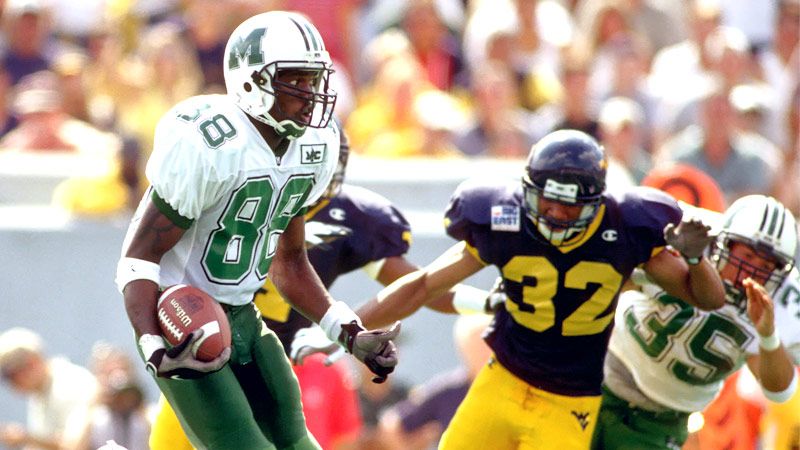
There are certain non-negotiables when it comes to historic rankings. I have my own thoughts, for example, about who the best college quarterback of the 2000s is, and they're pretty different than everyone else's. Best team of a given time period? Hoo boy, that will get you involved in an endless argument.
Two arguments, however, aren't really arguments: Barry Sanders is the best college running back of any number of time periods, and Randy Moss is the best receiver. Both positions have had lots of incredible players, and celebrating them is a lot of fun. But No. 1 is too obvious to debate.
Or at least, it was. Sanders is still safe at No. 1 in my book, but Moss' position is under severe threat because Ohio State's Jeremiah Smith won't stop doing amazing things. He was among the best players in the country from the moment he moved from Miami to Columbus for college, he might have been the best player on a national championship team as a freshman (despite the presence of many first-round NFL draft picks and another player on the list below), and his production has only improved since. After failing to win the Biletnikoff Award in 2025 (and noticing), he has ramped things up to a completely different level this fall. He's on pace for a 2,000-yard junior campaign -- 2,500 if the Buckeyes make a deep College Football Playoff run -- and he will likely finish his three-year college career with something in the neighborhood of 4,500 to 5,000 career yards and 50-plus touchdowns.
The best way to comprehend those ridiculous stats? Compare them to the rest of the sport's greats. Here are the 60 best college receivers of the last 50 years, adding 10 slots to the top 50 list that was first published in 2021.
(Quick note: This was a ridiculously hard list to make, and it required both big-time talent and big-time production. Someone like Alabama's Julio Jones didn't make the list because he just wasn't asked to do enough in Tuscaloosa, and others like Florida's Percy Harvin and Notre Dame's Rocket Ismail didn't make it because they were more RBs than WRs -- both ended with more career rushes than receptions. Hell, even a few former Biletnikoff Award winners didn't make the list. That's how high the bar is.)


60. Dez Bryant, Oklahoma State
Years: 2007-09
Career stats: 147 catches, 2,425 yards, 29 TDs (also: 3 punt return TDs)
He was denied a final act in 2009 because of NCAA silliness, but Bryant's 2008 season was an all-timer: He caught 87 balls for 1,480 yards and 19 touchdowns (and two punt return scores) and earned All-American status for Mike Gundy's first awesome OSU team.

59. Ryan Yarborough, Wyoming
Years: 1990-93
Career stats: 229 catches, 4,357 yards, 42 TDs (also: 1 passing TD)
The first star of Joe Tiller's vaunted "basketball on grass" offense, Yarborough played his way into the second round of the NFL draft with a pair of explosive seasons: 1,351 yards (15.7 per catch) and 12 TDs in 1992, then 1,512 yards (22.6 per catch!) and 16 scores in 1993.

58. Henry Ellard, Fresno State
Years: 1979-82
Career stats: 138 catches, 2,947 yards, 25 TDs (also: 205 rushing yards, 3 rushing TDs, 1 punt return TD)
An All-America triple jumper (and an eventual three-time Pro Bowler), Ellard's athleticism made him impossible to defend. Catching passes from eventual Fresno State head coach Jeff Tedford, he improved every year and peaked with a 1,510-yard season (24.4 per catch!) for an 11-1 Bulldogs team.

57. Jalin Hyatt, Tennessee
Years: 2020-22
Career stats: 108 catches, 1,769 yards, 15 TDs
A breakout star for Josh Heupel's top-ranked offense, Hyatt was a one-year wonder, but in that one year he averaged 18.9 yards per catch, led the SEC in both receiving yards (1,267) and TDs (15) and went for 207 yards in Tennessee's first win over Alabama in 16 years.

56. David Williams, Illinois
Years: 1983-85
Career stats: 245 catches, 3,195 yards, 22 TDs
Mike White's mid-1980s Illinois teams were pass-happy and provocative, and Williams stood out with a pair of All-America campaigns. He led the nation with 101 catches and 1,278 yards in 1984 and went on to become a Canadian Football Hall of Famer.

55. Antonio Bryant, Pittsburgh
Years: 1999-2001
Career stats: 161 catches, 2,805 yards, 26 TDs
He was somehow overshadowed by his Pitt successor (a youngster named Larry Fitzgerald), but Bryant's 2000 campaign was a supernova: 68 catches, 1,302 yards, 11 TDs and a Biletnikoff Award. He was only the second sophomore to win the award.

54. Ashley Lelie, Hawai'i
Years: 1999-2001
Career stats: 194 catches, 3,341 yards, 32 TDs
June Jones' early-2000s run-and-shoot offense at Hawai'i was a late-night must-watch, and it reached a different plane of existence in 2001, when the ridiculously speedy Lelie started connecting with Nick Rolovich. He finished with 1,713 yards and 19 TDs in 2001; his last three collegiate games: 23 catches, 758 yards, eight TDs. Goodness.

53. Sammy Watkins, Clemson
Years: 2011-13
Career stats: 240 catches, 3,391 yards, 27 TDs (also: 339 rushing yards, 1 rushing TD, 1 kick return TD)
One of the most highly touted and important signings of the early Dabo Swinney era, Watkins lived up to his billing, recording 1,219 yards as a freshman and 1,464 as a junior to help boost the profile of a rising Clemson program.

52. J.J. Stokes, UCLA
Years: 1991-94
Career stats: 154 catches, 2,469 yards, 28 TDs
A big-play threat throughout his career, Stokes finished seventh in the Heisman voting in 1993 while catching 82 passes for 1,181 yards and 17 TDs, leading the Bruins to a surprising Rose Bowl bid.

51. Herman Moore, Virginia
Years: 1988-90
Career stats: 114 catches, 2,504 yards, 27 TDs
Only one Virginia team has ever reached No. 1 in the AP poll: the 1990 team, which resided there for three weeks. Moore was the Cavaliers' most talented player, catching 54 balls for 1,190 yards and 13 TDs that season.

50. Trevor Insley, Nevada
Years: 1996-99
Career stats: 298 catches, 5,005 yards, 35 TDs
The 1999 Nevada Wolf Pack went just 3-8 and ranked 60th in scoring offense. That should tell you something about Insley's supporting cast: The senior caught, in all caps, ONE HUNDRED THIRTY-FOUR PASSES FOR TWO THOUSAND SIXTY YARDS, and it wasn't nearly enough.

49. Kirk Gibson, Michigan State
Years: 1975-78
Career stats: 112 catches, 2,347 yards, 24 TDs (also: 144 rushing yards, 2 rushing TDs)
Yes, that Kirk Gibson. Before going on to win the 1988 National League MVP award in baseball, he was an all-star receiver. His 42-catch, 806-yard performance in 1978 was equivalent to about 75 catches for 1,300 yards today.

48. A.J. Green, Georgia
Years: 2008-10
Career stats: 166 catches, 2,619 yards, 23 TDs (also: 105 rushing yards)
Despite playing basically only 2.5 seasons, the former star recruit from Summerville, South Carolina, was one of the sport's steadiest stars, catching between 53 and 57 balls for between 808 and 963 yards in each of his three seasons.

47. Emeka Egbuka, Ohio State
Years: 2021-24
Career stats: 205 catches, 2,868 yards, 24 TDs (also: 145 rushing yards, 2 rushing TDs)
Injuries derailed Egbuka's junior campaign, and he had to share the stage with two of the top 10 players on this list. (Seriously, Ohio State is on an all-time receivers run at the moment.) But Egbuka still finished with seven 100-yard games and nearly carried the Buckeyes past Georgia in the 2022 CFP.

46. Dede Westbrook, Oklahoma
Years: 2015-16
Career stats: 126 catches, 2,267 yards, 21 TDs (also: 118 rushing yards, 1 punt return TD)
Despite playing only two years -- at a school that has produced endless wideout talent, no less -- Westbrook stood out. As Baker Mayfield's go-to in 2016, Westbrook caught 80 passes for 1,524 yards and 17 TDs as a senior.

45. Golden Tate, Notre Dame
Years: 2007-09
Career stats: 157 catches, 2,707 yards, 26 TDs (also: 227 rushing yards, 3 rushing TDs, 1 punt return TD)
After catching just six passes as a freshman, Tate ignited, first to 58 catches for 1,080 yards in 2008, then a Biletnikoff Award-winning 93 for 1,496 as a junior. Bonus points for a memorable leap into the Michigan State band.

44. Danario Alexander, Missouri
Years: 2006-09
Career stats: 191 catches, 2,778 yards, 22 TDs (also: 1 passing TD)
Alexander was just beginning to emerge as a go-to star when he tore his ACL late in 2007 and spent most of 2008 as a backup. But in 2009, he put together one of the greatest individual seasons ever: 113 catches for 1,781 yards and 14 TDs. He gained 957 in his last five games. Otherworldly.

43. Aaron Turner, Pacific
Years: 1989-92
Career stats: 266 catches, 4,345 yards, 43 TDs
Pacific's program folded in 1995, but Turner gave Tigers fans some lasting thrills with three consecutive seasons of at least 1,171 receiving yards. He was the all-time career yardage leader at the time of his departure. (He's tied for 12th now.)

42. Ozzie Newsome, Alabama
Years: 1974-77
Career stats: 102 catches, 2,070 yards, 16 TDs
Yes, this is a list of receivers, not tight ends. But before becoming an NFL Hall of Fame TE with the Browns, Newsome came to Tuscaloosa as a 6-foot-4, 195-pound wideout. He even returned punts his junior and senior seasons. I say he qualifies.

41. Troy Edwards, Louisiana Tech
Years: 1996-98
Career stats: 280 catches, 4,352 yards, 50 TDs (also: 447 rushing yards, 6 rushing TDs, 1 punt return TD)
Edwards' career was more than a single game -- he had two seasons of 1,700+ yards, after all -- but no one has ever made a bigger impression in a single game than when Edwards opened 1998 by catching 21 balls for 405 yards and three scores against defending national champion Nebraska.

40. Tavon Austin, West Virginia
Years: 2009-12
Career stats: 288 catches, 3,413 yards, 29 TDs (also: 1,033 rushing yards, 6 rushing TDs, 4 kick return TDs, 1 punt return TD)
The perfect weapon for Dana Holgorsen's version of the air raid, Austin was both a deep threat and a jet sweep whiz. He finished eighth in the Heisman voting as a senior while producing 1932 yards from scrimmage (1289 receiving, 643 rushing) and 15 scores.

39. John Jefferson, Arizona State
Years: 1974-77
Career stats: 183 catches, 2,937 yards, 20 TDs (also: 47 rushing yards, 1 rushing TD)
Frank Kush's mid-1970s ASU teams so thoroughly dominated the WAC that it eventually earned them a Pac-10 bid in 1978. Jefferson was a big reason for that, catching 153 balls for 2,514 yards in his last three years -- equivalent to about three 1,300-yard seasons today.

38. Mike Hass, Oregon State
Years: 2003-05
Career stats: 220 catches, 3,924 yards, 20 TDs
When Mike Riley's second Oregon State tenure began, he inherited a gift in Hass, a former walk-on who caught 176 passes for nearly 3,000 yards in his final two seasons alone and won the Biletnikoff as a senior.

37. Corey Davis, Western Michigan
Years: 2013-16
Career stats: 331 catches, 5,278 yards, 52 TDs
Only two FBS players have generated more than 4,600 receiving yards in a career: Insley at 5,005 and Davis at a mind-blowing 5,278. He had three seasons of at least 1,400 yards and 12 touchdowns, and he led WMU to an unbeaten season and Cotton Bowl bid as a senior.

36. Wes Chandler, Florida
Years: 1974-77
Career stats: 93 catches, 1,994 yards, 22 TDs (also: 356 rushing yards, 6 rushing TDs)
How good did a receiver have to be to earn Heisman votes from a run-heavy offense in the 1970s? Well, Chandler was that good. He caught 44 balls for 967 yards and 10 scores as a junior before finishing 10th in the Heisman voting (and going third in the draft) as a senior.
35. Jameson Williams, Alabama/Ohio State
Years: 2019-21
Career stats: 94 catches, 1,838 yards, 18 TDs (also: 2 kick return TDs)
After two seasons as a backup at Ohio State, Williams made one of the most fortuitous transfers ever: He went to Bama for the 2021 season and exploded for 1,572 yards and 15 TDs. He topped 100 yards six times in an eight-game span, and if he hadn't torn his ACL in the national title game -- he already had four catches for 65 yards early in the second quarter -- Bama might have won a seventh title with Nick Saban.

34. Mike Evans, Texas A&M
Years: 2012-13
Career stats: 151 catches, 2,499 yards, 17 TDs
It's not just that Evans was the best receiver in the SEC in the Aggies' first two years in their new league; it's that he brought his A-game precisely when he did. Against Alabama and eventual national runner-up Auburn in 2013, he caught a combined 18 balls for 566 yards and five scores.
33. Brandin Cooks, Oregon State
Years: 2011-13
Career stats: 226 catches, 3,272 yards, 24 TDs (also: 340 rushing yards, 2 rushing TDs)
Originally a UCLA commit, Cooks instead went north to Corvallis, where he eventually became the second Beaver in a decade to win the Biletnikoff. He did most of his damage in his last two seasons: 3,281 receiving yards, 299 rushing yards and 23 combined TDs.

32. Marqise Lee, USC
Years: 2011-13
Career stats: 248 catches, 3,655 yards, 29 TDs (also: 146 rushing yards, 2 kick return TDs)
Let's put it this way: Lee averaged more than 1,200 receiving yards per year despite being limited by injury for most of his final season. In 2012 alone, he caught 118 balls for 1,721 yards and 14 scores. Even by USC's standards, his totals were wild.

31. Terrance Williams, Baylor
Years: 2009-12
Career stats: 202 catches, 3,334 yards, 27 TDs
Baylor produced an endless array of prolific receivers at the turn of the 2010s, but Williams' 2012 production stood out the most: 97 receptions, 1,832 yards, 12 TDs. In the Bears' famed 70-63 loss to WVU that year, he caught 17 passes for 314 yards!
30. Mike Williams, USC
Years: 2002-03
Career stats: 176 catches, 2,579 yards, 30 TDs (also: 1 passing TD)
Williams made a maximum impression in a minimal amount of time. He caught 81 passes for 1,265 yards and 14 TDs as a true freshman as USC surged back into national prominence, then caught 95 for 1,314 and 16 scores. And then he was gone, challenging the NFL's early draft eligibility rules, sitting out a season, and going 10th in the 2005 draft.

29. Tyler Lockett, Kansas State
Years: 2011-14
Career stats: 249 catches, 3,710 yards, 29 TDs (also: 192 rushing yards, 4 kick return TDs, 2 punt return TDs)
If you were watching a Kansas State game in 2013 or 2014, and QB Jake Waters dropped back to pass, you and everyone in the stadium knew where he wanted to go with the ball: to Lockett, who was somehow always wide open. In his last two years, he caught 187 balls for 2,777 yards and 22 TDs. Oh yeah, and he was the best return man in the country in 2011-12 too.

28. Braylon Edwards, Michigan
Years: 2001-04
Career stats: 252 catches, 3,541 yards, 39 TDs
The Detroit product and track star could either outjump or run past outclassed defenders. He produced three masterful seasons -- 67 catches for 1,035 yards and 10 scores, then 85 for 1,138 and 14, then 97 for 1,330 and 15 -- and helped Michigan to two Rose Bowls.
Let's pause in the middle to honor four players who technically didn't qualify for the list but whose performance needs to be mentioned all the same:
Raghib Ismail, Notre Dame (1988-90). He was only sort of a receiver -- he ended up with 1,565 career receiving yards and 1,015 rushing yards. But "Rocket" was the scariest player in college football in both 1989 and 1990, scoring seven times from scrimmage and six times via returns in his career. And his most famous TD didn't even count.
Darrin Nelson, Stanford (1977-81). I actually had Nelson as a serious top-50 candidate until I remembered he wasn't a wide receiver -- he was a running back! He averaged 54 catches for 592 yards per year in the late-1970s (equivalent to about 925 yards per year today) while also averaging 1,008 rushing yards. Way ahead of his time.
Kyle Pitts, Florida (2018-20). In just eight games in 2020, Pitts caught 43 balls for 770 yards and 12 scores -- a pace for 1,250 yards over 13 games -- and gave Florida nonstop matchup advantages. The problem: He was a 6'6, 245-pound tight end.
Howard Twilley, Tulsa (1963-65). The most ahead-of-his-time player in college football history, Twilley's career played out before this 50-year sample, but his 1965 receiving totals -- 134 catches for 1,779 yards and 16 touchdowns -- would have earned All-American status 60 years later. That's the approximate equivalent of 200 catches for 2,800 yards today.
27. Amari Cooper, Alabama
Years: 2012-14
Career stats: 228 catches, 3,463 yards, 31 TDs
You don't see former Bama star Julio Jones on this list simply because he wasn't asked to do a lot -- he averaged under 900 receiving yards per season. The next great Bama receiver of the Saban era, however, did quite a bit more: After 1,736 yards in two seasons, Cooper exploded for 1,727 and 16 scores as a junior.
26. Jaxon Smith-Njigba, Ohio State
Years: 2020-22
Career stats: 110 catches, 1,698 yards, 10 TDs
He was denied a proper farewell when his 2022 campaign was derailed by injuries, but Smith-Njigba had already left a lasting impression. In the last five games of 2021, he caught 60 passes for 958 yards and six TDs. That includes 347 yards and three TDs in an all-time Rose Bowl performance against Utah.
Jaxon Smith-Njigba put on a show in the Rose Bowl ð¹ @jaxon_smith1 https://t.co/vYfLhGwRJm
â ESPN College Football (@ESPNCFB) August 16, 2022

25. Torry Holt, NC State
Years: 1995-98
Career stats: 191 catches, 3,379 yards, 31 TDs (also: 119 rushing yards, 2 kick return TDs)
NC State has not lacked for star talent through the years, but the Wolfpack's best product might not have been Philip Rivers or Russell Wilson -- it might have been this Hargrave Military Academy product, who caught 150 balls for 2,703 yards in his last two seasons, winning the Biletnikoff as a senior.

24. Michael Irvin, Miami
Years: 1985-87
Career stats: 143 catches, 2,423 yards, 26 TDs
The U boasted an incredible amount of star power in the mid-1980s, and both blowouts and ball distribution might have tamped down this star's stats a bit. But the high-personality Irvin still averaged the modern-day equivalent of about 75 catches for 1,250 yards per season at the Orange Bowl.
23. Marcus Harris, Wyoming
Years: 1993-96
Career stats: 259 catches, 4,518 yards, 38 TDs
Without Harris at Wyoming, we might not have gotten the Drew Brees story at Purdue. Harris averaged 1,501 yards per season from 1994-96 in Joe Tiller's Basketball on Grass offense, and he was the star of the 10-win 1996 squad that got Tiller hired away by the Boilermakers. Quite the butterfly effect!
22. Ryan Broyles, Oklahoma
Years: 2008-11
Career stats: 349 catches, 4,586 yards, 45 TDs (also: 97 rushing yards, 1 rushing TD, 2 kick return TDs)
No power-conference receiver has ever gained more career receiving yards than Broyles (a feat made even more impressive by the fact that he missed four games during his senior season), and only Michael Crabtree's 134-catch campaign in 2007 can top the 131 Broyles generated in 2010.

21. Wendell Davis, LSU
Years: 1985-87
Career stats: 183 catches, 2,708 yards, 19 TDs
The mid-1980s were not the most prolific years for college football receivers -- in 1986, for example, only five players recorded over 1,000 receiving yards. But Davis caught 152 passes for 2,237 yards in 1986-87, the equivalent of about 240 catches for 3,350 yards today.
20. Charles Rogers, Michigan State
Years: 2001-02
Career stats: 135 catches, 2,821 yards, 27 TDs (also: 110 rushing yards, 1 rushing TD, 1 punt return TD)
It took the late Rogers just two seasons to break both Kirk Gibson's school record for career touchdowns and Randy Moss' NCAA record for consecutive games with a TD. He was a perfect receiver specimen at 6-3, 200, and he split his production almost perfectly: 67 catches for 1,470 yards one year, 68 for 1,351 the next. An unbelievable prospect.
19. Hart Lee Dykes, Oklahoma State
Years: 1985-88
Career stats: 211 catches, 3,275 yards, 30 TDs
In any year, catching 74 passes for 1,278 yards and 14 touchdowns, as Dykes did during OSU's 10-win 1988 season, would be extremely impressive. Doing so in 1988, however, is equivalent to catching about 100 balls for 1,700 yards today. No wonder he ended up a first-round draft pick.
18. Josh Reed, LSU
Years: 1999-2001
Career stats: 167 catches, 3,001 yards, 17 TDs (also: 63 rushing yards, 1 rushing TD)
Ousted LSU coach Gerry DiNardo left his successor, a guy named Nick Saban, the ultimate gift in Reed, who switched from RB to WR as a sophomore and, in just his second year in the position, gained 293 yards against Alabama on his way to a 94-catch, 1,740-yard breakout as a junior. Just imagine what he might have done with more experience at the position!
17. James Washington, Oklahoma State
Years: 2014-17
Career stats: 226 catches, 4,472 yards, 39 TDs (also: 70 rushing yards, 1 rushing TD)
Only one player had more than nine catches of 50+ yards in 2016-17: Washington, who had 13. Maybe the best pure deep threat of the 2010s, he averaged 19.8 yards per catch for his career with 39 touchdowns. He was well rounded, too, catching more than 70 balls twice. It's probably not a coincidence that OSU's offense regressed considerably the moment he left for the pros.
16. Reidel Anthony, Florida
Years: 1994-96
Career stats: 126 catches, 2,274 yards, 26 TDs (also: 56 rushing yards, 1 rushing TD, 1 kick return TD)
It's hard to know what to do with the bounty of great receivers Florida produced under Steve Spurrier in the 1990s. From 1995-2001, eight different Gators WRs recorded 1,000-yard seasons, and only one did it twice. Nobody, therefore, had standout career numbers. But of those eight receivers, nobody was as frightening as Anthony in 1996. He averaged 18 yards per catch with an SEC-record (at the time) 18 touchdowns for Spurrier's lone national title team.
15. Ja'Marr Chase, LSU
Years: 2018-19
Career stats: 107 catches, 2,093 yards, 23 TDs
It's OK to be a one-year wonder if your one year is like Chase's 2019. After catching just 23 balls in 2018, he, like the rest of the LSU offense, exploded: 84 catches, 1,780 yards (221 in the national title game) and an SEC-record 20 TDs. He won the Biletnikoff, LSU won the national title, and that was it for his supernova career.

14. Bobby Engram, Penn State
Years: 1991-95
Career stats: 167 catches, 3,026 yards, 31 TDs (also: 155 rushing yards, 1 rushing TD)
There weren't that many touches to go around for the Penn State receiving corps in 1994, not with RB Ki-Jana Carter rushing for 1,539 yards. But Engram made the most of his chances, needing only 52 catches to gain 1,029 yards that year as PSU fielded its most perfect offense in school history. Then he topped himself with 1,084 yards the next season.

13. Peter Warrick, Florida State
Years: 1995-99
Career stats: 207 catches, 3,517 yards, 32 TDs (also: 188 rushing yards, 4 rushing TDs, 2 punt return TDs)
Virginia Tech quarterback Michael Vick made a lasting impression in 1999's BCS Championship Game, almost single-handedly keeping his Hokies in the game with his arm, legs and incredible athleticism. Unfortunately for Tech, he was only the game's second-best player.
Warrick caught a 64-yard touchdown pass in the first quarter, took a punt 59 yards for a score in the second, then iced the national title with a 43-yard catch with 7:42 left. It was the perfect ending for an unbelievable career.
12. Anthony Carter, Michigan
Years: 1979-82
Career stats: 161 catches, 3,076 yards, 37 TDs (also: 213 rushing yards, 1 rushing TD, 2 punt return TDs)
One of the most consistent stars ever at the position, Carter was a three-time All-American who finished 10th in the Heisman voting in 1980, seventh in 1981 and fourth in 1982 while averaging the modern-day equivalent of about 60 catches for 1,100 yards per season. And that was after he had already become a Michigan legend as a freshman, catching a 45-yard game-winner against Indiana as time expired.
11. Keyshawn Johnson, USC
Years: 1994-95
Career stats: 168 catches, 2,796 yards, 16 TDs
Johnson is another player who made the most of a brief career and went out in style. Johnson transferred from West Los Angeles College to USC in 1994 and caught 66 balls for 1,362 yards, then one-upped himself with 102 for 1,434 as a senior. In his last game as a Trojan, he destroyed Northwestern's fairy-tale story in the Rose Bowl, catching 12 balls for 216 yards in a 41-32 win.
10. Marvin Harrison Jr., Ohio State
Years: 2021-23
Career stats: 155 catches, 2,613 yards, 31 TDs (also: 1 rushing TD)
Carrying the name of an all-time NFL great didn't drag Harrison down much as he became a breakout star and big-game go-to guy as a sophomore. He caught 33 balls for 585 yards in four games against Penn State and Michigan, and if he hadn't gotten hurt in the second half of the 2022 CFP semifinals, the Buckeyes might have upset Georgia. In his final 11 games in scarlet and gray, he topped 100 yards eight times. Then he was taken fourth in the 2024 NFL draft.

9. Calvin Johnson, Georgia Tech
Years: 2004-06
Career stats: 178 catches, 2,927 yards, 28 TDs (also: 40 rushing yards, 1 rushing TD)
From 2004-06, the Georgia Tech offense ranked 89th, 104th and 54th, respectively, in scoring. Just imagine where the Yellow Jackets would have been without the services of the receiver who would become known as Megatron. Johnson almost single-handedly dragged the Tech offense to the ACC championship in 2006, somehow catching 76 balls for 1,202 yards with minimal help. And then he went to the pros and basically did the same thing with the Lions.
8. Tim Brown, Notre Dame
Years: 1984-87
Career stats: 137 catches, 2,493 yards, 12 TDs (also: 442 rushing yards, 4 rushing TDs, 3 kick return TDs, 3 punt return TDs)
Brown only sort of counted as a receiver at Notre Dame -- like Rocket Ismail after him, he did a little bit of everything after Lou Holtz took over. In two seasons with Holtz, he caught 84 passes for 1,756 yards, rushed 93 times for 398 yards, scored 11 touchdowns from scrimmage and, oh yeah, served as the scariest return man on the planet with two scores on kickoffs and three on punts. He was rewarded for his efforts with a Heisman Trophy.

7. Michael Crabtree, Texas Tech
Years: 2007-08
Career stats: 231 catches, 3,127 yards, 41 TDs
Mike Leach was known for getting tons of production out of unheralded recruits in his Air Raid system, but in 2007-08, we got to find out what might happen if he had a star. Crabtree was a four-star prospect from Dallas, and quarterback Graham Harrell was a four-star from nearby Ennis, and the duo lit box scores on fire. It took Crabtree just two seasons to record the stats above. He won two Biletnikoff Awards and scored the most famous touchdown in Tech history. He packed a four-year career into 26 games.
6. Desmond Howard, Michigan
Years: 1989-91
Career stats: 134 catches, 2,146 yards, 32 TDs (also: 249 rushing yards, 2 rushing TDs, 2 kick return TDs, 1 punt return TD)
When a college football fan hears the words "Heisman moment," his or her imagination likely shoots immediately to one specific image: Howard striking the Heisman pose after returning a punt 93 yards for a touchdown against rival Ohio State. It was the ultimate punctuation mark after two dominant seasons in Ann Arbor. The Cleveland native scored on nearly one-quarter of his career receptions (nearly one-third in 1991), and he was an absolute terror, whether fielding a kick, going deep, or taking a handoff behind the line.
5. Justin Blackmon, Oklahoma State
Years: 2009-11
Career Stats: 253 catches, 3,564 yards, 40 TDs (also: 84 rushing yards, 1 rushing TD, 1 blocked punt return TD)
After one year as an understudy in 2009, Blackmon basically transformed into Michael Crabtree 2.0 as a sophomore. Over his next two years in Stillwater, he caught 233 passes for 3,404 yards and 38 TDs and served as the face of the most successful OSU team since 1945, one that came within an eyelash of reaching the BCS championship. He enjoyed a streak of 14 straight games with 100+ yards, and he is, along with Crabtree, one of only two to win the Biletnikoff Award twice.
4. DeVonta Smith, Alabama
Years: 2017-20
Career Stats: 235 catches, 3,965 yards, 46 TDs (also: 1 rushing TD, 1 punt return TD)
Talk about a perfect career: the eighth reception of Smith's career, a 41-yard touchdown from Tua Tagovailoa, won the national title. The last one, a 42-yard score from Mac Jones, locked up a second. In between were 200+ catches, 40+ scores and the first Heisman win for a receiver since Howard. The skinny 160-pounder from Amite, Louisiana, was a standout even among one of the greatest recruiting classes ever.
3. Larry Fitzgerald, Pittsburgh
Years: 2002-03
Career Stats: 161 catches, 2,677 yards, 34 TDs
After a year of prep school, Fitzgerald showed up in Pittsburgh and immediately became the Panthers' best player and one of the best receivers in the country. He caught 69 passes for 1,005 yards as a freshman -- 105 yards and three TDs against a top-five Virginia Tech, 159 and two against rival West Virginia -- and then massively raised his game. His 2003 season remains one of the best on record; against double-teams and every defense coordinators could think of, he reeled in 92 balls for 1,672 yards and 22 TDs.
He finished second in the Heisman voting behind Oklahoma's Jason White in 2003, then went third in the draft to the Arizona Cardinals, with whom he spent 17 years.
2. Jeremiah Smith, Ohio State
Years: 2024-26
Career stats: 211 catches, 3,474 yards, 38 TDs (also: 73 rushing yards, 2 rushing TDs)
If nothing else, I'm keeping Smith at No. 2 for now just to give him something to shoot for the rest of the season. The junior has already recorded a pair of 200-yard receiving games in 2026, and his Heisman odds have skyrocketed to -220, equivalent to about a 69% chance. Smith arrived in college as the most hyped receiver prospect in quite a while, and he has somehow exceeded the hype. He has 15 career 100-yard games, and he has a serious shot at breaking the all-time single-season yardage mark this year (2,060 by Nevada's Trevor Insley in 1999). He's absolutely ridiculous.

1. Randy Moss, Marshall
Years: 1996-97
Career Stats: 174 catches, 3,529 yards, 54 TDs (also: 1 rushing TD)
For now, at least, there's still no other choice. Moss' story is well told -- he has his own 30-for-30, after all. After getting declined admission to Notre Dame and kicked out of Florida State, he landed at Marshall. In 1996, he caught 78 passes for 1,709 yards and 28 TDs while leading the Thundering Herd to the FCS national title (he caught four TDs in the finale), then, with Marshall jumping to FBS, leaped to 96 catches, 1,820 yards and 26 scores. Product of poor competition? Probably not, considering he then jumped to the pros and caught 982 passes for 15,292 yards and 156 scores.
Even if you don't count his 1996 season because it came at the FCS level, he would have probably finished atop this list due to 1997 alone. He was a video game create-a-player brought to life. We hadn't seen anything like him.