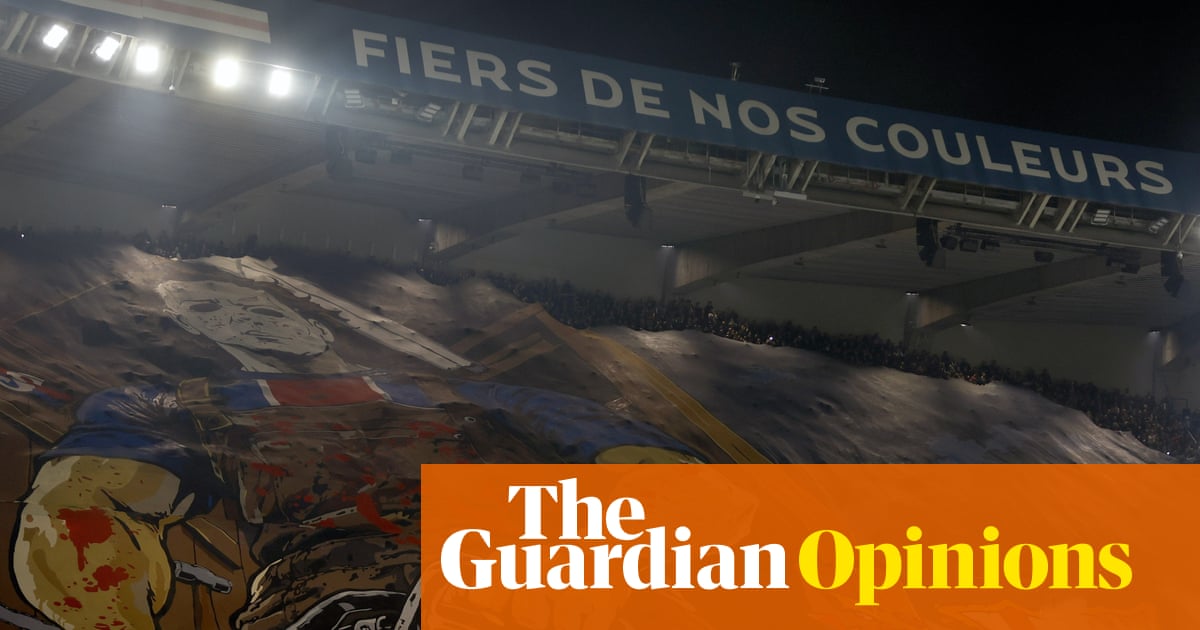

Paris Saint-Germain sparkle on the pitch while the city of light burns around them
PSG, pet project of the state of Qatar, expresses the dualism of the city, a place of deprivation where the centre is perfect
PASSION!
GOOOOAL!
MVP!
The security deployment will be massive.
Those who sought to bring down the Republic will have to answer for it.
Tell you who would have loved this? Who would have been utterly engrossed scrolling the hashtag #Paris on Tuesday night as two things happened simultaneously, the harrowing of the Barcelona defence at the Parc des Princes, and the harrowing of Paris itself via tales of city-centre thuggery and end-of-days political doomâÂÂmongering.
The big man, Guy Debord himself. The Society of the Spectacle, you say? Actually, I think weâÂÂre past that now. Hold the society bit. WeâÂÂll just take the spectacle.
The great Parisian Situationist philosopher wasnâÂÂt really one for managed fun. But it was impossible not to be bowled over by the extraordinary pre-match show for Paris SaintâÂÂGermain versus Barcelona, Champions League Matchday Three.
The wild pyrotechnics, the plumes of smoke, the full-wrap light show, the lime-green roboâÂÂtext spelling out every playerâÂÂs name on the pitch. Although not the Barcelona names, sadly, for anyone with an unrealised desire to see the words âÂÂANTHONY GORDONâ projected in vast letters for the delight of a shrieking crowd.
Admittedly, the HalloweenâÂÂthemed tifo banner showing a masked Paris Saint-Germain serial killer-type literally butchering the Barcelona badge to death with his bloodied chainsaw was perhaps a bit much. As were the Barça Puta signs, which are now reportedly the subject of a complaint to Uefa.
But it was a wild and allâÂÂconsuming spectacle, annihilating every other impulse in your head to a green thought in a green shade. And in the process capturing the profound sense of cognitive dissonance in the city.
Just walking around the streets of central Paris earlier in the day generated its own mild whiplash. On the face of it this was still the same city of flâneurs and tourists and everyday bistro business, and not, repeat not, a civil war drama or some kind of emergent military caliphate.
But the sense of dread was also tangible. You still got the occasional crunch of glass underfoot. Here and there charred bikes and scooters had been politely piled to one side. Even close to the Parc, away from the main hotspots, shopkeepers could be seen emerging warily into their doorways at the sound of a police siren.
By Tuesday night, a total of 2,513 people had been taken into police custody after the events of the weekend. At least 420 rental bikes had been destroyed or maimed. Liberated high-value retail goods were already being sold on Vinted, a commendable show of entrepreneurial energy from the maligned younger generation.

Not that youâÂÂd suspect these two worlds had any kind of overlap, lost in the booming triumphalism around PSGâÂÂs 4âÂÂ2 win, one of the most beautifully luminous football matches youâÂÂre ever likely to see. Or indeed reading the coverage of an event that seems to have been treated in France like its own clear, clean space, floating above the flames, all the chat about the brilliance of Monsieur Dynamite, Désiré Doué, the wonderful television audiences on Canal+ TV, the whole of European football âÂÂkneeling before the machineâ (are we sure this isnâÂÂt to do with anarchic rejection of social control?). âÂÂParis est insubmersible!â was the headline in Le Parisien. But is it?
Remember when football used to reflect the world? Or just provide clues, a commentary, some kind of metaphor? This is no longer the case. At a time when even the most thunderous of commentators is struggling to summarise all this in suitably trite and damning terms, it was hard to avoid the feeling Paris Saint-Germain, the pet power football project of the state of Qatar, expresses this dualism perfectly.
Sometimes you just have to let football tell you things. âÂÂPeople who want to cause trouble in the city centres next Saturday will be prevented,â Emmanuel Macron announced on Tuesday evening, speaking, as it happens, from Doha, where he met Sheikh Tamim bin Hamad al-Thani, ultimate owner of PSG.
Macron is said to be considering deploying the French military to keep the peace on the streets before the next planned protests, although even here he may have to ask QatarâÂÂs permission if he wants to deploy any of the French troops currently deployed working its missile systems, or embedded in the Doha security services.
The key event Macron is tooling up for is this Saturday night, 24 October, the date the gilets jaunes social media feed has set for an even greater swell of disorder. And again this will be football adjacent, with PSG playing Lyon at home on Sunday, a topâÂÂofâÂÂthe-table capitalâÂÂcity clash played out against whatever wreckage is left, however many thousands of Dot bikes are savaged, whatever guerrilla skirmishes are still playing out in the Marais.
What does this really have to do with football and the Ici CâÂÂest Paris brand appropriated by a state outreach project? Well, what are these demonstrations anyway? There have been many theories put forward as to what exactly is happening here, what is the spark, the kindling, the fire behind this disorder. School protests were the original line. Others have now roped in some kind of nebulous omni-cause, Instagram-activism, perhaps even a barbarian takeover, the decline of the west, savagery at the gates, of the type Donald Trump pretends to see.
Do you need a single reason? Take a look around. Modern life is pretty alarming on a minuteâÂÂtoâÂÂminute basis. Disaffection, alienation, a sense of being transformed in real time into a passive economic consumer unit, a set of eyeballs, an avatar of consumption. French youth unemployment is close to 20%. Robots nobody wants are being lined up to take jobs that donâÂÂt exist. Why donâÂÂt these young people want to join a youth club? Why donâÂÂt they sign up for the Liberal Democrats? Why are they enjoying empowered disorder? Maybe because nothing is yours around here, not even the things thrust into your brain as digital distractions. So why not grab something when you can? Debord would have called this âÂÂa vicious circle of isolationâÂÂ, lonely crowd, technologies based on isolation.
On the other hand, what is PSG in Paris, other than the perfect expression of this? It often seems to surprise people that celebrations of PSG victories end up with riots and burnt-out cars. But Paris is both a beautiful and deeply dysfunctional city, a place of makeâÂÂbelieve and deprivation, where the centre is a perfect, performative relic, the suburbs shunted out to the ring roads, a life lived inside a box, noses pressed up against the glass, peering through your binoculars at the city of someone elseâÂÂs love.

Paris is the divide between overclass and churn expressed in a single city. ItâÂÂs everything you might have had but never will. And PSG represent this like no other entity, a football club owned as an act of outreach by a staggeringly rich inherited monarchy, weaponised passion, borrowed culture, engineered spectacle, deeply cynical but also deeply seductive.
Why are the Qataris splurging hundreds of millions into this project? Because they just really like high-pressing positional football? Qatar is the indentured labour state that employs Colin Kaepernick to promote its outreach projects. It will hymn its connections to the footballers of the banlieue, which is true and real and valuable, but not because of anything this political project wants or needs other than public relations.
It is in its own way a perfect human lab experiment, synthesised beauty, collectivism, with a cold, cold hand at its heart. And this is why there werenâÂÂt two versions of Paris in evidence on Tuesday night, just the same one, the dark side and the shiny side, an engine of the same divisions, the same kind of violence, right down to the sight of kids in PSG training gear dodging the police or taunting the barricades at the Place de la République.
And now we have Sunday night to come, more Ici CâÂÂest Paris, more PASSION. What kind of background will it be played out against? Does it matter under the lights? Will anyone notice?
Le Monde has described these events as a very basic test of the republic, its ability to bend, to remain essentially itself, the stateâÂÂs willingness to pit itself against its own people. Football, as ever, holds these answers already. PSGâÂÂs Qatari owners have spent the past 15 years flaunting this city like a global luxury brand, extending its reach, creating its own ideal of conspicuous consumption, spectacle, triumph, son et lumière, bread and roses. As ever, if you want to know how and why, football has the answers.