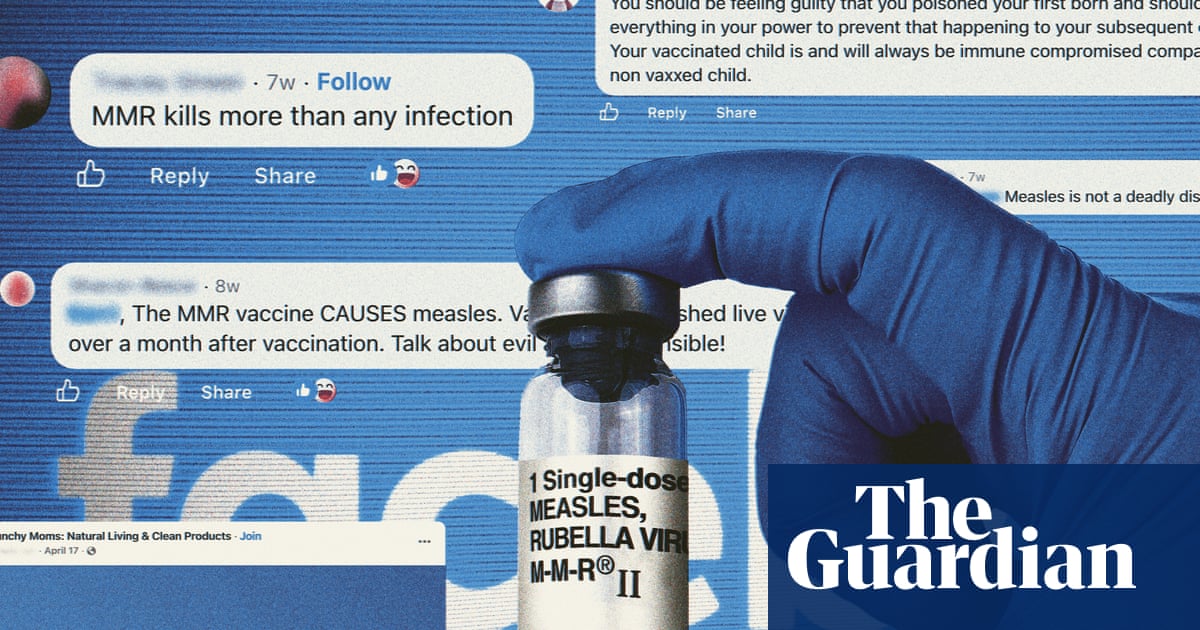

Measles, mumps and misinformation: how Crunchy Moms became âÂÂthe most dangerousâ group on Facebook
Meta says it removes content that could cause imminent physical harm â but nearly half a million members have joined a group that regularly promotes misinformation
As a measles outbreak spread through Lancaster county, Pennsylvania, in August, a parent turned to a massive public Facebook group, Crunchy Moms, for advice. They were considering getting their three-year-old vaccinated, in part to protect their six-month-old.
âÂÂIâÂÂm nervous for my baby,â the parent wrote.
âÂÂFirst of all your children cannot die of measles. It is literally impossible,â one member responded. âÂÂDo not do it,â advised another. Others said the vaccine would spread measles or that it would be like âÂÂinjecting poisonâÂÂ.
At the end of the post, FacebookâÂÂs AI system â run by its parent company Meta â summarized the 589 responses, writing in part that commenters âÂÂclaim the vaccine is unnecessary or even harmfulâÂÂ.
None of those claims are true. Pennsylvania has reported six measles-associated deaths this year, including two babies in Lancaster county. The measles, mumps and rubella (MMR) vaccine is safe and effective. Health officials say it is the best defense against measles spreading and injuring or killing people.
Scientists, doctors and advocates for health and childrenâÂÂs safety told the Guardian that what they see in Crunchy Moms and similar groups is alarming. They worry children could be getting hurt and that mothers are getting pulled into an online community that rejects science and fact-based medicine. One scientist who spends her free time monitoring the platform to highlight harmful health misinformation calls Crunchy Moms âÂÂthe most dangerous group on FacebookâÂÂ.
Meta did not comment on that characterization.
The spread of misinformation on Facebook has been a problem for years, but in the past, the company took steps to curb it. During the Covid-19 pandemic, for example, Facebook recognized it had a problem and changed its policies to âÂÂprioritize connecting people with accurate health informationâÂÂ.
But last year, shortly before the inauguration of Donald Trump, Mark Zuckerberg, FacebookâÂÂs billionaire founder, said there was âÂÂtoo much censorshipâ on MetaâÂÂs platforms.
Meta changed course; it eliminated factcheckers in the US and dialed down active moderation of anything but the most severe or illegal content. The company still maintains a policy that prohibits harmful health misinformation, but it is not known how Meta enforces it, and how its new permissive approach affects users at a time when measles and other infectious diseases are making a comeback.
In response to questions from the Guardian, Meta claimed nothing has changed in the policy or how it is enforced since 2023.
A Guardian investigation has found that dangerous medical misinformation is flowing freely on Facebook in groups like Crunchy Moms â now more than 490,000 members strong. WhatâÂÂs more, the company appears to have helped spread such ideas by promoting Crunchy Moms into usersâ feeds, even when they do not seek it out.
Zuckerberg previously suggested that waiting for users to report âÂÂbad stuffâ â rather than having automated systems catch them â would strike a better balance between what he termed censorship and free expression. But the Guardian found that following ZuckerbergâÂÂs suggested approach appears to have little to no discernible effect on false information that circulates on Crunchy Moms.
Facebook took no action on more than 50 posts and comments a Guardian journalist reported to the platform from her own Facebook account. The posts appeared to violate MetaâÂÂs own standards, including that vaccines caused autism, that measles is not deadly, or that âÂÂmiracle curesâ like the caustic agent black salve that destroys skin tissue can treat cancer. Facebook did not acknowledge or respond to a single one of the GuardianâÂÂs reports, made in May, July and September.

In a response, Meta said its misinformation policies allow people to discuss personal experiences and scientific research. It said it removes misinformation when it is likely to directly contribute to the risk of imminent physical harm. But Meta did not respond to detailed questions about Crunchy Moms or expertsâ assessment that such misinformation is commonplace in the group.
MetaâÂÂs revenue last year exceeded $200bn.
Doctors, researchers, former employees and public health advocates said the GuardianâÂÂs findings show that the pendulum at Meta has swung back to a time when there was little moderation of false health information.
âÂÂWe were documenting Facebook recommending anti-vaccine groups to parents almost a decade ago,â said Renée DiResta, a professor at Georgetown University who studies online manipulation.
She and others have shown how that approach harmed children. Back then, there were stories of children being hurt or dying after their parents turned to Facebook groups for health advice.
âÂÂIâÂÂm afraid that weâÂÂre going to see that same kind of dynamic all over again.âÂÂ
A Facebook recommendation sparks a Guardian investigation
A Guardian journalist was scrolling on her phone in March when something caught her eye. Her Facebook feed recommended she join a group called Crunchy Moms: Natural Living & Clean Products.
The group was created in March 2025, less than three months after Zuckerberg announced MetaâÂÂs new hands-off approach.
Crunchy Momsâ administrators describe it as âÂÂa supportive space for moms who want to raise their families using toxin-free products, low-tox alternatives, and clean ingredient solutions.â But a quick check of the group revealed, and experts confirmed, it was a hotbed of false medical information that could hurt people â especially children and their mothers, who turn to the group for community, advice and affirmation.
The group focuses largely on health, though some posters also come to seek parenting tips, product recommendations and other non-medical questions. Many posters appear to take it as a given that group members are â or should be â against vaccinating their children. They frequently describe vaccines and their ingredients as deadly, toxic or poisonous.

âÂÂWe donâÂÂt vaccinate in this group. ItâÂÂs the foundation of becoming a crunchy mom,â one anonymous member explained last month, in response to a question about the vaccine for RSV, a respiratory virus. A group administrator responded to a different post that âÂÂAs a crunchy community we are generally against v@csâ â a code for vaccines.
Crunchy Moms has more than doubled in size since January, and receives hundreds of posts a day, and thousands of comments and replies. replies.
Sara Rupe launched the group in March 2025. It was less than three months after Zuckerberg announced MetaâÂÂs new hands-off approach. The Connecticut mom said in an interview that her intention in creating the group was to share product recommendations for things like personal care products and makeup, but it turned into something bigger.
At least part of Crunchy Momsâ success, she said, was because it does not block âÂÂfree speechâÂÂ.
âÂÂEverybody has a right to say what they want to say as long as itâÂÂs within community standards of Facebook,â Rupe said. âÂÂI donâÂÂt censor things.âÂÂ
Rupe added: âÂÂIf somebody wants to say something, then I usually let them. But I mean, within reason, if I really think itâÂÂs going to hurt somebody, I donâÂÂt. But I also think letting some information get out there could be good.âÂÂ
Crunchy Moms is the largest group in a network of groups that collectively has over 1 million members. Rupe runs them with the help of several administrators and moderators, including her husband, who is a registered nurse, a pastor and wife couple in upstate New York, and a woman whose Meta-verified account describes her as a doctor of holistic health.
They post often with links to supplements and other products for sale on an Amazon store, with links to another administratorâÂÂs skincare line, or with affiliate links to products that provide a cut of sales to the person sharing it.
Rupe said she and another administrator use multiple accounts to run the group, which lets them maintain access to it if Facebook restricts her account. Her daughter was in seventh grade last year when Rupe used her account to post a listing of over three dozen products, including herbal remedy bundles that run over $100, non-fluoride toothpaste, $25 tallow balm and red light therapy panels that cost $200 or more.
A second administrator, Dawn Mannion, said she doesnâÂÂt make any money from the group, though others make a small commission thatâÂÂs âÂÂnot even minimum wageâÂÂ. She said she frequently recommends that members seek medical attention from holistic or other qualified healthcare professionals. She added: âÂÂWe do not discourage people from seeking medical care. We encourage it.âÂÂ
Other administrators and moderators contacted by the Guardian did not respond to Facebook messages and texts seeking comment.
Many Crunchy Moms members were already into âÂÂnatural livingâ and questioning vaccines when they come to the group, and group leaders donâÂÂt try to sway anyoneâÂÂs mind, Rupe said.
Rupe has a child with autism that she now believes is connected to vaccination, and said many others in the group believe their children were injured by vaccines.
âÂÂWe donâÂÂt want anybody to be hurt at all,â she said. âÂÂWe want everybody to be as happy and healthy as possible.âÂÂ
While Crunchy Mom posters often vehemently counsel against vaccines and modern medicine, Rupe said she does not think the group is harming anyone. Instead, she said it is helping people make their own decisions.

Some members say vaccines are so dangerous that it is safer to get a deadly or life-altering vaccine-preventable disease than it is to get immunized. They tell other members that catching a disease like measles or chicken pox âÂÂnaturallyâ can be more healthy than getting vaccinated. Others repeat US Health and Human Services secretary Robert F Kennedy JrâÂÂs unproven claims that Tylenol is linked to autism. One recent comment said that catching measles makes your body stronger, trains your immune system and results in a lower risk of cardiovascular disease and cancer.
Many posts spread the false assertion that vaccines cause autism and sudden infant death syndrome (Sids) â even though Meta specifies in its own policies that posts saying so violate its terms.
New or soon-to-be mothers looking for help and advice are frequent posters, and targets for swarms of comments telling them not to follow science-backed health recommendations for their children, like giving their newborns a Vitamin K shot that can prevent brain bleeds.
One woman asked about a link between vaccination and Sids, suggesting she feared she was putting her baby at risk of death if she followed the recommended vaccine schedule. She said she was considering spacing out her infantâÂÂs vaccines to lessen the risk. She ended her post: âÂÂIâÂÂm terrified.âÂÂ
âÂÂDelaying poison wonâÂÂt do anything beneficial. Injecting poison WILL increase the likelihood of SIDS,â one woman replied. Another, labeled an âÂÂAll-Star contributorâ by Facebook, weighed in: âÂÂSIDS is vaccine death. SIDS was invented to cover up the fact that vaccines kill infants.âÂÂ

Scroll through a post asking whether vaccines cause autism, readers will find comment after comment saying that they do. In one post, a frequent commenter offered a false statistic that 79% of autism is caused by vaccines. She replied to a person who said they were neurodiverse: âÂÂYour parents caused this with their vaccines. I am sorry.âÂÂ
The same commenter later counseled the Lancaster county parent who was worried about their communityâÂÂs measles outbreak that âÂÂIt is not worth risking death or a disabling lifelong neurodegenerative condition, such as autism, for a vaccine that is ineffective, at best, at preventing measles.âÂÂ
The group includes a mix of views. Some commenters will offer encouragement to seek medical care and to vaccinate their children. The Guardian spoke to people who became members of Crunchy Moms to try to provide a counterweight to the false information shared there.
Mannion said they do not endorse every statement made by individual members.
One of the Crunchy Mom rules that is supposed to govern the group is that the information shared is not medical advice, and that members should consult a healthcare provider before making any health or medical decisions. But in the many posts from parents asking for advice or sharing what their doctors told them, commenters often urge them not to follow what the doctor suggests, or say there is no need to speak to a doctor at all.
Rupe said she believes many of the comments are from âÂÂtrollsâ trying to get the group in trouble, and that people are simply posting their opinions.
Dr Alok Patel, a pediatrician who reviewed the group at the GuardianâÂÂs request, pointed to those kinds of comments as particularly concerning. It is a time-honored tradition for mothers to turn to fellow mothers for advice, and Patel believes it is important for people to use social media to find connection.
âÂÂBut when people are outright dismissing modern medicine and putting their foot down and saying donâÂÂt get vaccines, donâÂÂt get the vitamin K shot, donâÂÂt see a doctor, and instead promoting a product, that is outright misinformation and potentially dangerous,â he said.
Patel has built up his own following on MetaâÂÂs Instagram platform to deliver science-based medical information to people. Social media companies, he said, should show it is more important to provide quality information than it is to keep people on their apps.
âÂÂProve to us that you are prioritizing public health as much as you prioritize profits for your investors,â Patel said.

Research has shown that health misinformation shared on Facebook can have a real-world impact on peopleâÂÂs decisions.
Jennifer Allen, a professor at NYU Stern who worked at Facebook from 2016 to 2018, has researched the effect of misinformation and vaccine-skeptical content on Facebook. She and her colleagues have estimated that exposure to vaccine skeptical content on the platform during the Covid-19 pandemic reduced peopleâÂÂs intention to get vaccinated. Without that exposure, they estimated 5 million more Americans would have been vaccinated, saving approximately 21,000 lives.
While people should be able to express themselves, Allen said, there is evidence that the kinds of expression she saw in Crunchy Moms can be dangerous.
âÂÂThe fact that this group seems to exist and is being recommended to people, and there is so much clear misinformation in it, it seems to me that that means that thereâÂÂs a failure along the way of Facebook,â Allen said.
During the pandemic, she said Facebook got pretty good at identifying and taking down egregiously false information and also not recommending it to people. She said she was surprised to now see such explicit misinformation being shared in a public group, and Facebook recommending it to users.
One scientist who spends her free time trawling Facebook to highlight the harmful information she sees there spoke to the Guardian on condition of anonymity because she has received harassment and threats. She said Crunchy Moms stands out among the worst, but is far from the only group where these problems are happening.
âÂÂMeta, and specifically Facebook, is allowing for these things to continue,â she said. She cited posts she has seen that counsel mothers not to get the Vitamin K shot for their newborns and others that sell unregulated supplements. She said she believes it is more dangerous than any other groups she monitors.
âÂÂEverybody should have the freedom to talk about what they want to talk about,â Rupe said when given the opportunity to respond to that criticism.
Given the volume of the posts, Rupe said she and other administrators canâÂÂt vet every single post.
âÂÂIâÂÂm assuming that if Meta sees that it doesnâÂÂt agree that it will just take it down. So I donâÂÂt really worry about that part,â she said.
MetaâÂÂs rules and how they are enforced
In 2019, Facebook announced it would stop recommending groups that spread misinformation about vaccinations, saying it was âÂÂfully committed to the safety of our communityâÂÂ. DiResta said the company responded to public pressure as it became clear anti-vaccine activists were using Facebook to undermine public health in places like Samoa, where a 2019 measles outbreak killed 83 people, mostly children under age five. FacebookâÂÂs regional policy director said at the time that its teams were âÂÂproactively scanning for any health-related misinformation and are taking action to prevent its spread on our platformsâÂÂ.
Later that year, Zuckerberg was pressed on the issue by a Republican congressman who complained Facebook was censoring usersâ speech about vaccine risks and injuries. Zuckerberg, whose wife Priscilla Chan is a pediatrician and who donated $75m to a major San Francisco hospital which now bears their name, acknowledged the concern. But he said âÂÂwe also hear consistently from our community that people want us to stop the spread of misinformationâ and that he understood âÂÂscientific consensus is that it is important that people get their vaccinesâÂÂ. While users would be allowed to post anti-vaccine content or join such groups, Zuckerberg said Facebook would not âÂÂrecommend or go out of our way to show people content that would encourage people to join those groupsâÂÂ.

After Covid hit in 2020, Facebook stopped recommending health groups altogether, explaining that âÂÂitâÂÂs crucial that people get their health information from authoritative sources.âÂÂ
Anti-vaccine activists complained of censorship and joined with Republican politicians and others who took issue with FacebookâÂÂs response to false information about elections and other civic matters. Then Trump was elected to a second term. His pick to lead the nationâÂÂs health department was Kennedy, a longtime leader in the anti-vaccine movement who has accused Facebook of censoring him and the group he used to run, and sued over it. The case was dismissed.
Shortly before Trump was sworn into office, Zuckerberg and Meta announced the end to third-party factchecking in the US as well as rollbacks to moderation. A few weeks later, Zuckerberg and tech CEOs attended TrumpâÂÂs inauguration.
Still, Meta retained a misinformation policy.
The current policy says it removes what it calls harmful health misinformation that is âÂÂlikely to directly contribute to imminent harm to public health and safetyâÂÂ. It lists several specific examples of what it does not allow â much of it about vaccines. Among those are claims that vaccines cause autism or Sids; that vaccine ingredients are deadly, toxic, poisonous, harmful or dangerous; that vaccines are not effective; and that measles is not deadly. MetaâÂÂs policy also says it bars promoting or advocating for harmful miracle cures, including black salve which is peddled online as a skin cancer treatment without evidence that it works, and it has disfigured people or left their cancer to grow.
Though Facebook issued a report on how it has enforced its community standards this year, it did not discuss how or whether it has enforced its standards that govern misinformation on health.
The Guardian spoke to several people who had reported Crunchy Moms posts to Facebook or who had tried to report posts outside the group that similarly contained dangerous health misinformation. They said they had little success.
âÂÂMy own personal post reports have universally been ignored by Facebook,â said Dr Frank Han, a pediatric cardiologist in Connecticut.
âÂÂWhile Facebook claims that they moderate, the practical effect is that medical misinformation propagates much faster than medically correct information,â Han said.
Another Crunchy Moms member, Emily Loving-Rodriguez, said she had made dozens of reports to Facebook, and possibly hundreds, since she joined earlier this year. The Idaho resident has a personal interest in child welfare and misinformation, and noted a post she had seen recently in Crunchy Moms where someone said herpes could be cured with the dietary supplement zeolite. She said her reports rarely had any effect.
Kasey Kramps, another member, said she had made reports to Facebook in the past for medical misinformation but said she could no longer find a way to report it.
âÂÂTheir health misinformation rules are very explicit. TheyâÂÂre still up there,â said DiResta, who reviewed the group at the GuardianâÂÂs request. âÂÂThey have a policy and they actively choose â at this point â it does not seem that they are enforcing it.âÂÂ
Reporting misinformation goes nowhere
To test how Facebook enforces its harmful medical misinformation policy, the Guardian reported 55 Crunchy Mom posts, comments and replies and one video reel to Facebook that appeared to violate the policy.
It is the approach that Zuckerberg endorsed when he announced MetaâÂÂs changes in January 2025.
âÂÂWe used to have filters that scanned for any policy violation,â Zuckerberg said then. âÂÂNow weâÂÂre going to focus those filters on tackling illegal and high severity violations. And for lower severity violations, weâÂÂre going to rely on someone reporting an issue before we take action.âÂÂ
The GuardianâÂÂs reports spanned a range of content. One post stated in part that scientific research shows âÂÂvaccines cause autismâÂÂ. A comment said: âÂÂThe MMR vaccine CAUSES measles.â Another: âÂÂVaccines are extremely toxic and unnecessary as well as NOT safe or effective. They all poison.âÂÂ

In a video shared in the group that downplayed the dangers of tetanus and urged against vaccines, a caption included the line âÂÂHigh-dose vitamin C led to 100% survival in tetanus-infected children and reduced death rates in adults.â MetaâÂÂs policy prohibits saying Vitamin C is as effective as a vaccine.
On a post asking: âÂÂWhat are we using to get rid of skin cancer?â the Guardian reported several replies suggesting black salve. It also reported a post asking for a brand of black salve to use on a âÂÂquestionable mole/markâÂÂ, as well as the reply from a group administrator providing an affiliate link to purchase a black salve product, as well as to another administratorâÂÂs Amazon store.
The Guardian also reported the entire Crunchy Moms group on 1 October, given that similar content is commonplace within it.
There is no way to report content specifically as harmful health misinformation. Instead, the user making a report must first select a broad category: âÂÂscam, fraud or false informationâÂÂ. Then, content can be reported under the heading âÂÂSharing false informationâÂÂ.
The Guardian did not receive a single confirmation from Facebook to any of its reports, even though the company says it alerts users to the outcomes of their reports. Loving-Rodriguez said when she reports comments for hate or Nazi content in other Facebook communities, she gets a message from Facebook confirming her report. But not when she flags content that seems to violate FacebookâÂÂs rules in Crunchy Moms.
Nearly all of the content the Guardian reported to Facebook was still up when Meta was approached for comment.
While the repeated reports of policy violations by the Guardian didnâÂÂt receive any responses, Facebook invited the journalist to join the platformâÂÂs community notes program. The program replaced third-party factcheckers in the United States after the 2025 rollbacks. Meta has said it was already testing the program in several countries and plans to roll it out and eliminate factcheckers once it was confident it was working well.
The Guardian this week provided Meta with examples of content found on the group. Meta said it was reviewing those links and would take action on posts that violate its policies.
âÂÂI did not seek it outâÂÂ
Recommendations have become an important source of content on Facebook, now representing 36% to 39% of what users see in their news feed, according to the companyâÂÂs most recent reports. That content comes from sources they are not connected to but which Facebook determines might interest them. By contrast, content from friends makes up only about 20% of usersâ feeds.
Facebook says it makes such personalized recommendations to help people âÂÂdiscover new communities and contentâÂÂ.
When Facebook chooses to promote a group, DiResta claimed, it is using its editorial discretion, exercising its speech and making a value judgment. In the past, she said, Facebook had acknowledged that recommendations create a different level of responsibility from simply allowing people to speak.
The Guardian found several people who encountered Crunchy Moms in their feed as a result of FacebookâÂÂs curation choices.
âÂÂIt came across my feed, and I engaged,â said Kramps, who joined the group about six months ago. âÂÂI did not seek it out.âÂÂ
âÂÂIt was offered to me organically in my feed,â said Dr Casey Husser, an anesthesiologist in Sioux Falls, South Dakota. âÂÂI didnâÂÂt look for Crunchy Moms.âÂÂ
A Minneapolis mother of two children, ages two and five, told the Guardian Crunchy Moms showed up in her feed for months, even though she was not part of the group and did not seek it out.
Meta told the Guardian its approach to misinformation is to create an environment that reduces its distribution. It did not address specific questions about why it was recommending Crunchy Moms to usersâ feeds.
Facebook also has taken the step of adding titles or comment summaries to some posts. Generated by MetaâÂÂs AI tool, they are meant to âÂÂhelp people catch upâ on conversations on the platform. The comment summaries it offered on some posts conflicted with good science, critics said.
For example, MetaâÂÂs AI entitled one post: âÂÂWhat vaccines are recommended or skipped during pregnancy and infancy?â It summarized the comments by stating: âÂÂHepatitis B and flu vaccines are commonly suggested to skip, while some recommend delaying or picking and choosing vaccines.âÂÂ
That conflicts with recommendations from doctorsâ groups in the US, which recommend universal hepatitis B vaccination for all infants at birth, as well as flu vaccine for children six months and older and for pregnant women during influenza season.

On the Lancaster measles post, which asked for ways to âÂÂdetoxâ from the MMR vaccine, MetaâÂÂs AI summarized the discussion as: âÂÂNo detox needed, some commenters cite vitamin A deficiency as a measles risk factor, while others claim the vaccine is unnecessary or even harmful.âÂÂ
MetaâÂÂs AI system could be adding context to that post to clarify that a vaccine detox is not a scientifically valid idea, DiResta said.
âÂÂItâÂÂs very easy for an AI to do that,â she said, pointing out that Meta uses AI for some notes on Threads. âÂÂBut it seems, again, that theyâÂÂre choosing not to do that.âÂÂ
Meta told the Guardian on Wednesday evening it had gotten rid of AI summaries of discussions in September. But the Guardian took screen shots of more than 10 such summaries in October, some going back as far as December 2025.
Meta did not respond to specific questions on the issues the Guardian raised about the substance of the AI-generated content.
Husser said he makes it a habit to pay attention to bad medical information circulating online so he wonâÂÂt be surprised at work if patients ask him about it.
âÂÂ[Facebook is] way more permissive,â Husser said. âÂÂSince 2025, itâÂÂs become a totally different environment.âÂÂ
Crunchy Momsâ administrator Rupe said she has noticed a change as well. In the past, she remembers getting Facebook strikes or removals for mentioning the word vaccines.
âÂÂIt seems like weâÂÂre not getting in trouble for a lot of things like we used to,â Rupe said.
In the past, she recalls that Facebook would flag posts it deemed as containing misinformation before they were approved, and said she usually would not approve them if she saw such a message. But she doesnâÂÂt remember getting any this year. Rupe said Facebook only takes down about one post per month from Crunchy Moms.
MetaâÂÂs AI will alert her when someone uses a swear word, or a variation of one, in the group. But Rupe said it doesnâÂÂt give her any alerts about what some might call medical misinformation.
DiResta said the fact that Facebook is recommending this group to people is significant.
âÂÂMeta is pushing this thing unsolicited into the feeds of particularly new parentsâ who naturally have concerns and fears about their childrensâ health, DiResta said. âÂÂThey want to feel that theyâÂÂre doing the best for their kids.âÂÂ