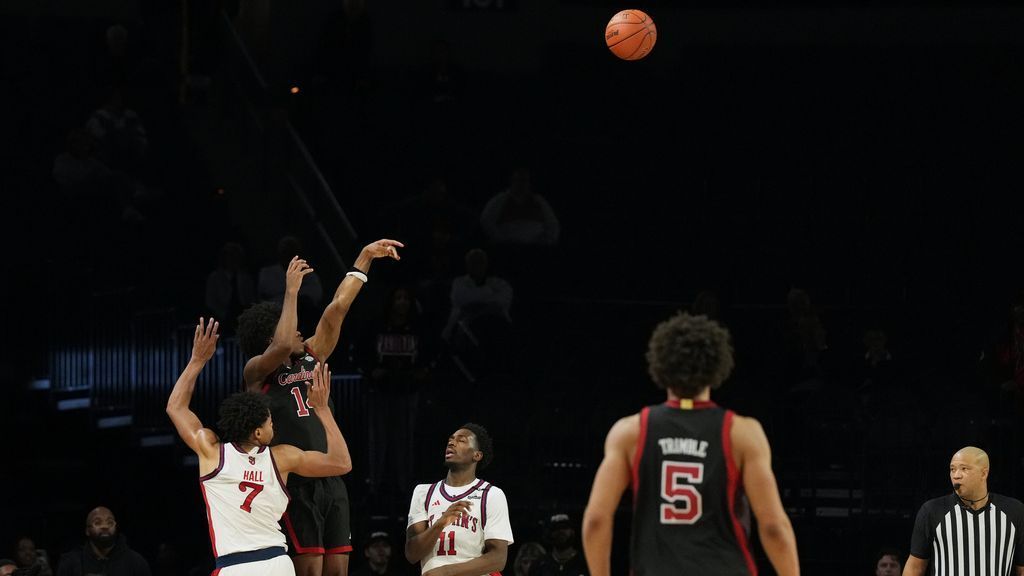
LAS VEGAS -- Louisville staved off a furious rally from St. John's after an excessive timeout rule that left both coaches confused helped set up Adrian Wooley's buzzer-beating 3 for a 93-90 win on Thursday night.
With 13.7 seconds to play and Louisville clinging to a 90-88 lead after St. John's had erased a 24-point deficit, Cardinals guard Jackson Shelstad was trapped and fighting to hold onto the ball when an official ruled that he'd called timeout even though his team didn't have any remaining.
While both Louisville coach Pat Kelsey and Shelstad argued he had not called timeout, a review confirmed the administrative technical foul call against Louisville and St. John's was awarded two free throws and made both to tie the game at 90 apiece.
But Louisville then retained possession, clearing the way for Wooley's game-winning 3-pointer.
"[The official] said it was a flagrant something and they get the basketball," said St. John's coach Rick Pitino, who faced Louisville for the first time since he was dismissed by the school in 2017 after a recruiting scandal. "I'm not the referee, so I can't tell you. That's what he told me."
Kelsey said he also didn't know about the rule that led to the game-winning play, either.
"No. I thought they got the ball too. I'm just being honest," Kelsey said after the game. "I thought they had two free throws and then they got the ball. Then when they said it's our ball, I'm like, 'Word?'"
The current NCAA men's basketball rulebook says that the penalty for an "excessive" timeout is an administrative technical foul. After the administrative technical foul call is made, however, "the ball shall be put back in play at the point of interruption," which is why Louisville retained possession, setting up Wooley's game-winner.
The excessive timeout rule was made famous in 1993, when Chris Webber called a timeout for Michigan in the championship game when his team did not have any left. Michigan was given a technical foul and North Carolina was awarded two free throws and possession of the ball. However, that rule changed in 2000 when the NCAA split technical fouls into separate categories.
Kelsey said he didn't want to comment on the official's ruling but noted that Shelstad told him he did not call a timeout.
"The official told me that [Shelstad] said timeout. You asked me what I was told. I was told that [Shelstad] said timeout," Kelsey said. "I haven't seen the video. I haven't watched it yet. I haven't seen anything like that because [the official] asked me, he goes, 'Did you see his mouth?' And I said, 'No, I'm way over here, but I know [Shelstad].'
"[Shelstad] looked at me and all of a sudden he had tears in his eyes."
That moment set up a thrilling finish that could have gone against Louisville, which led by 17 points with 5:02 to play in the game before St. John's launched a 20-3 run in the final minutes. Pitino said he was proud of his team's fight down the stretch, even though its comeback attempt fell short.
Louisville was led once again by Seth Trimble, who has scored 57 points combined in two matchups in Las Vegas this week.
"We got dominated by a great guard. Things didn't go right for us in the first half, but when we were down to 12, I said, 'We're going to win this game,'" said Pitino. "And I couldn't be more proud of our basketball team in the way they fought back and did a lot of great things with incredible hustle, incredible desire to win, so I'm real proud of them."
Kelsey, whose team will advance to the Players Era 16 bracket championship matchup against Tennessee on Friday, said he doesn't fault the officials for the way the game ended.
"Officiating is tough. I would never ever do it. I wouldn't wish that on my worst enemy," Kelsey said. "That is a really, really difficult thing and it was a crazy situation. I don't know if a St. John's kid said timeout. I don't know, but [Shelstad] swore he didn't. The official said he did. That's the way it goes. Things aren't always perfect."