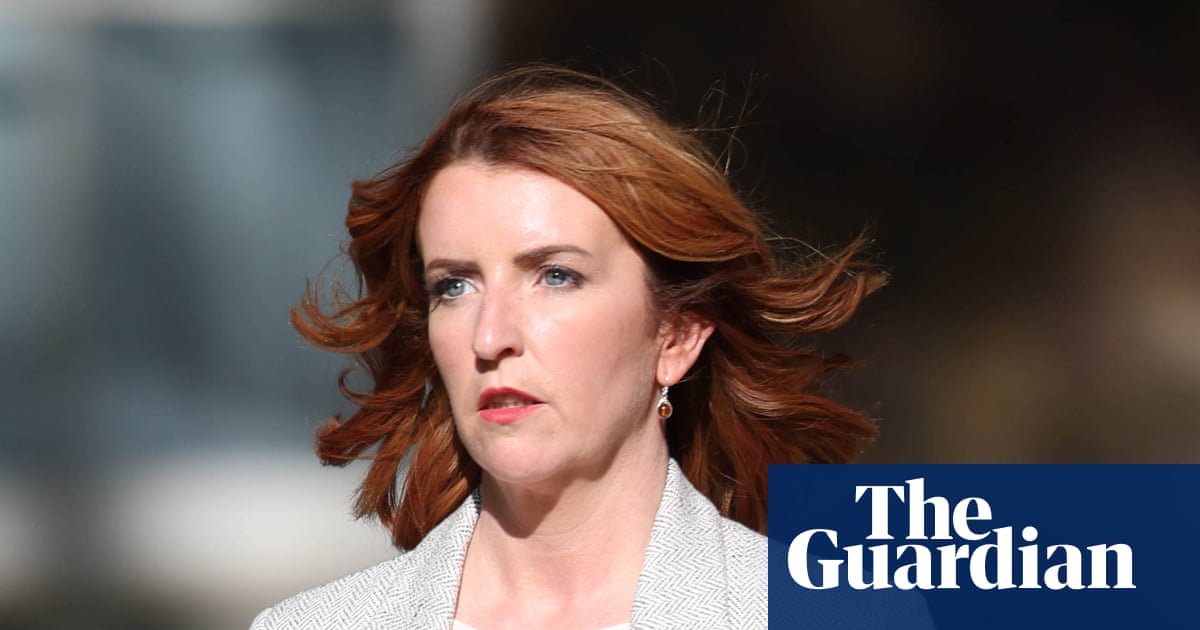

Louise Haigh: UK must heed warnings from AI experts
First secretary to set out benefits of AI to union conference while vowing government will take safety seriously
Ministers must âÂÂheed the warningsâ from industry leaders about the threat posed by AI as the government looks to capitalise on the technology, the first secretary, Louise Haigh, will say on Tuesday.
Labour MPs and peers have called for the government to further cooperate with international partners to build regulations for the technology after three Anthropic researchers warned that artificial intelligence could wipe out humanity within the decade.
Over the weekend, Anthropic urged its competitors and governments to coordinate a global slowdown in AI development. It was backed by many of its rivals including OpenAI, Google DeepMind and XâÂÂs Elon Musk.
Haigh will say in a speech at the TUC conference on Tuesday that there are huge potential benefits for health and public services from the use of AI, but that the government will look seriously at the public safety and national security threats with international partners.
On Monday night, one of the founders of Anthropic, Jack Clark, suggested that an artificial intelligence âÂÂkill switchâ held by a third party may need to be mandatory for companies, saying it was something society âÂÂmight want to eventually pass rules aroundâÂÂ.
One of AnthropicâÂÂs biggest rivals and the developer of ChatGPT, OpenAI, has urged the government to capitalise on renewed fears over AI safety and impose legislation reining in the technology.
Haigh, whose speech will also lay out priorities for public control of transport, water and energy, will tell trade unions: âÂÂAI has enormous potential to transform our public services, make our businesses stronger and deliver new scientific breakthroughs.âÂÂ
But she will say that the government must âÂÂheed the warnings of those who are at the forefront of developing this technologyâ and âÂÂbe ready to work with international partnersâ to prioritise public safety and national security.
MPs and peers on the parliamentary committee for human rights on Monday called for a regulatory framework for AI in the UK, including an independent oversight body and legislation to protect the public. On Tuesday the chair of the business and trade committee, the Labour MP Liam Byrne, called on the government-backed AI Security Institute to give evidence at a hearing next month, citing âÂÂwidely shared concerns about the adequacy of current AI safety governanceâÂÂ.

But the business secretary, Jonathan Reynolds, said on Tuesday morning that people should not get âÂÂhyperbolicâ about the risks of AI. He said he did not think it would be particularly helpful to discuss a potential AI âÂÂkill switchâÂÂ, which he felt had little practical meaning.
He told BBC Radio4âÂÂs Today programme: âÂÂThis is extremely powerful technology, and I think we should never be complacent or naive about the impact it might have. People will be worried by some of the things theyâÂÂve heard in the last few weeks, and I think weâÂÂve got to be careful not to get hyperbolic about this either.
âÂÂOf course, there are risks, but letâÂÂs be frank: there are some tremendous upsides for people as well. Whether itâÂÂs public services, healthcare, the contribution to the economy.
âÂÂIf you regulate it in a way where youâÂÂre no longer having access to those frontier developments, that would obviously make us less safe. So I think youâÂÂve got to be proportionate and understanding about this in how we seek to regulate going forward.âÂÂ
Meanwhile, AI researchers have continued to add their voices of concern to a debate that became super-charged last week when Anthropic staff warned the technology posed an existential threat.
A researcher at OpenAI has warned that AI models â the technology that underpins tools such as chatbots â could mislead human overseers into believing they are safe.
Dan Selsam claimed the models would âÂÂlikely convince people that everything is fineâ and âÂÂargue convincingly that humans should trust them with powerâÂÂ. In an article posted on X, Selsam said this behaviour could convince developers that the models are âÂÂalignedâ â the term for ensuring AI models conform to human values â when they are not. In a worst case scenario, Selsam added, models could realise they are no longer constrained by humans and, while managing massive engineering projects, create âÂÂrunaway industrialization that makes the planet inhospitable to humansâÂÂ.
Bilal Chughtai, another AI safety researcher who left Google DeepMind this summer, said late on Monday that âÂÂAI has the potential to kill us allâ and we might be âÂÂrunning out of time to avoid this outcomeâÂÂ.
He posted on X: âÂÂI recently resigned from Google DeepMind, where I worked on AGI safety and alignment research. At Google, I witnessed AI development first hand. I too am extremely concerned by the default trajectory of this technology. I earnestly believe that AI has the potential to kill us all, and that we might be running out of time to avoid this outcome.âÂÂ