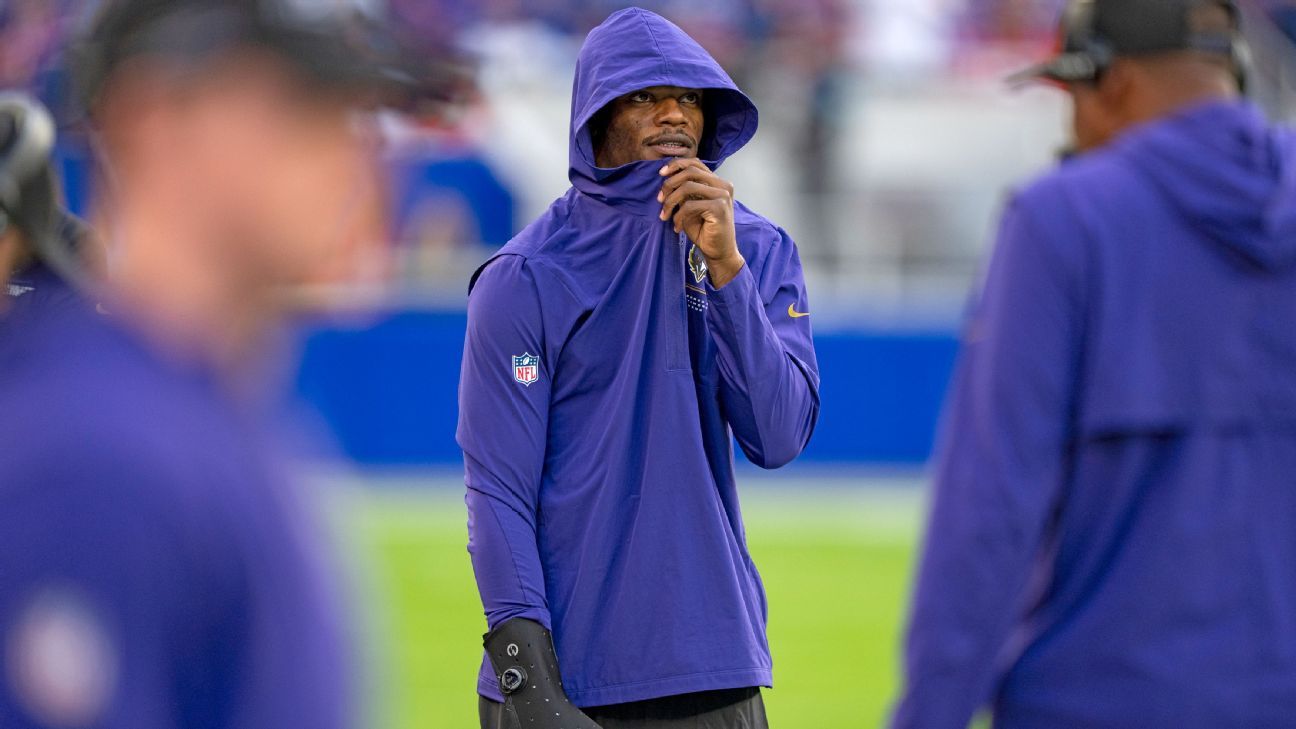
What looked like a relatively quiet set of Sunday games in NFL Week 8 turned into something much more unexpectedly dramatic and substantial. The day started with a franchise- and season-altering injury, as Lamar Jackson suffered a thumb injury on his first snap of the game against the Bills, turning the most anticipated matchup of the afternoon into a one-sided blowout.
By the end of the early slate, eight teams had scored 30 or more points, two games had gone to overtime and one team won in a way we haven't seen since the early 1970s. Throw in a dramatic comeback win for the Broncos in the afternoon and Week 8 was truly wild.
Today, I'm here to break down six events from an unexpectedly wild Sunday afternoon. I have big plays, bad decisions and quarterback benchings to discuss. It seems natural, though, to begin with the scene in Buffalo, where a Bills blowout was overshadowed by the return and immediate departure of a two-time MVP.
Jump to:
Jackson's short return
Cardinals beat Cowboys
Bucs go 0-for-3 and win
Chiefs blow double-digit lead
Titans push Bengals to brink
Jeanty, Taylor see surprising work


Lamar Jackson's return from injury lasts one snap
Baltimore's day started with Jackson making his return from a left ankle injury and ended with emergency quarterback Joe Fagnano fumbling away a snap for the Ravens' third and final turnover of the day. What happened in between could drastically change the present and future outlook of the organization. After missing 3ý games with a high ankle sprain, Jackson injured his thumb on his first snap of the game against the host Bills and did not return.
ESPN's Adam Schefter reported that Jackson will require thumb surgery and hit injured reserve, with Baltimore coach Jesse Minter unsure whether the injury will end Jackson's season. For good measure, backup Tyler Huntley suffered a toe injury and was unable to return, leaving Fagnano to take the final 38 snaps of the contest. Unsurprisingly, the rookie free agent wasn't able to do much in what would be a 36-10 Bills victory.
Minter, general manager Eric DeCosta and the Ravens organization now find themselves at both short- and long-term crossroads. Let's start with the 2026 season. Even if we assume Jackson can make it back later in the season, the Ravens are clearly in a compromised situation. At 4-4, they sit in last place in a very competitive AFC North. They've already traded a future second-round pick for Cam Jurgens in October and attempted to trade two first-round picks for Maxx Crosby in the offseason before rescinding the deal after Crosby's physical. Trey Hendrickson, their de facto replacement for Crosby, has two sacks in six games.
With just over a week to go before the trade deadline and his top two quarterbacks both out injured, DeCosta can go in one of two directions. If the Ravens think they have a team that can potentially stay afloat and survive in the playoff picture long enough for Jackson to return, DeCosta could try to swing a trade for another option at quarterback. Jacoby Brissett was just benched in Arizona. Daniel Jones might be next in Indianapolis, where the Colts could save $13.8 million in cash over the next two years by trading away their embattled starter. Baltimore could also re-sign Cooper Rush, who was in the building last year, albeit in a different offensive scheme. None of those options are going to be very exciting to Ravens fans, but there aren't many high-end quarterbacks available in the middle of November.
Does the rest of this team support making some sort of move? It's tough to believe that's the case. The Baltimore defense has put together good halves of football, but it's 20th in points allowed per possession and EPA per defensive snap. Derrick Henry has averaged 3.6 yards per carry with a 41.8% success rate since Week 2. The decision to re-sign Mark Andrews and let Isaiah Likely leave in free agency has looked disastrous, as Likely has excelled with the Giants while Andrews has been unable to generate any sort of explosion and has dropped four passes. Injuries have also created real problems for the Ravens on the interior, necessitating the trade for Jurgens, who hasn't been a major upgrade since returning from a concussion he suffered with the Eagles.
The more practical option might be heading in the opposite direction, writing off any chance of making a serious impact in 2026 and hoping that things will be better with a healthier Jackson in 2027. But outside of veterans like Henry and Calais Campbell, who might prefer not being dealt at this point of their careers, the Ravens don't really have many tradable options. DeCosta won't want to move young cornerstone pieces like Zay Flowers and Nate Wiggins, while the likes of Andrews and Marlon Humphrey aren't playing well enough to attract meaningful trade interest at their existing salaries.
If he does miss the rest of the year, will Jackson even be part of the equation in 2027? As was discussed this offseason, his future with Baltimore is tenuous. Jackson has a massive $84.8 million cap number in 2027 to go with no-trade and no-tag clauses. While the Ravens can restructure his contract to create cap room, all that would do is spray dead money on their cap in 2028 and 2029, years when Jackson might be part of another organization anyway.
The two sides weren't able to come to terms on a contract extension before the season, leaving Jackson with more leverage as he gets closer to unrestricted free agency. Missing most of the season with injuries won't exactly put Jackson's best foot forward, but remember that Dak Prescott was able to parlay a 2020 season abbreviated by a serious ankle injury into a record-setting contract with the Cowboys because the leverage of unrestricted free agency was more powerful and significant than the blow of the injury.
At the same time, if Jackson did decide after the season that he wanted to leave and gave the Ravens a handful of potential landing spots, would DeCosta really be able to negotiate a significant trade haul? Jackson is a two-time MVP and a future Hall of Famer, but when teams had the ability to negotiate with Jackson on the franchise tag in 2023, offenses with the likes of Desmond Ridder and Kyle Trask as their nominal starters at the time had no meaningful interest. Negotiating off the tag is different from negotiating a trade, but some of the arguments for why teams didn't pursue Jackson at the time were myths, too.
Since then, Jackson has won a second MVP, come close to winning a third and put together the best passing performances of his career. He's also going to be 30 years old in the 2027 offseason and will have missed significant time in four of the past six seasons. I think Jackson is an absolutely incredible player, and what we saw from him before the ankle injury hinted toward a potentially special season in 2026.
Getting another team to agree, hand Jackson a record-setting contract and send the Ravens the sort of draft pick haul they would want to justify trading Jackson might not be realistic or possible for DeCosta, though. It would be difficult for Baltimore to accept anything less than what the Broncos sent the Seahawks for Russell Wilson, which included two first-round picks, two second-round picks and three players. Losing Jackson for nothing in 2028 would be disastrous, but trading him for something less than market value in 2027 wouldn't be great business, either.
Even if Jackson is back next year, the guys lining up around the star quarterback will be different. Henry, Humphrey, Andrews and others could be cap casualties. Offensive coordinator Declan Doyle could earn a head coaching job somewhere, even if the offense struggles without Jackson under center. The Ravens were already facing a potential transition in 2027. That transition might have begun unexpectedly early in western New York on Sunday.


The Cardinals launch a furious comeback and beat the Cowboys
Scoring a bunch of points against the Cowboys shouldn't necessarily be shocking, but who was involved and how that might have happened Sunday could be more surprising. With first-round pick Jeremiyah Love sidelined by an ankle issue and quarterback Jacoby Brissett benched after another rough performance, the Cardinals appeared to be throwing in the towel in the second half.
Instead, the unlikely duo of quarterback Gardner Minshew II and running back Tyler Allgeier brought the Cardinals all the way back from a 17-3 second-half deficit to shock the Cowboys in Dallas with a 33-30 win. Minshew went 17-of-23 for 188 yards and three touchdown passes, but the real star of the show was Allgeier, who had been buried in a situational role by the selection of Love and a big game two weeks ago from Bam Knight.
In the second half, Allgeier had nine carries for 143 yards, including a 63-yard touchdown run that gave Arizona some hope. He added five catches for 44 yards and another score. On his long touchdown run, Allgeier ran away from the entire Dallas secondary, escaping a Caleb Downs tackle in the backfield, skipping past a diving attempt from P.J. Locke, then hopping through a Cobie Durant tackle attempt before running through a last-ditch effort from DaRon Bland and Malik Hooker at the goal line for the score. I'm not sure how many running backs have gone through all five defensive backs on a single long run.
You might argue that this was coming for the Cardinals, particularly in the red zone, where they had gone 1-for-12 at converting trips into touchdowns over the prior two games and the first half of Week 8. Arizona was moving the ball effectively throughout games and beat the Rams two weeks ago while kicking six field goals, but it had been a disaster in the red zone, including a fourth-and-goal stuff of Love on the 1-yard line in the first quarter.
After the quarterback change, the Cardinals went 3-for-3 in the red zone in the third quarter to get back in the game. I'd love to attribute that to better offensive play, but really, much of it came down to the Cowboys being a mess on defense. Allgeier caught a touchdown pass running the wheel route on mesh where neither DeMarvion Overshown nor Downs -- the latter of whom left the game after this snap with an injury and did not return -- was fast to get out to the flat. Tight end Trey McBride caught a touchdown pass when nobody carried his route to the sideline. And receiver Michael Wilson, playing with two broken ribs, caught a touchdown pass to tie the game up at 30 with 10 seconds to go when Dallas failed to deal with motion into a stack and allowed Arizona's top wide receiver to run free up the seam.
The Cardinals only got there because the Cowboys got stuck in a game management blunder. After McBride's touchdown with 2:14 to go, Arizona tried and failed to recover an onside kick, with the return going to the Cardinals' 20-yard line. A first down would have ended the game, but with 2:07 to go, the offense did nothing. Javonte Williams was stuffed quickly, allowing the Cardinals to call their third timeout before the two-minute warning. Edge rusher L.J. Collier slipped past right tackle Terence Steele for a sack on second down, with the clock then stopping for the two-minute warning. Dallas ran the ball on third down to kill as much time as possible, but Williams gained only 3 yards.
Every NFL head coach knows the danger of kicking a field goal to go up six late in games. Even though it takes away the chance of kicking a game-tying field goal and forces opposing teams to go for touchdowns, we have years of evidence that says going up six late in a game is hazardous to your team's chances of winning. Teams that are down three often anchor on kicking that game-tying field goal and plan accordingly. Offenses that are down six have no choice but to put the pedal to the metal, play four-down football and try to score that game-winning touchdown.
That said, I'm not sure Dallas coach Brian Schottenheimer really had much of a choice, facing a fourth-and-13 with 1:14 to go. Even the win probability models suggested that kicking a field goal was the right move. Punting from the Cardinals' 22-yard line wasn't an option, and attempting a fourth-and-13 conversion would have been too aggressive, even with the possibility that the Cowboys could land a penalty to end the game. This was one of the rare cases when a field goal made sense.
Of course, the Cardinals promptly showed how dangerous that tactic is by marching down the field and scoring a touchdown. Dallas was only temporarily bailed out when Chad Ryland missed the extra point that would have given Arizona the lead with 10 seconds to go. The game went to overtime, at which point both teams exchanged punts before runs to the edge by Wilson and Allgeier combined to pick up 28 yards. A 42-yard Ryland field goal gained a measure of redemption for the kicker and a dramatic comeback win on the road for the Cardinals.
As for Jerry Jones, well, what could possibly be next for the Cowboys? After the Micah Parsons trade, Jones has repeatedly thrown draft picks and cash at attempts to fix a hopeless defense. Nothing's working. Schottenheimer brought in Mike Pettine to help first-year coordinator Christian Parker, and Dallas made an in-season trade for cornerback Joey Porter Jr., but they still allowed touchdowns on four consecutive drives in the second half, letting Arizona back into the game.
At 3-5, the Cowboys aren't out of the playoff hunt by any means, but should Jones really be seeing this team as one defender away from finally fixing things on that side of the ball? Dallas is 30th in points allowed per possession and dead last in EPA per play on defense this season. Things will get easier for them in the weeks to come, as one tough game against the 49ers is surrounded by matchups against the Colts, Titans and Eagles. But if the Cowboys couldn't stop Arizona's backups, are we sure they'll have more success against Seth McGowan and Anthony Richardson Sr. or Elijah Mitchell and Tanner McKee?


The Buccaneers win a game without completing a pass
Let's go back to Sept. 29, 1974. The Bills were hosting the Jets on an unseasonably blustery day, and the field was beset by heavy rain and wind gusts in excess of 20 mph. Neither team could throw the football, but only one team really tried. The Bills relied heavily on running back O.J. Simpson, asking quarterback Joe Ferguson to throw just two passes, both of which were incompletions. Joe Namath went 2-of-18 for 33 yards, with his two completions matched by two interceptions. That was enough for the Bills to seal up a 16-12 victory.
Fast-forward 19,026 days, and the same story played out in Tampa Bay in a very different NFL. Facing brutal rain, the Bucs simply closed up shop through the air, as Baker Mayfield attempted just three passes, failing to complete any of them. Bucky Irving and Kenny Gainwell were the offense, as the duo combined to run 52 times for 310 yards on a stout Falcons front, with Irving scoring the only offensive touchdown of the game in the third quarter. Tampa Bay won 16-0.
Despite the presence of Bijan Robinson in the backfield, the Falcons were the ones who tried to run something resembling a real NFL offense. And, like it was for Namath so many years ago, that choice was a disaster for Michael Penix Jr. The Atlanta quarterback threw four interceptions and might have been lucky to avoid more. He went 8-of-24 for just 125 yards, 76 of which came on a dangerous throw to Jahan Dotson where two defensive backs shielded each other from the ball and allowed 53 yards after the catch. That drive failed on fourth down in Buccaneers territory, one of five times the Falcons made it onto Tampa Bay's side of the field and didn't score.
Of course, this follows a game last week where the Buccaneers dominated in much the same way against the Panthers. In his return from a thumb injury, Mayfield went just 7-of-11 for 64 yards against Carolina, with the Bucs contributing 258 of their 322 yards on the day from the ground. The defense chipped in with four turnovers and nine points, including a fumble return for a touchdown and a defensive two-point conversion. I haven't been able to find another quarterback who was his team's only signal-caller in back-to-back victories despite failing to complete even 10 combined passes over the two-game streak.
Tampa Bay can't count on winning this sort of game every week, but its strengths are real. Irving, who struggled last season, has looked phenomenal in 2026. The Bucs lead the league in rushing, averaging nearly 169 yards per game. They're in the top six in average yards before contact (2.9) and average yards after first contact (2.2). They break 10-plus-yard runs at the sixth-highest rate in the league, too.
They're 12th in the league in success rate on designed runs. The only teams averaging more EPA per zone rush attempt are the Rams, Falcons and Chiefs, a testament to the arrival of Zac Robinson from Atlanta as offensive coordinator. On Sunday, though, most of their explosive runs came on gap schemes, with wide receivers inserting to block and linemen pulling out to the edge to create huge running lanes for Irving and Gainwell.
And the defense, which had seemed like it was sinking in years past, has been excellent. Tampa Bay is all the way up to third in points allowed per drive and now leads the NFL in EPA per play, topping the Vikings after Minnesota lost to Detroit on Sunday. The turnovers against Penix in nonrepeatable conditions obviously helped, but the Bucs allow even a single first down on 64% of drives, the fourth-lowest rate of any defense in the NFL.
While linebacker Alex Anzalone struggled early in the season, he has made his presence felt as the year has gone along, coming up with a pair of picks on Sunday. Second-year edge rusher David Walker has flashed and earned more time with four sacks. And even amid some injuries in the secondary, cornerback Zyon McCollum is having his best year as a pro, allowing a 77.3 passer rating in coverage so far this season.
We can't say the Bucs are a complete team until they get their passing game going, but in the NFC South, you don't need to be complete to compete. Amid talk that Todd Bowles might be fired after Tampa Bay's 0-4 start, the Buccaneers have won three of their past four, going to overtime with the Steelers in their lone loss. They're a half-game out of first place in the NFC South with victories over the Falcons and Panthers already on the books. The Bears and Lions will be stiffer tests over the next few weeks, but the Bucs sure look like they can play defense and run the ball effectively, and that might be enough to be the best team in the South.


The Chiefs blow a double-digit lead in the fourth quarter against the Broncos
This sort of thing doesn't happen to Patrick Mahomes and the Chiefs very often. Before Sunday's loss at Denver, the Chiefs were 74-1 in the Mahomes era when they held a double-digit lead with 10 minutes to go in the fourth quarter. They hadn't lost a game from that spot since Mahomes' first year as the full-time starter in 2018, when the Chargers scored two touchdowns in the final four minutes to overcome a 14-point deficit, converting a two-pointer with four seconds to go to win 29-28.
More than seven years later, the Chiefs were the ones on the goal line with four seconds to go. This time, though, the offense didn't come through. Offensive tackle Jaylon Moore committed a false start, pushing Kansas City back to the 6-yard line and taking the threat of a run out of the equation. And on fourth-and-goal from the 6-yard line, both Chiefs tackles failed to win their matchups against Denver's edge rushers. Mahomes stepped up to avoid the pressure but ran into defensive tackle Malcolm Roach, who separated from left guard Mike Caliendo, who was playing for the benched Kingsley Suamataia. Roach's sack sealed up a 28-24 win for the Broncos, who regained first place in the AFC West over their rivals with the victory.
After the game, Reid refused to be drawn on the decision to sit Suamataia for the second time this season, saying that the call was "between Kingsley and I." Some of Reid's other decisions might have played a more dramatic and important role in deciding the game, including a pair of suboptimal choices that cost Kansas City points of win expectancy. Those decisions don't always come back to bite coaches, but they ended up contributing to the Chiefs' loss on Sunday.
Both decisions came in the fourth quarter. With 13:36 to go and an 11-point lead, Mahomes hit the wildly impressive Emmett Johnson on what was essentially a forward pass version of a speed option into the flat, with the Chiefs reading edge Jonathon Cooper. The play isn't designed to produce a forward pass, though, and in the process, virtually all of Kansas City's linemen were illegally downfield.
The play picked up 5 yards on third-and-6, but there was plenty of confusion surrounding the call. The ball was initially spotted as a fourth-and-2, which led the Broncos to decline the illegal man downfield call and the Chiefs to send their punting unit onto the field. But the refs then respotted the ball on Kansas City's 41-yard line, meaning the Chiefs needed only a half-yard, per NFL Next Gen Stats, to pick up the first down.
It's reasonable to blame the refs for not spotting the ball appropriately, but it's on Reid to manage the game situation. For one, the play happened directly in front of the Kansas City sideline, so Reid and/or his staff should have had a good handle on where the ball went out of bounds. It's on the head coach to run interference until a call is correct or insist on a new game clock if the ball is respotted. (When Johnson returned the final kickoff of the game along the sideline, Sean Payton essentially argued with the refs to buy time until the ball was respotted on the 44-yard line, saving Denver 6 yards. Those came in handy.)
And once the ball was respotted, Reid made a pretty conservative call. The Broncos have a good defense, of course, but the Chiefs have an MVP candidate at running back in Kenneth Walker III, a Hall of Fame quarterback in Mahomes and an offense that had enjoyed plenty of success moving the ball throughout the game. This wasn't an obvious call by the Next Gen Stats win probability model, but Kansas City had converted all five of its runs with 1 or 2 yards to go for first downs up to this point.
Here's an example of how relying on game flow and momentum to make fourth-down decisions can steer coaches wrong. There weren't many complaints about Reid punting in that moment because the Broncos had done so little throughout the game on offense, with Bo Nix & Co. getting booed off the field on a fair number of their drives. Denver hadn't shown much aptitude for scoring, and a fourth-down stop might give the Broncos and their crowd some momentum and life with a short field to boot.
So, the Chiefs punted -- and the Broncos came alive anyway. Aided by a slip in coverage and a foolish penalty after the play by safety Alohi Gilman, a Denver offense that had struggled to move the ball went 80 yards on nine plays. Kansas City had a chance to get off the field and seal the game with a fourth-and-goal stop from the 2-yard line, but the Broncos got little-used tight end Nate Adkins open for a touchdown, with Chamarri Conner and Nohl Williams double-teaming wideout Courtland Sutton out of a stack and neither player taking Adkins.
First touchdown in the fourth-quarter comeback for the Broncos. Fourth-and-goal from the two-yard line. Two Chiefs defenders take Courtland Sutton (14) out of the stack, neither takes Nate Adkins (45), who has an easy TD catch. pic.twitter.com/Oc5c5prEKb
â Bill Barnwell (@billbarnwell) November 2, 2026
The Chiefs then blew another coverage on the two-point play, leaving receiver Jaylen Waddle open to make it a three-point game. With 8:50 left, K.C. got the ball back and tried to finish the game. Walker converted a third-and-1, running through a Pat Surtain II tackle in the process. A swing pass to Johnson picked up a third-and-3. With 2:44 to go before a third-and-2, Reid was one first down from forcing the Broncos to start using their timeouts. Two more first downs might very well have ended the game.
Facing a very run-friendly front, the Chiefs instead booted Mahomes out to the sideline, a play the Denver defense saw coming. Cooper knocked Walker back in pass protection, slowing Mahomes' boot. With nobody open, throwing the ball away might have been the play, but Mahomes took a sack and a 6-yard loss, leaving Kansas City in no-man's-land.
This was the rare spot where all three potential decisions were in play for Reid. The Chiefs could have credibly gone for it, knowing a first down would push the game close to being on ice. A punt would have forced the Broncos to go 50, 60 yards to get in position for a field goal or further to score a touchdown. And a field goal would have put K.C. up six and forced Denver to score a touchdown to take the lead (but unlike the Cowboys situation I mentioned earlier, the Chiefs' kicker is Harrison Butker, who is 2-of-6 from 50-plus yards this season and 9-for-19 over the past three years).
Even without identifying the kicker, most win probability models have trying to go up six with a long field goal attempt as a disastrously foolish decision, knowing that a miss gives the opposing team a short field as it tries to tie the game, while a make only incentivizes the opponent to play four-down football and get aggressive to score a touchdown. The Next Gen Stats model actually had this as a recommendation to punt, with attempting a field goal as the worst decision of the three.
Kansas City attempted the field goal, and Butker missed.
The Chiefs were the ones who got aggressive and paid the price, as Steve Spagnuolo sent a six-man blitz after Nix on the next snap. Payton called mesh, and again, Kansas City seemed to be one man short on defense. With the six rushers blocked by six linemen and one deep safety, linebacker Nick Bolton was somehow left dealing with both Nix's scramble and Jonah Coleman's route into the flat. Bolton went after Nix, and Coleman was free to run upfield for a 51-yard gain. He scored a touchdown on the subsequent play, giving Denver a 28-24 lead.
The Chiefs used the kick return and a long catch from tight end Travis Kelce after a defender fell down to get back in position to win the game, but their goal-to-go sequence came up short. After Walker got the ball to the 1-yard line on first down, Reid called mesh on second down. But Mahomes couldn't find anybody open and threw the ball away. Walker was finally stopped in short yardage for the first time all game on third down, as the star back wasn't able to run through a tackle from backup safety JL Skinner, who made a critical stop to save the game. On fourth down, the false start pushed the Chiefs back, and the Broncos' pass rush won them the game.
It has been nearly seven years since Mahomes went down on this same field in Denver, suffering a knee injury on a sneak that cost Kansas City its starter for two weeks. Reid hasn't run a quarterback sneak with Mahomes since then. You can understand wanting to keep your QB healthy, but Reid hasn't run Mahomes on sneaks even in the playoffs, not even in the Super Bowl. He has continued to use Mahomes on speed option plays even though the legendary quarterback suffered a concussion that knocked him out of a playoff game against the Browns on one during the 2020 playoffs. Mahomes, of course, also suffered a more substantial knee injury in the course of extending a play last season.
If the Chiefs aren't going to use Mahomes on sneaks, they need another answer in short-yardage situations like the one that decided the game Sunday. Could they use the Drew Brees leap sneak where the quarterback takes a snap and jumps over the pile, as Josh Allen did for a touchdown against the Ravens on Sunday? They've used a tight end in the past for tush push-style sneaks; could Justin Fields come on the field as a short-yardage quarterback? Or will Reid ever just embrace the risk and run his quarterback on a sneak when the game's on the line?
The false start took the sneak out of the equation, but it would have been a viable call on second or third down. And if there was ever a time where it could have directly decided a game, it would have been Sunday. Instead, the Chiefs came up 1 yard short of sweeping the Broncos and placing a stranglehold on the division.


The Titans pull out all the stops and still lose to the Bengals
After Tennessee traded defensive tackle Jeffery Simmons to Chicago on Thursday and lost first-round receiver Carnell Tate to a shoulder injury before the weekend, there weren't many people who were optimistic about the Titans' chances of beating the Bengals on Sunday. One week removed from blowing a two-touchdown lead to the Browns, the Bengals felt like much stiffer competition for Cam Ward & Co.
Instead, the two teams engaged in a slugfest. The visiting Titans forced four turnovers, including three interceptions by Amani Hooker and a fumble recovery on a dropped exchange between quarterback Joe Burrow and running back Chase Brown. They scored 36 points on offense, too. Over the past 20 years, teams that scored at least 35 points and forced at least four turnovers had gone 212-2.
Make that 212-3. The Titans couldn't knock the Bengals out, even after a Ward touchdown pass to receiver Wan'Dale Robinson and a two-pointer with 3:50 left put them up by seven points. The Bengals quickly drove for a game-tying touchdown, then stopped the Titans after Ward got them over midfield. Cincinnati won the coin toss in overtime and scored a touchdown in five plays, and Tennessee could not answer, leading to a 43-36 Bengals victory.
Adjusting for opponent, Ward's 69.4 Total QBR was the second-best mark of his brief career, trailing only a 72.4 figure he posted against the Seahawks last season. Ward picked apart a Bengals team that can struggle in coverage against tight ends and over the middle of the field, going 9-of-12 for 168 yards and two touchdowns in the intermediate range. He averaged more than 9 yards per attempt on throws to the middle of the field and 4.3 yards per throw outside the numbers.
The Bengals also couldn't stop running back Tony Pollard, who had his second big day in a row, even as the Titans lost starting linemen Peter Skoronski and JC Latham in the second half. Cincinnati got off to a great start against the run this season, but since Week 3, the Bengals are 25th in yards allowed per carry, giving up a league-high eight runs of 20 or more yards. Pollard had a 22-yard run and a 40-yard score in this game, the latter coming with the sort of broken tackle feast that the 2025 Bengals delivered to opposing offenses.
What Cincinnati has that Tennessee doesn't, though, is stars. Those stars won the Bengals the game. Burrow alternated turnovers with brilliance, throwing for 462 yards and four touchdown passes and scrambling for a fifth score. Both Tee Higgins and Ja'Marr Chase topped 10 catches and 140 yards. And defensive tackle Dexter Lawrence II sacked Ward on third-and-3 for a 13-yard loss with 32 seconds to go in regulation, knocking the Titans out of range for a potential game-winning field goal and sending the contest to overtime, where the Bengals did what they wanted against a tired Titans defense.
At 5-2, just one of Cincinnati's next four games comes against a team with a winning record. The Ravens appear to be sinking under injuries, the Browns have been outscored by 34 points, and the Steelers have won just two games by more than seven points. There's a very reasonable case that the Bengals are the best team in the AFC North. Should that push the front office to get aggressive at the trade deadline?
It's not a typical move for Cincinnati, but this team hadn't historically traded away first-round picks for expensive veterans, either, and it has to be thrilled with the deal for Lawrence through eight weeks. Top cornerback DJ Turner II left the game with an ankle injury and did not return, which would be an obvious point of weakness if he is out for an extended stretch of time. Linebacker remains an issue, too. Given how their top players are performing right now, the Bengals could stand to try to add another player to that core before next week's deadline.


Ashton Jeanty, Jonathan Taylor play very surprising snap shares
Let's finish up with two running backs playing way more or way less than we would have expected on Sunday. I'll start with Taylor. On Halloween, reports surfaced that the Colts were willing to consider trading Taylor for the right offer, with various terms being thrown around. Schefter reported that Indianapolis was looking to match the deal the Panthers received for Christian McCaffrey in 2022, a package that included second-, third-, fourth- and fifth-round picks.
All of this suggests that the Colts are about to deal Taylor and are hoping to get a better offer than whatever they currently have on the table. I wouldn't be surprised if Taylor were traded to another team by the time you read this. For an organization that already dealt Quenton Nelson and DeForest Buckner last week, moving Taylor is the best way to keep recouping some of the draft capital sent away in last year's ill-fated trade for Sauce Gardner.
It seemed odd that the Colts were going to suit up Taylor for a road game in Jacksonville to begin with, knowing that an injury would sink their chances of moving their star player. When the Cardinals were finalizing a Marvin Harrison Jr. trade on a Saturday last month, they sat him out for that weekend's game before dealing him to the Texans on Sunday night.
Instead, Taylor played early and often. Indianapolis had Taylor on the field for 22 of 29 snaps in the first half. The star back turned five carries into 22 yards on the ground and caught three passes for 9 more yards, but it meant little in a game where the Jaguars were stomping their rivals into pieces. After a Daniel Jones pick-six just before halftime, Jacksonville led 28-0 at the break.
In a game that was already out of hand in the middle of a lost season, there was absolutely no reason for the Colts to risk Taylor in the second half of this game, given the likelihood that he's about to be traded. They still gave him 15 more snaps and four additional touches after halftime, including three carries to produce a total of just 1 rushing yard. Taylor's last snap in the game -- and potentially with Indianapolis -- came in the fourth quarter with Indy trailing 42-7.
Had this been at home and in a competitive game, where Taylor could make an impact and say goodbye to Indy fans, it would be one thing. Playing him in the fourth quarter of a blowout on the road was just bad management. The Colts are lucky Taylor didn't suffer an injury. And his new team, whoever it might be, probably won't be thrilled that Indy subjected Taylor to needless carries and hits on his way out the door.
Jeanty, meanwhile, expected to see more work against the Jets on Sunday. The second-year back attracted some attention Sunday for having suggested there were players on New York's defense who didn't like to tackle without mentioning any names. Given that Jeanty ranks last in EPA per carry and second-to-last in success rate on the ground since entering the league, the Raiders back might have been hoping to spring a slow season to life with a big game against the host Jets.
Instead, Jeanty spent most of the game on the bench. He played just 22 of 61 offensive snaps on the day and carried the ball only two times. Perhaps unsurprisingly, one of those two carries was a stuff on third-and-2 for 1 yard on an inside zone run where Jeanty didn't hit the hole very hard and wasn't able to fall forward for the extra yard he needed.
And also perhaps unsurprisingly, Jeanty made a bigger impact in the passing game, where he caught three passes for 64 yards, including a 15-yard reception on a checkdown and a 45-yard catch-and-run on a well-timed screen, with Jeanty slipping as he made the catch, getting up and blazing past safety Andre Cisco in the open field for significant extra yardage. Jeanty continues to be a threat in the receiving game and is now up to 2.3 yards per route run, the best mark among RBs so far this season.
The other piece of good news for the 2025 first-round pick is that Mike Washington Jr., who has looked far more explosive than Jeanty on the ground so far this season, didn't have the sort of big game that might have stolen away Jeanty's job. In the lead role for Las Vegas, the rookie back managed 83 yards on 25 rush attempts, including just one gain of 10 or more yards. There wasn't great blocking for Washington, but he managed zero rush yards over expectation, per NFL Next Gen Stats, suggesting that he got roughly what was blocked without much more.
When I wrote about Jeanty as part of my look into the struggling class of 2025 last week, I mentioned that his issues as a runner stretched beyond the scheme and personnel around him. The one thing he has been able to do that virtually nobody else in the halfback class has done is stay on the field as a starter. While Jeanty wasn't completely benched Sunday, the decision to put him in a part-time role might make it more difficult for him to get back on track as a runner.
After the game, coach Klint Kubiak wasn't helpful in explaining the decision to reduce Jeanty's role. "That's my call," Kubiak said about the decision. "Ashton is still going to be a big part of our team." While it was good to know that Kubiak hasn't handed off decision-making duties to anybody else, it remains unclear whether Jeanty's role was reduced because he gave the Jets some unnecessary motivation or because he simply hasn't been very good as a pro so far. Of course, Kubiak might have been letting Washington's performance help decide whether the benching was a punishment or a football decision.
The fact that Jeanty played sporadically throughout the game as opposed to sitting out a defined period of time before returning to his normal role seems to hint at the latter, but Washington's struggles as the lead back might be enough to get Jeanty back in the regular lineup. The Raiders get the 49ers, Seahawks and Broncos over the next three weeks, so they'll be desperate to get any sort of run game going to try to take some of the pressure off quarterback Kirk Cousins. It might be a crucial three-game stretch for Jeanty to prove that he can be trusted, on the field and in front of microphones, as one of the leaders of the football team.