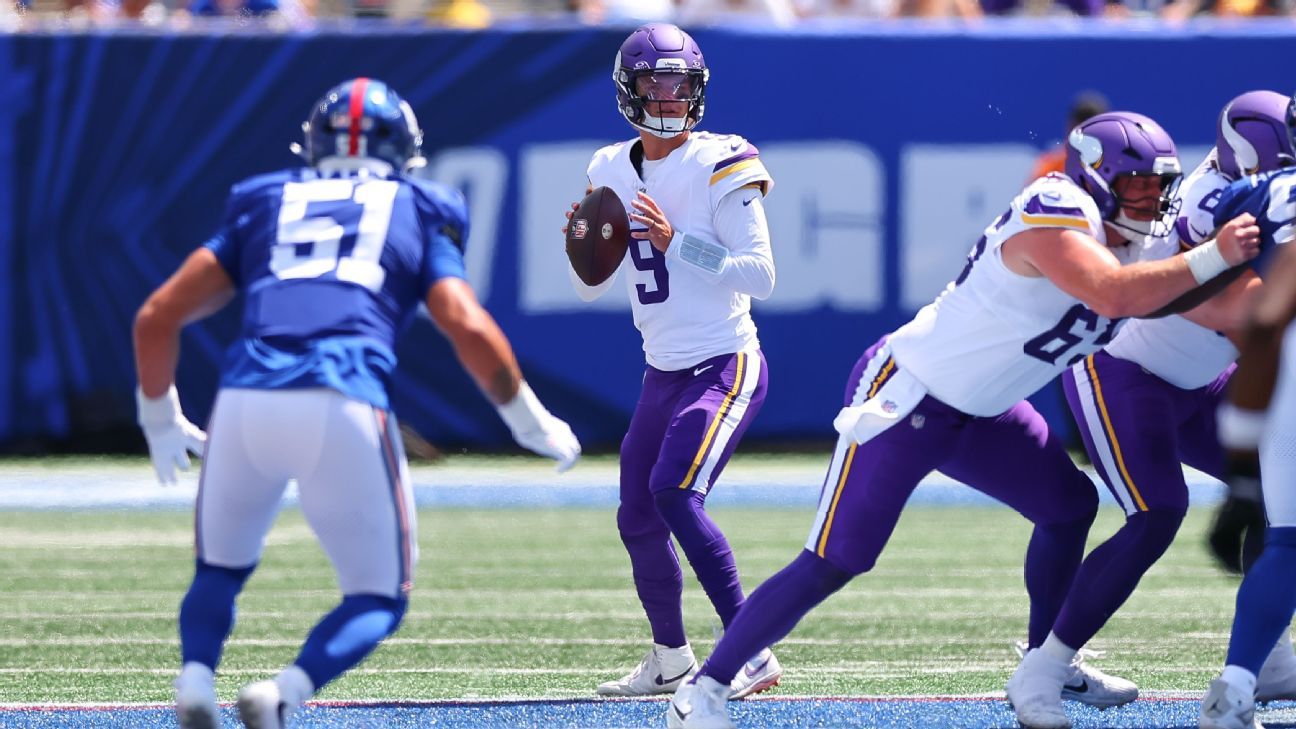
After Jaxson Dart went down with a season-ending knee injury in Week 2, it was probably inevitable that the Giants would add another quarterback to their roster. Jameis Winston can be combustible at his best, and while the weather wasn't great at MetLife Stadium on Sunday, he has averaged 4.7 yards per attempt and completed 51% of his passes since inheriting the starting job. With Jake Haener as the only other QB on the roster, getting someone to back up Winston and potentially take over if he continues to struggle was a no-brainer for the Giants.
And while Giants fans might have loved the idea of adding someone like Joe Flacco to continue the veteran's tour of Northeast football, teams weren't about to trade a useful backup who was one injury away from being their starter to the Giants out of pity. The market was QB3s, not QB2s, which left one very clear choice for New York: J.J. McCarthy
Landing a fifth-round pick for McCarthy was an obvious call for the Vikings. Once their quarterback of the future after they traded up to take him in the first round of the 2024 draft, McCarthy had quickly and brutally fallen out of favor in Minnesota. After being the NFC Offensive Player of the Week in his NFL debut last season -- an opening-week win over the Bears -- McCarthy's inability to work all areas of the field, operate within the structure of the offense or avoid negative plays frustrated a Vikings organization that had let Sam Darnold leave in free agency to hand the job to him.
While it was no surprise when McCarthy lost something resembling a QB competition to new starter Kyler Murray in training camp this summer, the writing was really on the wall once it became clear that Kevin O'Connell preferred Carson Wentz as his second option. Trading McCarthy netted some small amount of draft capital for the Vikings while also saving them $4.6 million over the next two years in the process.
So, the trade makes sense for both organizations. Will it work out for McCarthy, who is still only 23 years old and younger than Ty Simpson, whom the Rams took with their first-round pick in this year's draft? We're living in a bit of a golden era of second (or third) acts for quarterbacks around the NFL, with the likes of Darnold, Bryce Young, Malik Willis, Baker Mayfield and others enjoying varying levels of success after their first organization gave up (and/or benched) them before the end of their rookie deals. Could McCarthy be the next to follow in their footsteps and turn his career around after a rough start?
In the wake of the Giants' trade, I'll argue both sides of that question. I'm not sure where I'll land, but I can see a case for McCarthy thriving in New York, and I can see one where he disappoints Giants fans who are hoping for an answer. I'll lay out both potential outcomes and see if one resonates more than the other when I'm done. Naturally, let's start with the positive side of things. Why should Giants fans believe that McCarthy is the guy who can help keep their season afloat?
Jump to:
Why this could work
Why this can't work
And ... will it work?

The case for McCarthy
With young quarterbacks, growth isn't linear, and what we see at the very beginning of a player's career might not fully represent what he can be by even the end of his rookie campaign. Two picks after the Vikings selected McCarthy in the 2024 draft, the Broncos went after their own QB of the future in Bo Nix, who struggled to open his career. Across his first four starts, Nix completed 60.1% of his passes, averaged 4.8 yards per attempt and threw one touchdown against four picks.
From that point forward, Nix has been about a league-average NFL starter, completing more than 68% of his passes, averaging 7.3 yards per attempt and throwing 28 touchdowns against eight picks. He has had his ups and downs since, and, as we saw in the Rams-Broncos game Sunday night, those bumps in the road can come in the same game. Nix has been good enough to sustain the Denver offense, though, and if it weren't for a poorly timed fractured ankle, Nix might have been quarterbacking the Broncos in last season's Super Bowl.
Nix was awful at the very beginning of his career, but we have a large enough sample of games since then to suggest that his true level of play is more in line with a solid quarterback. We're not there yet with McCarthy given the significant amount of time he has missed with injuries. McCarthy's first six games as a pro were generally a mess. He completed 54.1% of his passes, averaged 5.8 yards per attempt, took sacks on more than 11.1% of his dropbacks and threw 10 interceptions on 159 pass attempts. That is an unplayable quarterback.
But over his final four starts in 2025, McCarthy was quietly ... pretty good? Returning from a concussion, he oversaw four victories as the Vikings worked their way back to respectability over the end of the year. And over that stretch, McCarthy wasn't a problem for the Minnesota offense. He completed 64.3% of his passes, averaged a robust 8.4 yards per attempt and threw five touchdown passes against two picks, adding two more scores with his legs. McCarthy's sack rate dropped to 7.7%, which is still higher than you would like but much improved on what he had produced early in the season.
Those aren't superstar numbers, but the McCarthy of the first six games was one of the worst QBs we've seen over the past decade, whereas the guy over the final four starts was completely playable. His 70.3 Total QBR over that stretch was the seventh-best mark in the league, just behind Matthew Stafford, who was finishing up an MVP season for the Rams. He was fourth in yards per dropback and eighth in passer rating.
That's only a four-game stretch, of course, but it's also 40% of McCarthy's career as a starter and the four most recent games we've seen from him as a pro. If he is that quarterback moving forward, he's a completely viable starter. And given that he still has yet to turn 24, it's fair to project some semblance of growth from McCarthy if he could stay on the field long enough to get more reps.
It's not great to see a respected offensive mind like O'Connell move on from McCarthy so quickly, but are the Vikings infallible as quarterback evaluators? They were originally the ones who targeted McCarthy and took him in the top 10. They moved on from Darnold after a disappointing stretch at the end of 2024, only for him to excel with the Seahawks. They traded for Sam Howell and then gave up on the backup before he ever played a snap with the team, preferring to sign Wentz last summer. And while I can't fault them for targeting Murray, given his contract and skill set, the early returns have been very disappointing, even as the defense has led Minnesota to a 3-0 start. The Vikings might just be wrong in the same way that other organizations were wrong about Darnold, Mayfield and Willis.
While McCarthy had plenty of big names around him on offense, they weren't as effective as the Vikings might have hoped. An expensively assembled offensive line didn't live up to expectations. The run game was inconsistent. And McCarthy's receivers dropped a full 6% of his passes, the highest rate for any quarterback with at least 150 pass attempts last season. That could be on the QB, but Vikings receivers also dropped 4.6% of the throws from Wentz and Max Brosmer last season.
And frankly, the Giants don't need McCarthy to shoulder the workload. This is going to be a run-heavy team, built through their offensive line, heavy personnel groupings and a Cam Skattebo-led backfield. McCarthy can make an impact with his legs, where he ran for 181 yards and four touchdowns in 2025. The Giants can retain some of the RPOs they installed for Dart, giving McCarthy easy answers for confidence-building completions. McCarthy was at his best booting out of the pocket and getting on the run, where his QBR in 2025 was a solid 67.7 -- more than 40 points better than where it landed from throws inside the pocket (27.5).
In a carefully crafted offense, McCarthy can make this work. And given that the Giants are paying him less than $1 million over the rest of the season, he doesn't have to be great for this deal to pay off. Winston hasn't been able to move the ball, and while the weather was a real factor against the Titans, he was missing open receivers by yards against the Rams in Week 2.
McCarthy is still young enough for us to be wrong and was better by the end of his rookie season than many of us remember.
The case against McCarthy
Well, to start, there's a reason McCarthy hasn't played many games: He hasn't been healthy enough to stay on the field for any meaningful stretch of time. He missed all of his rookie year after tearing his meniscus, which required season-ending surgery. He was then sidelined for seven games in 2025 amid a high-ankle sprain, a concussion and a hand injury. It's unclear whether McCarthy would have beaten Darnold out for the job as a rookie in 2024, but he was healthy enough to start 10 of 34 possible contests over his first two seasons in the league before the Vikings moved on to Murray this offseason.
You can't develop as a quarterback if you can't stay on the field to get regular reps. And while McCarthy was relatively healthy during his time under Jim Harbaugh at Michigan, he's yet to make it to a fifth consecutive start as a pro without getting hurt. The Giants were already worried about this with Dart, and now they're acquiring a second quarterback who hasn't been able to stay healthy or protect himself as a pro.
The numbers from that four-game stretch in 2025 are real, but they come with some incredibly large qualifiers. That run started against the Commanders, who fielded the league's second-worst defense by QBR. It continued against the Cowboys (fourth-worst) and then these Giants (10th-worst). And it finished with the Packers, who would have been the league's second-worst defense by QBR if we just consider their snaps without Micah Parsons on the field. (The star edge rusher missed that Week 18 matchup with the Vikings after tearing his ACL.) Total QBR adjusts for quality of opposition, but that's a particularly friendly slate of opponents.
Even in those games, the Vikings very clearly didn't trust McCarthy. They dialed up designed runs nearly 46% of the time in those games, which would have been the fifth-most run-heavy offense in the NFL. The Vikings asked McCarthy to throw only 21 passes per game over that stretch, a barely-there workload for most quarterbacks, albeit one more in line with how rarely McCarthy threw at Michigan (22 times per contest). Minnesota played at the third-slowest pace in the league to try and shorten games and lean heavily on the defense, which was both smart and likely telling about how the team viewed McCarthy.
At the same time, in obvious passing situations during that stretch (where NFL Next Gen Stats projected that the Vikings had at least a 75% probability of throwing the football pre-snap), McCarthy was 21-of-31 for 291 yards with a touchdown and no interceptions. He actually had the best EPA per pass dropback of any quarterback from Week 13 onward in those clear passing situations.
Tailoring the offense to fit McCarthy, as the Vikings did by removing many of their middle-field concepts last season, is much harder to do in-season than it is with a full training camp to prepare. Winston has his own foibles, but we're already seeing what an offense that is built for a unique quarterback looks like when a different kind of passer steps in to take his place.
The reality is that McCarthy probably just wasn't a very good quarterback prospect to begin with. There were eyebrows raised around the league when the Vikings took him with the 10th pick given how rarely he was asked to throw at Michigan, where the offense really ran through a Blake Corum-led rushing attack. Other quarterbacks who failed after being drafted in the top 10 despite limited college experience, like Trey Lance and Anthony Richardson Sr., at least offered the promise of significant untapped upside and high-end mobility and arm strength.
McCarthy's a solid athlete and has an NFL-caliber arm, but he was supposed to have a higher floor than what we've seen from him so far as a pro. His attitude and personality played just fine at Michigan under Jim Harbaugh, where he was the starter and the Wolverines were winning, but there were reports of friction between McCarthy and the Vikings coaching staff over his two-plus seasons in Minnesota.
Nix isn't always consistent and misses too many throws, but he sustains an incredibly high floor by avoiding negative plays. If you're not going to push the offense forward or drive success as a downfield passer, you can quietly keep the offense afloat by avoiding interceptions, fumbles and sacks.
McCarthy ... doesn't do those things well. He posted a 4.9% interception rate as a rookie, throwing 12 picks on just 243 attempts. His sack rate over the full year was an even 10%. And McCarthy fumbled six times, including a lost fumble that handed his new team their only touchdown of the day when the Vikings beat the Giants 16-13 during that aforementioned four-game stretch of otherwise-solid play a year ago.
He hasn't been a good play-action passer, either. Just about every quarterback in football gets better when they get to work off a play-fake. In 2025, quarterbacks collectively averaged 5.9 yards per dropback on pure passing plays and 7.1 yards per dropback when using play-action.
That wasn't true for McCarthy, who actually averaged more yards per dropback without play-action (6.0) than with a play-fake (5.0). His Total QBR on play-action throws was 22.6, which ranked 35th out of 36 quarterbacks in 2025. Only Shedeur Sanders was worse. With the Giants leaning into the run and using play-action at the eighth-highest rate in the league through three weeks, it's tough to believe that McCarthy is a great fit for this offense.
While I wondered whether the Vikings were wrong a minute ago, there's the other side: Nobody was more invested in McCarthy's success than the team that prioritized him over the likes of Darnold and Kirk Cousins. The Vikings thought McCarthy was a top-10 pick and had two offseasons to tailor an offense to his strengths. They were on the hook for McCarthy's rookie deal. They surrounded him with high-end receivers, including a bonafide superstar in Justin Jefferson. None of that produced even below-average quarterback play over McCarthy's lone full season.
After 2025, the Vikings didn't run it back with McCarthy in the hopes that he would improve in the same way that the Jets did with Darnold or the Panthers did with Young. They were immediately ready to abandon their initial plan, both by acquiring Murray to take over as their starter and returning Wentz as the backup. Despite Murray struggling during training camp and Wentz already being established as a second-string-caliber quarterback in his mid-30s, the Vikings were still ready and eager to move on from McCarthy, who wasn't impressive during preseason.
Which argument holds more water?
Both sides of the McCarthy conversation hold some truth. McCarthy did improve as a rookie, but it came against some very bad defenses and over a very small sample. He was a negative play machine for most of the season, did little to encourage the Vikings to trust him with more on his plate and could not stay healthy for any real stretch of time.
On paper, I can make the case that it's a reasonable trade for the Giants. McCarthy's still young. A fifth-round pick isn't an exorbitant sum to give up to land a quarterback who was worth a top-10 pick two years ago. And if McCarthy's even a viable backup, the Giants will realize some meaningful surplus value on what they pay him over the next two seasons. Obviously, if there's something more here and he turns into a solid NFL starter, this would be a heist for the Giants in the big picture.
You just really have to squint and be incredibly selective about what you leave out to have any optimism about McCarthy given what we saw from him in 2025. Even guys like Darnold and Young weren't as bad early in their careers as McCarthy was in 2025, and they were much more impactful college passers in terms of their responsibilities. Those quarterbacks needed to get in better situations and have more help to thrive, but the Vikings were already considered one of the league's best situations for a young passer after the likes of Darnold and Joshua Dobbs had elevated their games under O'Connell. McCarthy isn't entering a better situation with the Giants.
And on top of all that, the injuries take the McCarthy concerns over the top. Struggling quarterbacks need to stay on the field to improve. Even if the Giants do turn to McCarthy as this season goes along, how can they count on him to stay healthy for any length of time? If this turns into a developmental season for the young signal-caller and he actually exceeds expectations, would the Giants really be willing to enter 2027 in a world where they commit to McCarthy ahead of Dart as the starter? Would any team be willing to trade legit draft capital to acquire the final year of McCarthy's deal given those injury woes? Would the Giants ever be willing to fully guarantee a fifth-year option for McCarthy in 2028?
The answer to all of those questions is no, which dramatically caps the ceiling case for McCarthy. And as we saw a year ago, the floor for what he might offer as a quarterback can be painful to watch. I can't fault the Giants for trying to do something given Dart's injury, but I would be very surprised if McCarthy was any sort of short- or long-term answer for this organization.