
Iranian football returns in the shadow of war and with row over last league title
Prolonged league suspension due to war and falling behind Saudi spending power are weakening the sport in Iran
Just three months ago, Iran was one of the biggest stories in football as Team Melli arrived at the World Cup to try to play in the US, a country that had been bombing and firing missiles at Tehran and other targets. A disallowed goal and a last-minute effort that hit the bar in the final group game against Egypt confirmed IranâÂÂs group-stage exit â to the delight of some US officials â by the narrowest of margins. It also signalled the abrupt end of international attention.
This week there was a return, however, to international action as Esteghlal and Tractor SC started out in the AFC Champions League Elite. It comes after the Persian Gulf League kicked off in mid-August, almost six months after it was postponed at the end of February, and subsequently abandoned as the war continued.
âÂÂThe most important impact of the war on Iranian football was the prolonged suspension of competition,â the Esteghlal head coach, Sohrab Bakhtiarizadeh, says. âÂÂFor months, we were deprived of club football, and not only were the players and teams unable to train, but the fans also had nothing to talk about, engage in banter over, and so on. It was sad that football was suspended for such a long period and it will certainly weaken the sport and its passionate supporters.âÂÂ
Esteghlal were especially blue as the Tehran giants were top of the league when it stopped with 22 games of the 30 played, two points clear of Tractor. It soon became clear that the season was never going to take place meaning that the 10-time winners feel they should be given number 11. âÂÂEsteghlal should be declared the champions of the previous season,â Bakhtiarizadeh says. âÂÂBeing at the top of the table is a suitable criterion for determining the most successful team in a tournament at any given time. This is also what Esteghlal fans want.âÂÂ
A decision is to be made soon. The majority of the other clubs seem to be against such a presentation, especially those owned by industrial companies such as the steel-backed pair Sepahan FC and Foolad, which have suffered during the war. Whatever happens, Esteghlal have started pretty well in the new campaign.
As has the league in general. There had been talk in the buildup that the games would be behind closed doors but most matches have had fans, with some decent crowds. At the Tehran derby between Persepolis and Esteghlal, the biggest game in Iran (and many would argue the biggest in Asia), 50,000 fans were in the second city of Isfahan. The usual home of both teams, the capitalâÂÂs renowned Azadi Stadium, is unavailable, not because of bombs and missile damage, though the wider sports complex has been hit, but because of continuing repairs. The money spent has become a hot topic and it seems nothing is ever simple in Iranian football even during times of relative peace.
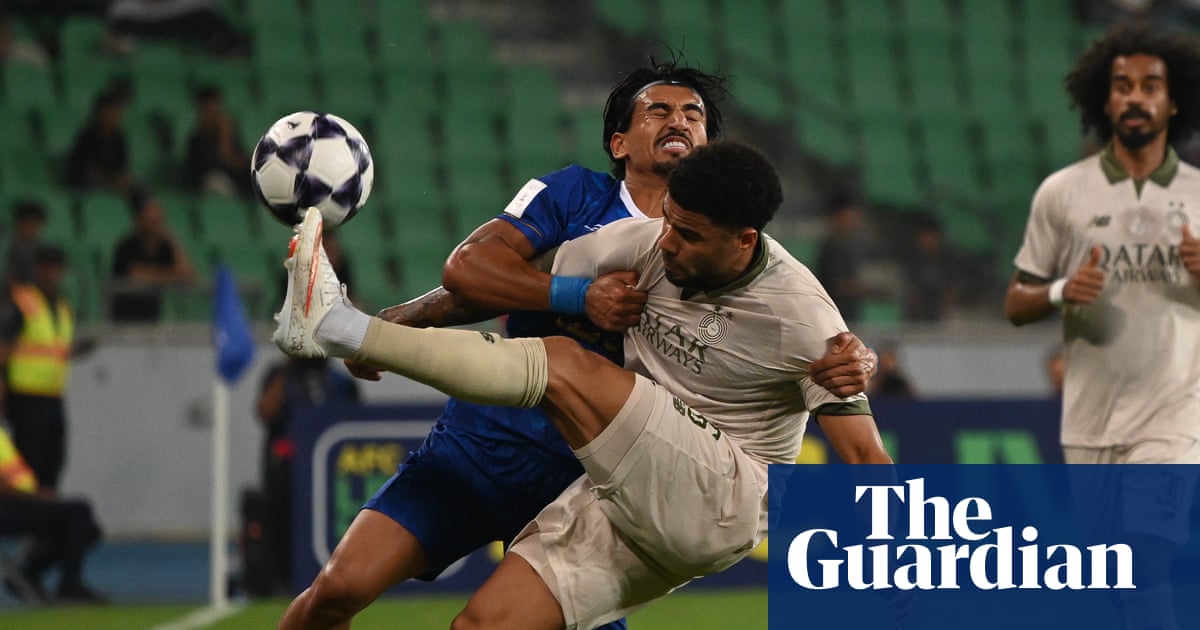
Esteghlal may not have got the trophy yet but are representing the country in the AFC Champions League Elite and started with an impressive 3-0 win against the Qatari powerhouse Al-Sadd on Monday. It was even more impressive that the home game took place in the southern Iraqi city of Basra. Iranian clubs are accustomed to playing home games away.

Photograph: Troy Wayrynen/Imagn Images/Reuters
âÂÂBeing deprived of home advantage has been one of the biggest problems that Iranian football has faced in recent years,â Bakhtiarizadeh says. âÂÂIn every situation, this opportunity has been taken away from Iranian clubs. Nevertheless, it makes us happy to host Al-Sadd in Basra, close to Iran ⦠with the presence of some of our supporters who live in southern Iran.â The 8,000 fans did their best to create a Tehran-like atmosphere in the massive Basra International Stadium.
Given that relations between Iran and the United Arab Emirates are not exactly cordial these days, Tractor may have been relieved that there were just 1,300 in attendance in Dubai as they lost 1-0 against Shabab Al-Ahli. However, given the AFC has, for some reason, followed UefaâÂÂs big league-style group stage, there is a lot of time to overcome a poor start.
At least Saudi Arabian clubs were avoided, useful on and off the pitch. Even before 2023, when Riyadh and Jeddah sides started spending big, Iranian clubs were unable to compete. Years of international sanctions have had huge economic effects and football â closely connected to the state â has not escaped. Salaries have stagnated, facilities are often neglected and training camps, overseas friendlies and all the rest are harder to arrange here than in most other countries.
But it is not just Iran. No one in Asia can come close to matching the $200m (ã148m) plus paid by Al-Hilal alone in the summer for Ollie Watkins, Gabriel Martinelli and Crysencio Summerville. Saudi Arabia (which unbelievably has hosted the Champions League from the quarter-finals onwards for the past two editions, an arrangement that was recently extended to 2029) and Japan have five representatives each in the 32-team tournament. Iran, a leading Asian power, has two.
The Champions League is not a level playing field, then, in many ways, but Bakhtiarizadeh is hopeful that his team, Asian champions in 1970 and 1991, can compete. âÂÂIt is currently impossible for any team in Asia to match the Saudi spending power,â the former Iran international defender says.
âÂÂNevertheless, I still believe that football is a game in which, over 90 minutes, you may be able to overcome this financial gap through effort, determination and teamwork. Competing against Asian teams is certainly difficult, especially since we have entered the competition without having participated in the summer transfer market but EsteghlalâÂÂs history compels us to try.âÂÂ