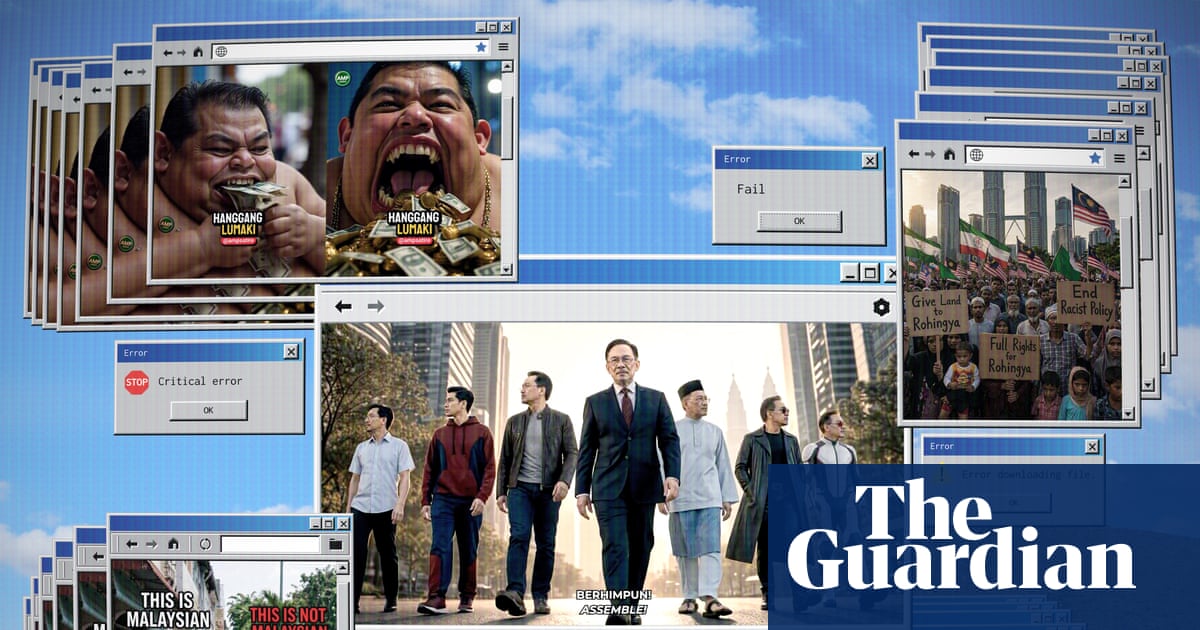

Composite: Guardian Design/Getty Images
Composite: Guardian Design/Getty Images
How AI could âÂÂsuperchargeâ election risks across south-east Asia
Some experts fear AI could be weaponised in south-east Asia, home to nations with predominately young and hyper-connected populations
Years ago it would have been an elaborate operation involving any army of cyber troops creating fake news websites, social media accounts and forged dossiers, all deployed to spread disinformation en masse.
Now, all you need is AI.
In a worrying sign of how AI could âÂÂsuperchargeâ fake news, Anthropic recently revealed how Claude AI was used in a political influence operation in Malaysia. It created a commercial election manipulation platform, utilising a network of about 1,000 X accounts, a fake news outlet called âÂÂMalaysia Pulseâ and a series of fabricated documents.
The operation appeared designed to target voters in in recent state elections, pulling in census and electoral data to exploit sensitive political and social fractures, including race, religion, and royalty across all 222 Malaysian parliamentary constituencies.
The experiment was ultimately ineffective once Anthropic stepped in but has sparked alarm about how AI could be weaponised in future elections in south-east Asia, a region already deeply vulnerable to fake news.
Katie Harbath, who formerly worked on public policy for global elections at Meta, says the case is an example of how AI brings a new level of sophistication and ease to the disinformation landscape.
âÂÂAI can supercharge it in terms of you can make a lot more content thatâÂÂs more personalised, quicker and cheaper,â says Harbath, who now heads the tech consultancy company Anchor Change. âÂÂBut you still need a distribution mechanism, and at the moment, thatâÂÂs still your more social media type platforms.âÂÂ
Anthropic detailed the Malaysia election operation in its latest threat assessment, released in September. The report revealed how actors used Claude to build networks of fake social media profiles and news websites that targeted audiences on six continents. Anthropic said the actors included âÂÂgovernments, state-aligned propaganda institutions and state media, as well as private firms selling influenceâÂÂ.
âÂÂFlood the zoneâÂÂ
South-east Asia is no stranger to disinformation. In recent years Nobel laureate and Filipino journalist Maria Ressa has likened the Philippines to a âÂÂpetri dishâ for the weaponisation of disinformation and fake news, with techniques tried and tested in the south-east Asian nation later successfully replicated in the west.
But AI makes it all much easier.
âÂÂBasically AI is just mimicking what we would have, I guess, termed a few years ago, a troll factory,â says Rossine Fallorina of Sigla, a Philippine thinktank that researches AI. âÂÂMostly because it speeds up the production process. So you donâÂÂt need 10 people to create a narrative or a story. You can just prompt it and then have it propagated.âÂÂ
Last year OpenAI banned accounts using AI to generate comments about Philippine politics and public officials across social platforms, with many fictitious comments generated in support of President Ferdinand Marcos Jnr.
Across south-east Asia, home to nations with predominately young and hyper connected populations, some fear the divisive potential of AI on social media.
âÂÂIt feeds political polarisation and it feeds on divisions,â says Bridget Welsh, from the University of Nottingham Asia Research Institute Malaysia. âÂÂThatâÂÂs really whatâÂÂs concerning about the fragmented nature of whatâÂÂs happening in Malaysia.âÂÂ
MalaysiaâÂÂs general election could be called for late 2027, while the Philippines and Cambodia have polls in 2028, and Indonesia the following year.
Already in the region, AI has been effective. In Indonesia, an AI-generated cartoon image of now-president Prabowo Subianto that helped soften his strongman image became wildly popular in the 2024 election.
It has also been used to inflame tensions, such as inciting hatred toward ethnic Rohingya refugees who fled to Malaysia from Myanmar during the civil war, says Dr Ben Loh, a media lecturer at Monash University Malaysia.
âÂÂItâÂÂs come to the point where people already have this deep-seated hate in their minds and when they see the content like this, even though itâÂÂs AI-generated to them, itâÂÂs merely reinforcing what they believe is already true,â says Loh.
The Anthropic report notes that the fake news outlet scraped legitimate Malaysian reporting and had the model rewrite it several times before republishing it under fabricated bylines. It also republished articles from Russian and Chinese state-aligned foreign outlets, including TV BRICS, Xinhua, Sputnik/RIA, and CGTN, stripping them of attribution.
Anthropic said in its threat assessment that in each case of identified political influence the company âÂÂdisrupted the activity, used what we learned to strengthen our safeguards, and shared intelligence with authorities and industry partners, where appropriateâÂÂ.
In future, Harbath says AI could be used to âÂÂflood the zoneâ in an attempt to influence the large language models (LLMs) from which AI models draw their information.
âÂÂIf thereâÂÂs any sort of news drought, or if you have a place where thereâÂÂs mostly government-sponsored media,â she says, âÂÂIt wouldnâÂÂt take very much money to kind of flood the zone.âÂÂ