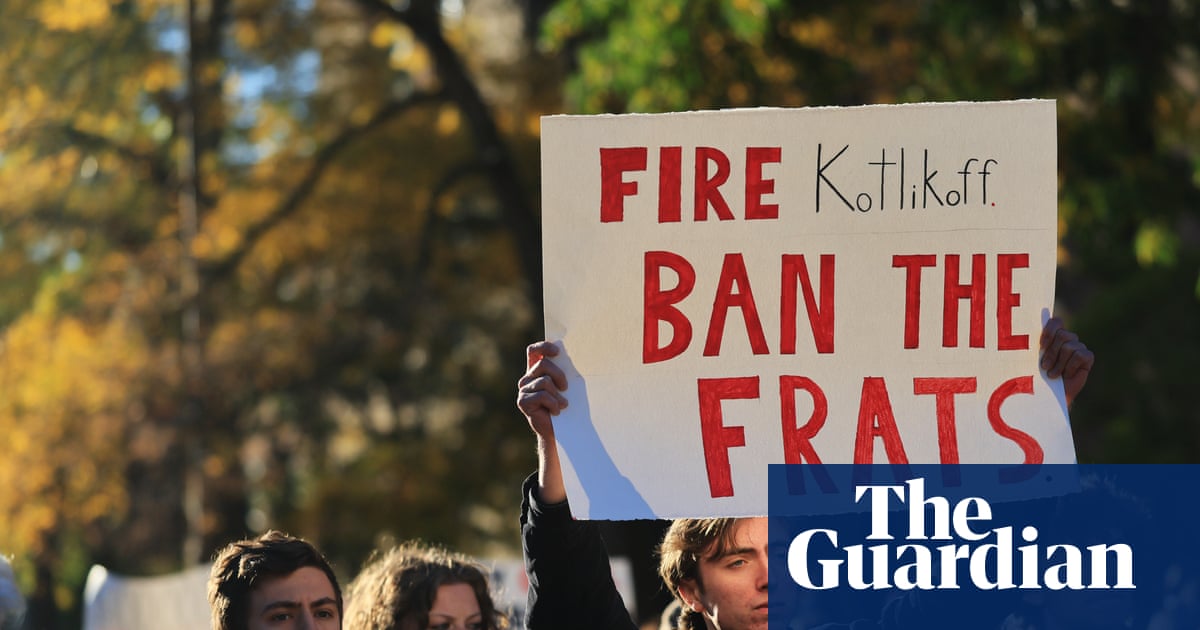

Fraternities are the most likely place for US campus rapes. Should they be shut down?
As an alleged 2024 gang-rape at Cornell comes to light, universities are grappling with a choice: student safety or alumni donations
Daniel R Schwarz, an 85-year-old English literature emeritus professor, still works at Cornell University after 59 years because he loves teaching and âÂÂwatching young people growâÂÂ, he said.
Most of his students, he also said, have not been part of fraternities at Cornell in Ithaca, New York, where seven men allegedly gang-raped a woman in 2024.
The incident, which has sparked national outrage, and other alleged wrongdoings at fraternities have prompted Schwarz and others to call for the abolition of âÂÂGreek lifeâ at US colleges. In recent months, fraternities across the US have been implicated in multiple hazing cases; in Pennsylvania, one fraternity was even exposed as being at the center of a drug-dealing network.
But even with a long history of scandal, critics of Greek life â so-called because of the letters of the Greek alphabet that make up most fraternity and sorority names â are uncertain that schools in the US will close them. At many colleges, they are a fixture of campus life, help students form friendships and can make institutions more attractive to high schoolers, a particular concern for university leaders as they grapple with a declining birth rate.
In short, they argue, if students wish to pledge allegiance to fraternities and sororities, colleges wonâÂÂt stop them.
âÂÂAll the Greek alumni would have pitchforks, and it would be a whole debacle rather than kind of letting this play out in the press and then just going back to business,â said Lucy Taylor, a University of Maryland graduate and the creator of the podcast Snapped about the sordid history of fraternities and sororities.

In 1825 at Union College in Schenectady, New York, five seniors feeling âÂÂan aching voidâ after the dissolution of a military company at the school formed a secret society for âÂÂliterary and social purposesâÂÂ, according to The Company He Keeps: A History of White College Fraternities. It became Kappa Alpha Society, the countryâÂÂs first social fraternity.
Such groups opened at colleges across the country, and joining them became a rite of passage for some students. Comedy film classics like Animal House and Old School celebrated the shenanigans that occur at frat parties. Fraternities and sororities were also created at historically Black colleges, where they are often a vital part of campus life, providing crucial social support and post-college networks.
But there has also always been a darker side to the organizations. The first hazing incidents were reported in the 1870s, and the first death at a fraternity house occurred in 1873 during an initiation at Cornell, according to a report, Fraternities in North America, in the Ebsco database.
From 1838 to 2025, there has been an average of two hazing deaths reported annually, according to Hazinginfo.org, which tracks such incidents.
This year, an 18-year-old at Northern Arizona University died from alcohol poisoning after he and three other Delta Tau Delta pledges passed around two bottles of vodka to ensure they vomited, the Associated Press reported. The fraternityâÂÂs national organization closed the chapter, and a 20-year-old pleaded guilty to felony hazing.

Hazing has been an issue at Black fraternities, too. In 2025, at Southern University in Louisiana, a 20-year-old student died after allegedly being punched four times in the chest as part of a hazing ritual. The alleged perpetrator was charged with manslaughter and criminal hazing.
At Penn State, 14 people were arrested in August for running a cocaine-trafficking ring out of two fraternities in which hazing allegedly played a role.
In addition to abusing pledges, fraternity members have long been accused of encouraging women to drink so that they can take advantage of them. In a 2019 survey from the Association of American Universities, a quarter of undergraduate women reported experiencing nonconsensual sexual conduct. The setting where it was most likely to occur was a fraternity.
In August, the University of Tennessee issued a safety notice to students after three reports of sexual assault, two of which included suspected drugging at fraternities, according to WBIR. In April at the University of Arkansas, a 19-year-old allegedly raped a woman at his fraternity, Kappa Sigma, months after another woman received a temporary order of protection against him, KNWA reported.
At Cornell, the school suspended fraternity parties and social events in 2022 after reports that over the course of a weekend, one student was sexually assaulted and at least four others were drugged at residences affiliated with fraternities.
Then, in 2024, the event allegedly occurred that has prompted a national reckoning with Greek culture: a 20-year-old female student, known as Jane Doe, said later that she had been drugged and raped by seven members of the Chi Phi fraternity.
Despite concerns over toxic behavior at fraternities and sororities, students still join because they want community and friends, said Jennifer Freyd, professor emeritus of psychology at the University of Oregon, who has studied sexual assault on college campuses.

A member of a different Cornell fraternity said he joined because he had a large friend group in high school but had not found the same connections on campus.
âÂÂWhen I met the people in my fraternity, I felt that these were people that I felt would not only just be my friend, but be a support system,â including by giving career advice and connecting him with alumni, said the student, who asked not to be named for fear of being doxed.
Students also join because family or friends encourage them and convey that the organizations âÂÂbring them power and statusâÂÂ, Freyd said.
But to achieve that, some students often must engage in hazing rituals.
During initiation rites, students âÂÂengage in humiliation, and there is a tradition in fraternities of objectifying womenâÂÂs bodies and in sororities of complying with fraternitiesâÂÂ, Freyd said.
In September, police arrested two fraternity leaders at the University of Wisconsin-Madison after partially clothed pledges were discovered in the basement of the frat house covered in food, condiments and other liquids.
Sorority leaders can also contribute to the unhealthy environment.
New York magazine recently reported on the âÂÂOzempidemicâ at colleges. Students are taking GLP-1 drugs to get skinny enough to âÂÂget into the sisterhood of their dreamsâÂÂ.
âÂÂThe drug is new but the pressure isnâÂÂt. Sororities have always ranked women by how they look,â said Taylor, the podcast creator.
She joined Alpha Phi as a freshman and was initially âÂÂfeeling validated and excited about all my new friendsâÂÂ, she said.
But after she posted a photo on social media of herself in a bikini, a fellow member commented, âÂÂSNAPâÂÂ, which stood for âÂÂSo Not Alpha PhiâÂÂ, Taylor explained.
A student then sent an email urging members to âÂÂkeep the booties tucked awayâ and to use âÂÂSNAP if you think you see something that might not be the best image for our chapterâÂÂ.
Even after taking it down, Taylor felt ostracized from other members.
While she was shamed for the photo, she also felt as though she were living in a âÂÂrape cultureâÂÂ.
She said members were told not to leave a fraternity before midnight because âÂÂwe donâÂÂt want to seem rudeâÂÂ.
âÂÂIt was just normal if someone didnâÂÂt remember hooking up with someone from the night before. Blacking out was totally normal,â said Taylor.
She alleges she was raped by a fraternity member. She left the sorority after seven months.

âÂÂThe Greek system, in my judgment, supports alcoholism, sexual harassment, bullying under the guise of hazing, groupthink and, of course, the objectification of women,â said Schwarz, whose students have confided in him about sexual harassment.
The Guardian asked the North American Interfraternity Conference, a trade association of fraternities, about the benefits of Greek life and concerns that fraternities are incubators of sexual assault.
Hillary Brewer, the organizationâÂÂs chief communications officer, did not respond to a question about whether sexual misconduct is pervasive at fraternities but stated in an email that they âÂÂare an accelerator for success in college and beyond. They create lifelong connections to the campus, community and friends.âÂÂ
Asked whether the alleged gang-rape at Cornell was indicative of a larger problem, she stated: âÂÂAny fraternity man who commits or is complicit in sexual assault should be held accountable to the fullest extent of the law. The men involved in the incident at Cornell were immediately expelled from the fraternity and the chapter was disbanded. We will continue to call for necessary personal accountability when members neglect their fraternal obligations.âÂÂ
Despite concerns about Greek life, Schwarz said, university leaders havenâÂÂt stopped it out of fear that alumni will stop donating money.
Colleges must grapple with the fact that their customer base will likely shrink because people are having less children. The United States is projected to experience a 13% decline in high school graduates from 2025 to 2041, according to the Western Interstate Commission for Higher Education.
Michael Kotlikoff, CornellâÂÂs president, said that the school would take âÂÂa serious look at the role of fraternities and sororities in campus lifeâÂÂ, but officials are not considering ending Greek life, the Associated Press reported.
On Wednesday, the Ithaca Common Council voted to stop issuing permits to Cornell student groups, including fraternities, WSYR reported.
The Cornell fraternity member interviewed by the Guardian said the administrationâÂÂs response to the alleged gang-rape was âÂÂincredibly frustratingâÂÂ. Two students were expelled and a third who graduated was barred from campus. Four others were given lighter punishments â including two suspensions â but allowed to remain at the school.
Fraternities who âÂÂhave too many people at an event, at a party, they get a far greater punishment than what seems to have happened toâ the Chi Phi members, he said.
He does not think the school should force fraternities to close.
âÂÂWhen you get rid of Greek life, you get rid of some of the most passionate people that cared about the school, right? And so why would someone like that donate to the school if the school is eliminating something that was a key part of their time at Cornell?â he said.
Schools like Bowdoin College, Middlebury College and Swarthmore College have, however, shut down Greek life and survived. This week, the University of Arizona dean initiated an âÂÂinterim activities suspensionâ at its fraternities, the New York Times reported.
âÂÂThe alleged behaviors range from physical assault, drugs and alcohol, hazing and creating unsafe environments for our students,â the dean stated in a letter to fraternities and sororities. âÂÂSome cases are also under criminal investigation.âÂÂ
Freyd used to think Greek life could be reformed but changed her mind because leaders must âÂÂovercome the generations of tradition that are misogynist and bonding over humiliation. That is enormous work.âÂÂ
She thinks colleges should eliminate Greek life.
âÂÂThe colleges and universities that make change in this domain, itâÂÂs going to be hard, and it will take courage,â Freyd said. âÂÂBut it will really be worth it.âÂÂ