Flying cars could launch in China next summer, maker of two-seat model says
XPeng says its $300k low-altitude device will soon be ready for emergency services and recreational use in rural areas
People could start taking trips in flying cars in China as soon as next summer, the manufacturer of a two-seater vehicle with autopilot model has said.
Deli Zhao, the chief executive of the Chinese flying car company XPeng, said the $300,000 (ã225,000) low-altitude device would be ready for use by recreational users in rural locations and by emergency services in the second half of 2027. After 10 years of development including trials of flying motorbikes at the companyâÂÂs Guangzhou base, it has been approved by ChinaâÂÂs civil aviation authorities for limited use.
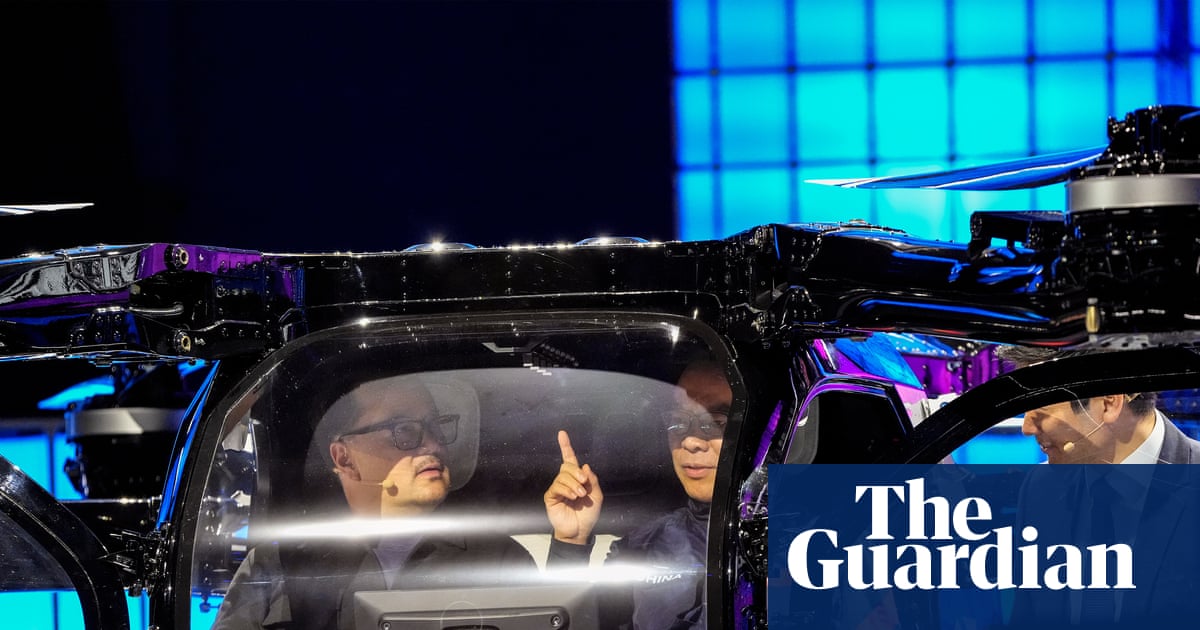
The small cockpit is about the size of a Fiat 500 car and the vehicle is lifted into the air by six drone-like battery-powered propellers and steered by a simple joystick. It can also fly autonomously to a programmed destination, but Xhao, a trained pilot, claimed he could teach anyone to fly it in five minutes.
The price tag for the contraption includes a six-wheel van about the size of a Ford Transit, out of the back of which the flying vehicle unfolds âÂÂjust like the TransformersâÂÂ, said Zhao. He has been developing flying cars for almost a decade and said he was part-inspired by the flying creatures ridden by humans in the Harry Potter stories and the Green GoblinâÂÂs flying skateboard from the Spider-Man comics.

âÂÂThe world where everyone can be a captain is about to arrive,â he said at the Web Summit in Lisbon on Tuesday, where a prototype of the vehicle drew large crowds. Zhao said no one had yet been injured or hurt using the vehicle which, although described as a car, lacks wheels and is better described as a helicopter-style drone. He said the initial target market was people who were into âÂÂdiving, surfing, off-roading and flyingâÂÂ.
Elon Musk last month showed off his version of a flying Tesla which uses high-powered blasts of gas to twist and flip in the air. Amid intense competition between the US and China over the development of electric vehicles and drone technology, Zhao said MuskâÂÂs prototype was âÂÂreally hopping or jumping and not really flyingâÂÂ. The XPeng vehicle can cruise as high as 1km above the ground â well below an unpressurised light aircraft such as a Cessna.
âÂÂIâÂÂm looking forward to seeing a potential future generation that can actually fly,â he said, and agreed when asked if MuskâÂÂs showcase had the characteristics of a circus act.
However, the XPeng âÂÂflying carâ also has limited scope. It will only be usable in approved park areas in China and by emergency services needing to reach inaccessible areas. It has a flight range of 30km (18.6 miles), although this will soon be doubled by increasing the batteryâÂÂs energy density to 400 kilowatts per kilogram.
Its emergence is part of a wider push by Beijing to develop what it calls the âÂÂlow-altitude economyâ â including drones and flying cars, starting with flying cargo, then people, and moving from rural areas to the cities. Zhao said his firm was one of about 20 in China working on flying vehicles.
âÂÂAll cars in the future will grow wings and all transportation will move from two dimensions to three dimensions,â said Zhao, who claimed he had signed agreements with the United Arab Emirates and countries in south-east Asia to develop the flying carâÂÂs use, adding: âÂÂWe aim to enter the European market as soon as possible.âÂÂ