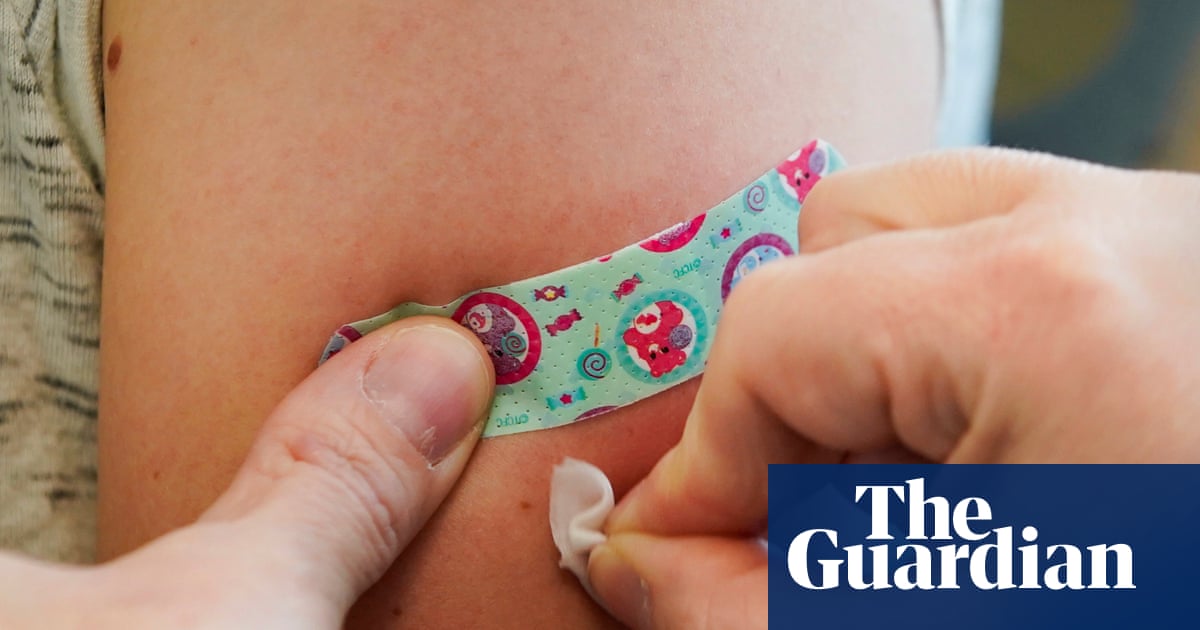

Families in the US are opting for earlier measles vaccinations amid outbreak
Parents are opting for a second shot of MMR vaccine sooner, which aligns with guidance in Germany, the UK and France
Measles cases are accelerating in the US, with twice as many confirmed cases as last year, and more parents are opting for earlier vaccination â especially with the second dose of the measles, mumps and rubella (MMR) vaccine, which can be given as soon as four weeks after the first.
Giving the second shot soon after the first aligns with what some other countries, such as Germany, the United Kingdom and France, recommend â and the US Centers for Disease Control and Prevention (CDC) also says itâÂÂs an option.
âÂÂMore parents have heard about doing it âÂÂearlyâÂÂ,â said Elias Kass, a naturopathic physician and vaccine advocate in Seattle, Washington. The CDC typically recommends giving the first MMR shot after age one and the second between the ages of four and six. But Kass began recommending the MMRV shot, which combines the second MMR and chickenpox (varicella) into one, at 15 months of age when measles cases began increasing a few years ago.
More parents are taking that recommendation now, he said, adding that their thinking is pretty straightforward: âÂÂThereâÂÂs no reason to wait, measles is here now.âÂÂ
Margot Taylor, a mother in Chicago, has three young children with three different vaccination histories for the MMR vaccine.
âÂÂAll three of them are fully vaccinated, but itâÂÂs had to be accelerated because of all of these increasing cases,â Taylor said. âÂÂWeâÂÂve gone backwards so much.âÂÂ
Her oldest, born in 2019, received her shots at ages one and four. Measles âÂÂwasnâÂÂt on my radarâÂÂ, Taylor said. âÂÂI wasnâÂÂt even thinking about it.âÂÂ
But with her second child, born in 2023, Taylor was surprised when the pediatrician recommended the second shot at age two. Chicago was battling a measles outbreak, so they went ahead with it.
Her third child, born in 2025, received the first shot after her first birthday â and then the second shot only three months later, in June.
Taylor worried the shots might not work as well if they were so early. But evidence shows the vaccines still work well at earlier ages; the recommendation to give the MMR dose between four and six years is based more on logistical concerns, to ensure children have both shots before they enter kindergarten and to cut down on doctorsâ visits because other shots are also typically given at those ages.
And Taylor knows how vital the MMR vaccines are. When her third daughter was too young to get the first dose, she was exposed to measles at an airport during the west Texas outbreak. When the baby, only a month old, developed a fever afterward, they rushed to the hospital and stayed in a negative-pressure room until the test was negative for measles.
âÂÂI am relieved, and I still cannot say enough how grateful I amâ for the vaccines, Taylor said. But she still wonders at the need to make these decisions at all. âÂÂI never thought that I would have to be learning the vaccine schedules,â she said.
Germany had similar recommendations to the US until 2001, when an outbreak brought a wave of illness and death that led the country to recommend the first shot at 11 to 14 months and the second shot at 18 to 23 months. In 2020, they moved the second dose to four weeks after the first.
âÂÂThereâÂÂs absolutely no indication so far that any kid that has been vaccinated twice in any rhythm would have a higher risk of measles than someone whoâÂÂs been vaccinated according to the old rule,â said Catherina Becker, a scientist in Germany.
Her son was two and a half years old when he got his second measles vaccine â and that was delayed only because he was recovering from a case of chickenpox. The CDC should âÂÂabsolutelyâ consider a stronger recommendation to give the second shot earlier, Becker said.
Some parents are also choosing to get their babies the first shot at the age of six months â which the CDC recommends in areas with outbreaks, before international travel, and after exposure to measles. Those infants should also receive a third dose.
If a mother was vaccinated against measles before a pregnancy, that immunity is shared in utero, so the baby is protected for the first few months of life. ThatâÂÂs why a third dose is recommended if infants receive the first dose early â because itâÂÂs possible the baby still has some maternal antibodies and thus doesnâÂÂt establish a strong response to a vaccine at six months.
The second MMR shot is different from other boosters. Most people mount a strong response to the first shot, which is why only one shot was recommended until 1989. But scientists discovered that some people donâÂÂt respond to the first shot and need a second â which is why the booster was recommended. ThatâÂÂs also why people born before 1989 may need to get a second shot now.
âÂÂItâÂÂs a second chance to respond for the first time,â Kass said.
Becker looks to past outbreaks to understand the effectiveness of the shots. In a 1998 outbreak in Alaska, only 17 people were sickened at a school where nearly all students â some 2,186 in total â had received measles shots. She compared it with a 2010 outbreak at a Waldorf school in Germany where nearly half of the 300 students were unvaccinated and 71 people were sickened.
âÂÂIt shows you what the measles vaccine does for you â it protects you from getting this thing,â she said.