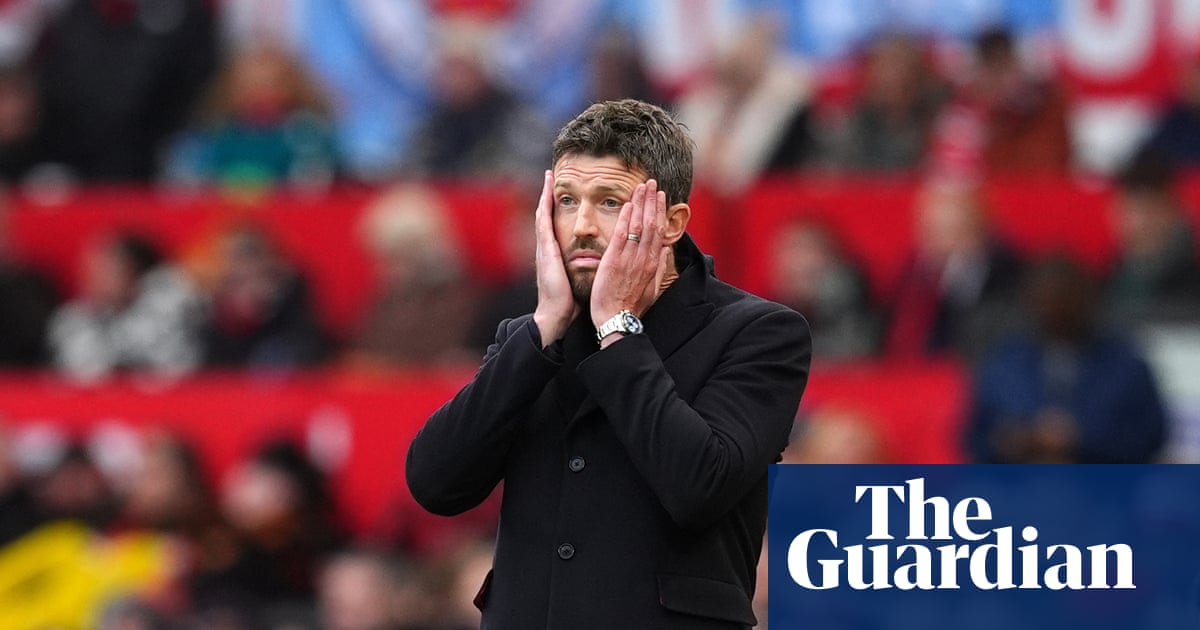

Damning data: stats that show Michael CarrickâÂÂs luck was bound to run out
Favourable conditions and the rub of the green were behind Manchester UnitedâÂÂs successful finish to last season
Manchester United have been the third-best team in the Premier League for the period in which Michael Carrick has been their head coach. It is some effort for his job to be so under threat when only Arsenal (57 points) and Manchester City (56) have been more productive than United (46) during the 45-year-oldâÂÂs tenure.
The tally obscures pertinent facts. CarrickâÂÂs side topping the Premier League across his 17-match interim spell last season is irrelevant when they sit 16th with no win in eight games in all competitions. Losing narrowly against City is one thing, but three-goal defeats by Como and Bournemouth will surely spell managerial change.
Carrick can point to a degree of misfortune this season. Conceding stoppage-time equalisers to Everton and Tottenham was very costly, albeit they also required an 89th-minute goal to avoid losing at a then-winless Fulham. OptaâÂÂs expected points model suggests United have earned 3.8 points fewer than their underlying statistical performances merit in 2026-27. Only three clubs are further adrift of where they can reasonably expect to be.
Equally, UnitedâÂÂs expected position of 10th is hardly befitting a club whose net transfer spend this summer topped every club outside the Premier League bar Real Madrid, even before we consider their annual revenue and illustrious history. Their par level remains uninspiring.
And if they have been a touch unlucky with results, it was almost an inevitable outcome. United outperformed their expected points by 12.7 in CarrickâÂÂs share of 2025-26, 7.6 more than any other club. Such fortune was never going to last, as any back office paying the remotest attention to data would know. Poor recruitment in the summer increased the likelihood of a slump.
The run of results appeared as unsustainable as it has proven. Eight of UnitedâÂÂs 12 league wins under Carrick last season were by one goal. In that time, only Napoli (nine) had more such victories in EuropeâÂÂs big five leagues. The expected goal margin was no more than 0.6 in UnitedâÂÂs favour in five of those eight victories, and they lost the xG by about 0.6 in their draws at West Ham and Sunderland. A lot of coin-flips went in their favour.
UnitedâÂÂs woes are not simply the result of luck turning against them. They have proven incapable of breaking down teams when dominating the ball. An issue that seemed insurmountable for Ole Gunnar Solskjær has also hampered Carrick. Meet the new overpromoted club legend, same as the old overpromoted club legend.
In CarrickâÂÂs first game, United won a Manchester derby despite having 32% possession. They were similarly ball-averse in victories against Liverpool (38%), Chelsea (40%) and Arsenal (43%) last season. Yet they have drawn blanks against Hull and Bournemouth in 2026-27 despite having 72% and 63% possession respectively. They were also unable to break down City when having a man advantage for three-quarters of the contest and 55% possession. United lead the division for shots but no team have had a higher proportion of their efforts from outside the penalty area, which explains why their non-penalty expected goals per shot average is the second-worst in the Premier League.
It is therefore fair to question CarrickâÂÂs tactical blueprint, as Bruno Fernandes did after defeat by Como. âÂÂWhatever system you play, whatever tactics you play, if you donâÂÂt run, and you donâÂÂt run forward, and you donâÂÂt run back, you ainâÂÂt going to win,â was CarrickâÂÂs response to his captainâÂÂs comments. A look at UnitedâÂÂs physical data justifies his concern.
It is important to remember there is little correlation between distance covered and success. Arsenal lead the league for kilometres per match this season (119.4) but Fulham (119.0) are second. United are third-bottom, though their 112.3km per game average is up on the 102.2km they posted for Carrick in 2025-26.
Far more notable is the shift in sprints. Data from Gradient Sports shows UnitedâÂÂs outfield players are averaging fewer sprints per 90 minutes than they did under Carrick last season. Youri Tielemans is not just below his figure for Aston Villa in 2025-26, he is barely at the level Casemiro offered despite being five years his junior.
The increase in average possession from 49.1% under Carrick last season to 56.7% may partially explain why United are sprinting less. However, City lead the Premier League for possession (64.7%) and average marginally fewer sprints than United, while Arsenal have the second-most ball (61.1%) and sprint more often. It seems unlikely UnitedâÂÂs sprinting decline is entirely by design.
Have the players stopped trying for Carrick? Or do they simply no longer have the advantage of free weeks thanks to the Champions League qualification his success brought? Wherever the truth lies, intensity has dropped. The favourable circumstances of last season have gone and Carrick does not look up to the task of navigating a far more challenging campaign.