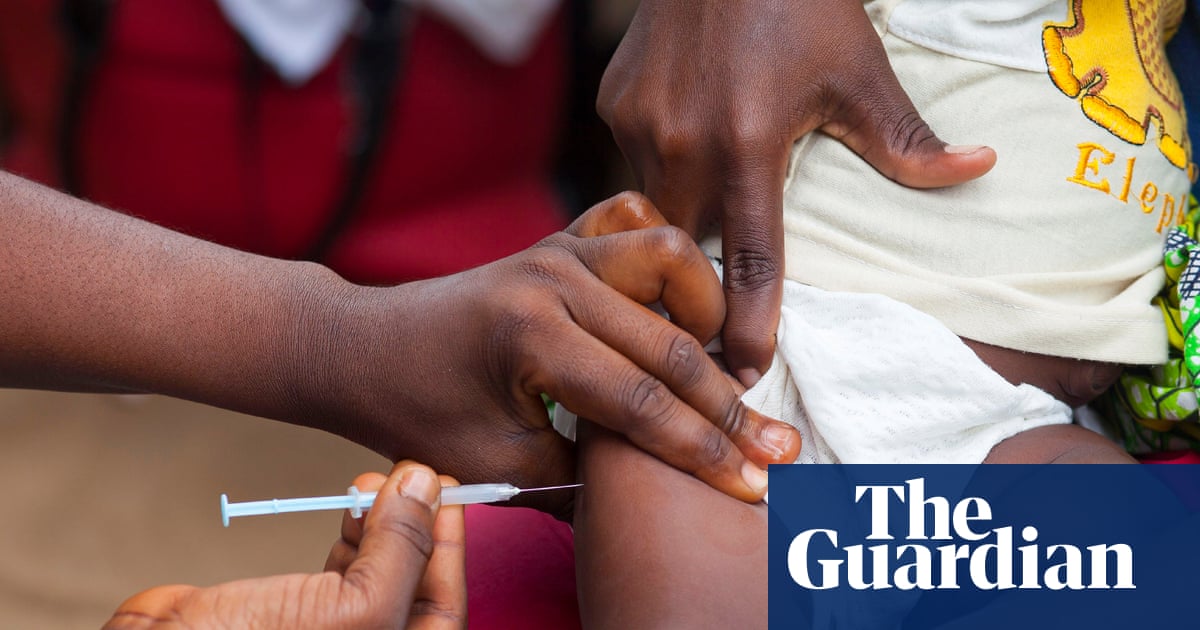

Controversial vaccine trial touted by RFK Jr gets go-ahead in Guinea-Bissau
Recommended dose of hepatitis B vaccine will be withheld from thousands of newborns by Danish researchers
A controversial research trial that will withhold hepatitis B vaccines from some African newborns was given approval to move forward this week.
It is a central part of the vaccine vision for Robert F Kennedy Jr, the secretary of the US Department of Health and Human Services (HHS) and a longtime vaccine opponent.
At an anti-vaccine conference last month, Kennedy praised the Danish researchers behind the trial and touted US-supported research on hepatitis B in newborns as exemplifying the Trump administrationâÂÂs agenda for vaccines, which has included slashing vaccine recommendations and casting doubt on the safety and effectiveness of shots.
Kennedy âÂÂwants to make it so we donâÂÂt use a birth dose here in this country,â said Paul Offit, an infectious disease physician at ChildrenâÂÂs Hospital of Philadelphia. âÂÂThatâÂÂs the goal.âÂÂ
Kennedy would never be able to do the trial in the US because of its significant ethical concerns, Offit added. âÂÂHeâÂÂs taking advantage of a developing country ⦠Is it because children in Africa are more expendable than children here?âÂÂ
Danish researchers plan to enroll 14,000 infants in Guinea-Bissau in the trial, giving the hepatitis B vaccine to half of the babies at birth and withholding it from the others for the first six weeks of life.
An ethics committee at the researchersâ home institution of the University of Southern Denmark voted this week to proceed with the trial, and officials in Guinea-Bissau have also greenlit the project, which the health minister, Quinhin Nantote, initially said was suspended after international uproar earlier this year.
Stig Børsen Hansen, a founding member who was one of two reviewers who presented the study to the Danish committee, resigned from the group in protest on Friday, citing major ethical issues with the study.
âÂÂYou are now enrolling newborns in a lottery to test a hypothesis,â Hansen said. The children who are randomly selected not to receive the birth dose of the vaccine, those who âÂÂlost the lotteryâÂÂ, face in their earliest days the risk of contracting hepatitis B, which can cause irreversible lifelong damage. âÂÂThey contract hepatitis B in the context of being part of a research project,â Hansen said, which made their infection happen, in effect, âÂÂby designâÂÂ.
Three other members of the committee have also resigned in protest.
The US Centers for Disease Control and Prevention (CDC) has reportedly set aside $1.6m in this yearâÂÂs budget for the project, and it will be matched with private funding from the Pershing Square Foundation, which was co-founded by the billionaire activist Bill Ackman, and the Bluebell Foundation.
The CDC, the Danish researchers, Pershing Square and Nantote have not responded to the GuardianâÂÂs questions about this trial.
The news that the trial was approved by the Denmark ethics committee was first reported on Thursday by CIDRAP News. This is the first time details of the updated protocol have been disclosed.
The Guinea-Bissau study protocol has changed since it was posted in January, according to details shared with the Guardian. The researchers will now test mothers for hepatitis B before they give birth. The babies of mothers who test positive will be given the vaccine and will not be included in the trial. But the babies of mothers whose tests are negative may be enrolled. The new protocol has not been shared publicly.
In previous research, half of children who contracted hepatitis B did so after birth, through community exposures. âÂÂThis virus can be transmitted casually,â Offit said. It can live on surfaces for up to seven days, and it can be acquired by sharing washcloths, toothbrushes and fingernail clippers. In addition, the hepatitis B test has a 5% false negative rate, which could provide false assurance that a birthing parent does not have the virus.
Decades of research make it clear that the vaccine would be beneficial, which means it would be unfair to place some children in the vaccinated group and some children in the unvaccinated group, said Henrik Støvring, a professor of statistics and pharmacometrics at Aarhus University in Denmark.
According to the Helsinki declaration, international medical research must be approved by ethics committees in both the host and sponsor countries.
The Danish research ethics committee at the University of Southern Denmark had never considered medical studies before, but it changed the rules in order to vote on this one. While committee members with expertise argued against approving it, the majority ruled to move forward.
âÂÂItâÂÂs very unusual to bring this into a committee like that,â Støvring said. The national ethics committee in Denmark oversees medical research, but this study was outside of their purview because it wonâÂÂt take place in Denmark.
Yet âÂÂI donâÂÂt see why you couldnâÂÂt do it in Denmark,â Støvring said of the trial. In fact, several conditions make it a better location. The hepatitis B vaccine is not usually given to newborns in Denmark unless the mother is positive for the virus, for which all pregnant people are tested in Denmark.
Guinea-Bissau has some of the highest rates of hepatitis B in the world, with about 18% of adults carrying the virus. While it may be transmitted from mother to child during birth, it could also be transmitted from another parent, relatives, siblings or caregivers. Children who are infected with hepatitis B in the first year of life are significantly more likely to develop severe outcomes, including chronic infection and liver cancer.
The Bandim Health Project, run by Danish researchers Peter Aaby and Christine Stabell Benn, has operated in Guinea-Bissau for decades and is closely enmeshed in the countryâÂÂs health system. At least one top official, the current director of public health, held a dual appointment with Bandim as recently as December.
Kennedy praised the Danish researchers at a recent anti-vaccine conference, calling them âÂÂthe deities of vaccine researchâÂÂ. Kennedy claimed that a prior study they conducted indicated that after vaccination, âÂÂyou can have mass injuries, and catastrophic injuries, and theyâÂÂre hiding in plain sight.â He did not mention that another follow-up study from the same researchers found no effects at all.
This study will focus on vaccination and mortality, as well as outcomes such as skin conditions and neurodevelopmental conditions. âÂÂThe main problem of this trial is that you have some very well-known bad diseases that you can protect with this vaccine,â Støvring said. âÂÂAnd what they then want to study is something highly speculative â in a situation where WHO and others are saying that you should give this vaccine at birth, period.âÂÂ
When asked about the study in a Thursday briefing, an official with the Africa CDC, which has opposed the trial, said there were âÂÂongoing discussionsâ between the US and Guinea-Bissau and more details would be shared shortly. Guinea-Bissau planned to begin vaccinating all newborns against hepatitis B in 2027, but they pushed the campaign back to 2028.
Kennedy and the Danish researchers were âÂÂtaking advantage of that delay in practicing standard care to put these children at risk unnecessarilyâÂÂ, Offit said. âÂÂWhat a terrible thing to do. What a horribly unethical and cruel thing to do.âÂÂ