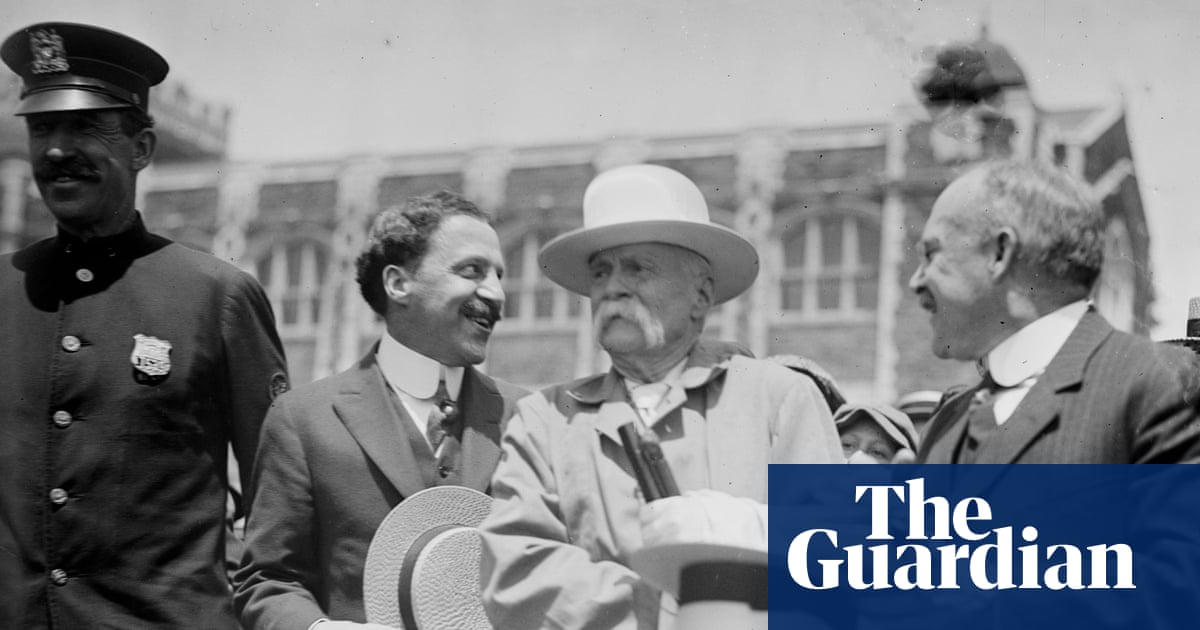

Champagne, cocaine and some very long walks: when pedestrianism ruled the sporting world
Crowds once flocked to see ambling athletes pull of amazing feats of stamina. Edward Payson Weston was chief among them
More than $1.4bn has been staked on prediction markets for this weekâÂÂs US midterm elections, according to CNN.
Though a lot of people are about to win â or lose â a lot of money, itâÂÂs hard to imagine any wagers as consequential as the election bet that birthed a sporting craze spearheaded by a chancer who walked and talked his way into becoming one of the greatest athletic stars of the 19th century.
Before ultrarunning, there was ultrawalking: pedestrianism. The Victorian-era fad started with laddish banter that got out of hand. A 21-year-old door-to-door bookseller named Edward Payson Weston made a wager with a friend that if Abraham Lincoln were elected president in 1860, Weston would walk 478 miles from the Massachusetts state capitol in Boston to the US Capitol in Washington. In less than 10 days.
âÂÂIt was simply a banter between ourselves while dining together one day, and I do not suppose that either of us at that time had the remotest idea of ever attempting such a task,â Weston wrote in his 1862 account, The PedestrianâÂÂs Adventures.
Born in Providence, Rhode Island, Weston was sacked from his job with a traveling circus because he was unable to perform as he recovered from being struck by lightning. He then worked as a copy boy for the New York Herald and discovered he had âÂÂgreat locomotive powersâ while rushing across Manhattan. A slim 5ft 7in, he had average speed but exceptional stamina. The New York Times would later describe his âÂÂelastic, swinging stride and legs that never seemed to tireâÂÂ.
Lincoln won the presidential election on 6 November 1860. On Christmas Day, Weston decided to stick to his word. Seeking to monetize his side hustle (as he put it, âÂÂI bethought myself to devise some means to defray my expensesâÂÂ), he assembled a support team to accompany him in a horse-drawn carriage and secured sponsors who would pay him to deliver circulars to homes he passed on his route.
He set off on 22 February. His media blitz seemed to have backfired when he arrived in front of a crowd at the Massachusetts state house to start his walk to Washington: he was accosted by a constable who arrested him for an unpaid debt.

After negotiating his way out of trouble, Weston arrived in Washington on 4 March, narrowly missing his 10-day goal by a few hours after taking a wrong turn. That night he attended LincolnâÂÂs inauguration ball. A couple of days later a member of Congress introduced him to the president, âÂÂwho seemed much surprised that he should possess such great powers of enduranceâ and offered to pay his fare home. (Weston refused, insisting he would walk back.)
So began the long career of a man dubbed the âÂÂWily Wobblerâ for his distinctive gait, albeit that it was soon interrupted by the civil war. Weston put his ability to traverse great distances to use as a Union spy and dispatch-bearer. After the war, thanks in large part to WestonâÂÂs feats and celebrity status, pedestrianism became one of the most popular spectator sports of the remainder of the 19th century, with grueling, torturous events held in venues including Madison Square Garden in New York and the Oval in London.
The phenomenon has unsurprisingly captured the attention of several chroniclers, including Nick Harris, Helen Harris and Paul Marshall, who wrote a biography of Weston, A Man in a Hurry, in 2012. The history of pedestrianism teems with bizarre incidents and exceptional athletic achievements. Its culture presaged todayâÂÂs commercialized, hype-driven and detail-obsessed sporting landscape.
This year is the 150th anniversary of WestonâÂÂs first British tour, which stoked transatlantic rivalries. A report in the Times in December 1876 describes Weston seeking to walk 505 miles in six days in a contest that started at midnight and was billed as Weston âÂÂagainst the worldâÂÂ. Three Englishmen were hired as pacers âÂÂto give a certain amount of zest to the affairâÂÂ, each walking for 48 hours and incentivized with rewards of up to ã60 (the equivalent today of ã6,250, or $8,400). The newspaper reported WestonâÂÂs early split times down to the second: âÂÂTen miles, 1h.53min. 50sec. ; 20 miles, 3h. 50min. 50 sec.â and so on. Even his pit stop was timed precisely: âÂÂWeston made but one stoppage, of 18min, 10sec, during which time his head and feet were bathed.âÂÂ
Another report describes Weston consuming beef tea and gruel during a walk of 55 miles in 12 hours around Trent Bridge cricket ground in Nottingham. Ever the showman, he walked backwards for half a mile and âÂÂ[accompanied] the band for a time on his cornetâÂÂ.
Weston treated pain by dousing his feet with whiskey and lashed his legs with a riding whip until he bled as he tried to stay awake during an 1870 attempt to walk 112 miles in 24 hours. His body was a source of fascination to early sports scientists as he seemingly pushed the limits of human endurance. During a walk in Britain in 1884, doctors examined his pulse and breathing rates, tracked his food and drink intake and took samples of his urine and feces. Weston was even at the center of a debate over performance-enhancing drugs after it emerged that he chewed coca leaves during one race, thereby ingesting traces of cocaine. Some walkers experimented with other actual or presumed stimulants, including champagne. But Weston abstained from alcohol before and during races, making him a role model for the temperance movement.
What pedestrianism lacked was a governing body. While one of its legacies is Olympic race walking, introduced as a standalone event for men at the 1908 London Games, the International Olympic Committee was not founded until 1894. Hucksters and opportunists including PT Barnum filled the void by staging and marketing races and settling rules.

Events were often highly lucrative. The leading British promoter, Sir John Dugdale Astley, an MP and retired lieutenant colonel, inaugurated a âÂÂworld championshipâ in 1878 with a prize for whoever could walk the farthest over six days. The winner received the Astley Belt and ã500, the equivalent today of ã54,000 or $72,000 in 2026. The first was won by WestonâÂÂs great rival, an Irish-American, Daniel OâÂÂLeary, who walked 520 miles around a track at the Agricultural Hall in Islington, north London (now the Business Design Centre).
As recounted in a New York Times article from 1879, a British walker who traveled to the US, Henry âÂÂBlowerâ Brown, gloomily watched a crowd of 3,000 hail Weston at Madison Square Garden and accused the American of deviously dissuading him from entering a money-spinning race. âÂÂ[Brown] is short and stout, and has the face of the English prize-fighter,â the writer observed. âÂÂHe sat in his box last night and drank lager, staring at the great throng which had assembled to greet his rival.â The article adds: âÂÂThe Times reporter attempted to talk with him, but found that he had no ideas worth communicating to the public. âÂÂBlowerâ Brown is a walker, and nothing else. His talents lie entirely in his legs.âÂÂ
The surge in betting on sports and politics in the present-day US is throwing up a range of legal and ethical concerns that echo the challenges faced by pedestrianism, which was hugely attractive to gamblers but vulnerable to race-fixing. As the author Matthew Algeo pointed out to NPR, there were many ways to manipulate contests given that spectators could wager on a variety of outcomes within races, such as who would be the first walker to drop out or the first to reach 100 miles.
During one high-profile, high-stakes walk around a Bradford pub in 1864, a leading British female pedestrian, Emma Sharp, walked 1,000 miles in 1,000 hours. As she approached her target, gamblers who had bet against her reportedly tried to scupper her attempt in various ways, from trying to trip her up to hurling burning embers at her feet and attacking her with chloroform. In response she was said to have armed herself with a pistol that she used to fire warning shots.
Pedestrianism declined in the 1890s as it fell victim to shorter and more watchable pastimes, such as bicycling and baseball. But the closing years of WestonâÂÂs life were no less colorful than his youth. In 1909, on his 70th birthday, he embarked on a walk from New York to San Francisco, aiming to complete the challenge in just 100 days. The public interest was so great that he chronicled his exploits in a series of dispatches for the New York Times, and schoolchildren were let out early to cheer him on. He arrived a little later than planned, having covered 3,895 miles in 104 active days (122 days including rest periods).
Weston remained remarkably vigorous into his mid-80s. In 1924, aged 85, he was reported to have fought off intruders who shot him in the leg at his home on a farm near the Hudson River in New York state. Despite all the rewards and endorsements he collected during his career â including a Weston sock brand â the New York Times reported that, towards the end of his life, he was living off a $150-a-month trust fund and had long ago separated from his wife. His demise was poignantly cruel: he was left wheelchair- and ultimately bed-bound after being struck by a taxi in Manhattan while walking to church in 1927 and died two years later at 90.