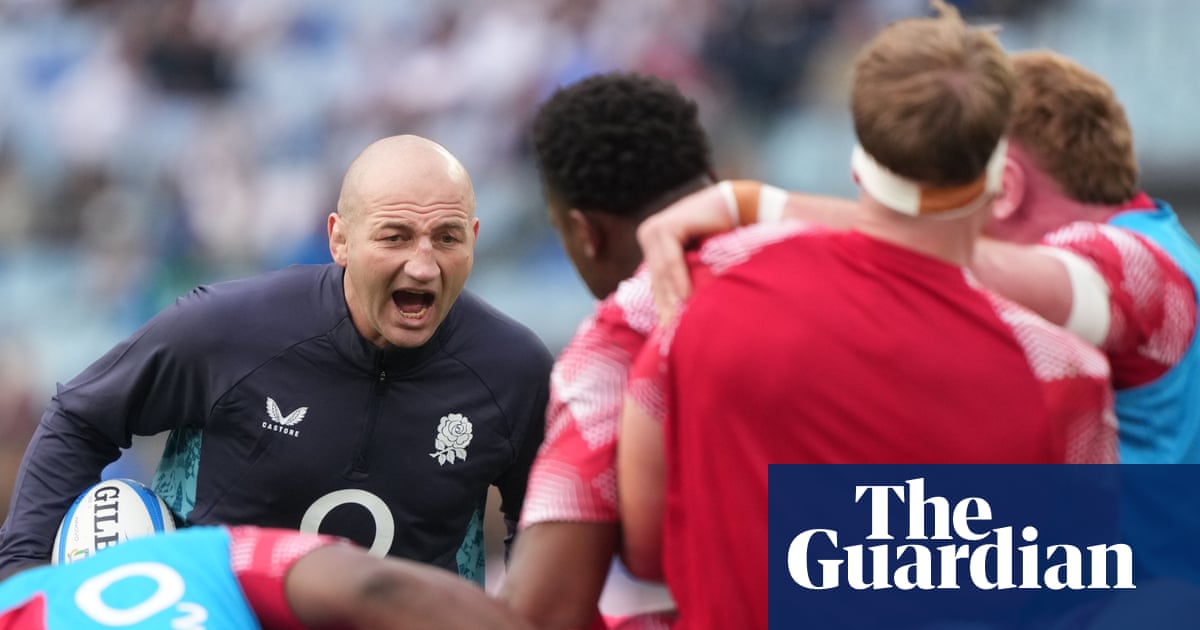

BorthwickâÂÂs England reign remains full of contradictions with World Cup a year away
EnglandâÂÂs identity under Steve Borthwick is not as clear as it should be this close to the tournament
It was not so long ago that the Rugby Football Union would host an annual Christmas bash. Executives, head coaches, assistants, members of staff and an invitation to the press pack. Mince pies and mulled wine, even a touch of merriment if we were lucky. Eddie Jones would sometimes make an appearance, but the mind goes back to one year when he did not.
To give him his due Steve Borthwick, his assistant at the time, did. He would probably rather have been anywhere else, but one of the more clear-eyed RFU employees, who had long-since figured out that the then forwards coach was destined for the top job, did their utmost to involve him. Alas, Borthwick soon had a long-distance train to catch and hours of in-depth analysis on a laptop ahead of him.
That anecdote feeds a narrative about EnglandâÂÂs head coach. That he is astonishingly diligent when it comes to analysis, but struggles with the more human elements of the job. Speak to anyone who has shared a dressing room with him and there are countless more. Equally, however, there is the time he surprised the 2023 World Cup squad by inviting their families to a training session and the compassion shown to Jamie George and Maro Itoje when his two captains were dealing with bereavements.
The point here is that Borthwick is much more complex than the robotic stereotypes that persist. Data-obsessed, yet a far more bold selector than his supposedly maverick predecessor. Full of contradictions.
So, too, are his England side. The players queue up to defend him and his gameplan. Yet they have produced their best performances when taking matters into their own hands and slipping the straitjacket.
Even the RFUâÂÂs recent public pronouncements about Borthwick have vacillated. A vote of confidence after the historic Italy defeat was unprecedented and read like an ultimatum. Less than two months later, BorthwickâÂÂs position had been strengthened after one of the unionâÂÂs cloak-and-dagger reviews. A few weeks ago, we learned his contract was being extended.
All of which makes it hard to assess where England stand, almost four years into his tenure and with one year to go until the 2027 World Cup. Are they contenders any more than they were in the final throes of JonesâÂÂs reign?
Borthwick leans heavily on statistics, but his record does not stand up to much scrutiny. He has overseen 28 victories from 48 matches, a 58% winning percentage, marginally worse than Stuart Lancaster.
It is a feature of BorthwickâÂÂs term that records achieved along the way have been unwanted.
Their heaviest home defeat at the hands of France, first losses to Fiji and Italy and the worst Six Nations performance in EnglandâÂÂs history. At the same time, there was the 12-match winning run and glimpses of what this team are capable of, occasions when Twickenham has rocked the rafters, but, in perhaps the greatest indictment, the absence of a statement victory away from home.
Borthwick did not want to take over as England head coach in December 2022 â nine months before he was supposed to â but could not say no. It is to his credit that he guided England to third place in the World Cup, losing to South Africa in the semi-finals by a point, all the more so after a catastrophic warm-up campaign. That he held his nerve despite losing at home to Fiji is a testament to his resilience because there were times he looked as if he might crumble.
It is also true that England could not have wished for a more straightforward draw in France, but then Borthwick had insisted his side âÂÂwere not good at anythingâ soon after taking over. In many ways, a short-term run-up to a World Cup campaign is perfect for someone whose coaching credentials, in the true sense of the word, cannot be questioned.
As the ever excitable Jonny May said after EnglandâÂÂs third-place win over Argentina: âÂÂWeâÂÂre starting to see what a genius Steve is. You wonâÂÂt find a harder working man and his approach to the game is a little bit like Alan Turing. If anybody is going to crack the code to rugby, it will be Steve. HeâÂÂs got an analytical brain, evidence-based, scientific, Spock-like approach.âÂÂ

The trouble is that the manner in which EnglandâÂÂs third-place finish was achieved has entrenched the prevailing narrative. Rassie Erasmus has hit upon a similar theme, if not as complimentary as May, the South Africa coach describing Borthwick as a coach who âÂÂthinks like a machineâ and as one who âÂÂchases trendsâÂÂ. The obvious inference being that he is not one who sets them.
The second part of BorthwickâÂÂs tenure began at the 2024 Six Nations. He insisted English rugby had turned a corner, effectively signalling this was when he was initially expecting to take over. Two steps forward, two steps back would be a better way to describe the ensuing period. It is hard to argue that any corners have been turned.
The championship began well enough, Borthwick was quick to put out new faces and in Immanuel Feyi-Waboso, who made his debut against Italy in Rome, you could argue there is no more important player to EnglandâÂÂs hopes in Australia than the Exeter winger.
In round three, England arrived in Edinburgh with two wins from two but the wheels came off spectacularly at Murrayfield. Borthwick said his team had âÂÂplayed smallâÂÂ, that the jersey had weighed heavy and Itoje bemoaned âÂÂtip-tap, hot-potato rugbyâÂÂ. A weekâÂÂs soul-searching at a training camp in York, when Borthwick is understood to have been implored to give the players more time to learn attacking structures, followed.
It paid off with a thrilling win over Ireland and though the campaign ended with a narrow defeat in France, the performance suggested England were rounding the bend.
Two more narrow defeats in New Zealand were greeted with optimism, but then came the departures of Aled Walters and Felix Jones, key members of the backroom staff. Beginning the 2024 autumn with three defeats, each more demoralising than the next, turned the pressure dial up, but Borthwick survived his first crisis, helped because the RFU chief executive, Bill Sweeney, was busy trying, and failing, to quell a revolt over his seven-figure salary and bonus.
The 2025 Six Nations began with another narrow defeat, but England broke the dam at home to France and proceeded to embark on a 12-match winning run. It is the most prosperous period of BorthwickâÂÂs tenure and included a stunning 68-14 win in Wales and an autumn clean sweep.
Pull back the curtain, however, and fundamental to EnglandâÂÂs winning streak was that they had stolen a march on their rivals in adapting to law tweaks around the aerial contest. When the rest caught up, England could not cope, lost four straight Six Nations matches and Borthwick was suddenly clinging on again.
A heavy defeat by South Africa this summer before wins over Fiji and Argentina have done little to move the needle. Hitting out at the âÂÂnegativity committeeâ when asked about EnglandâÂÂs indiscipline suggests Borthwick is still feeling the heat.
When it comes to coaching, he clearly knows his onions. Well-placed sources often describe him as a âÂÂworld-class forwards coachâÂÂ, which is a compliment, but again infers he is not quite up to the top job. Listen to the players wax lyrical about his methods, witness the fight that they demonstrated in patches against the Springboks and they have not all given up on him yet, however.
It is said there is a generational divide in the camp and a split of opinions along those lines about how best to play. Perhaps that explains the crossed words between Itoje and Fin Smith during the loss to Italy in March. But there is no mutiny yet and George was unequivocal after this yearâÂÂs Six Nations: âÂÂSteve is one of the best coaches IâÂÂve ever worked under. Under Steve I think we will be right up there with the favourites to win the World Cup in 2027.âÂÂ
It is said he treats his players like princes, but is considerably more strict with his staff. A close look at his staff certainly says a lot about Borthwick and his tenure. The most pivotal moment of this World Cup cycle could be the departures of Walters and Felix Jones in the summer of 2024.
Waltersâ reasons for heading to Ireland are easier to understand. His wife is Irish and he had strong ties from his time with Munster. Those of Jones are far more opaque, but clearly Waltersâ decision to leave influenced his own, so, too, a difference of opinion with Borthwick in New Zealand. That Jones was forced to work out his notice by the RFU underscored what an odd situation it was.
Equally strange is that Borthwick has steadfastly appointed assistants of a certain type. Nick Evans, Byron McGuigan, Tom Harrison, Lee Blackett, Kevin Sinfield and Joe El-Abd had no experience of international coaching. All of which adds fuel to the argument that when it comes to coaching Borthwick struggles to relinquish control.
At other times, however, he has impressed with a willingness to delegate. Walters was a clever appointment because he is a vibes man, which Borthwick clearly isnâÂÂt. George was a clever choice of captain because he can connect with supporters in a way Borthwick canâÂÂt. Sinfield serves as a pastoral figure to the squad in ways Borthwick does not. The problem is, when these people either move, or are moved on, from their roles, they leave a void.
The contradictions continue to mount as we enter World Cup year â even the performance in their last outing, against Argentina, was Jekyll and Hyde. Sensational for 40 minutes, substandard thereafter and it all leaves you with the feeling that EnglandâÂÂs identity is not as clear as it should be this close to a World Cup.
That first half against Argentina, the sense of liberation in defeat in Paris â admittedly when they had little to lose â must be the blueprint if Borthwick is to win over the public in the next 12 months. âÂÂIf we have a pretty ropey autumn, on the back of building some momentum over the summer, I think we will need to have a pretty hard look at ourselves,â said the fly-half Smith recently.

OâÂÂShea has said it is âÂÂnot even remotelyâ a possibility that Borthwick is sacked before next yearâÂÂs World Cup, but he underestimates the power of the fanbase, whose disapproval did for Eddie Jones. Whether Sweeney has the appetite for change so close to another World Cup is another question.
It would be misguided to believe BorthwickâÂÂs contract extension through to the following Six Nations has raised the temperature any higher. It merely buys the union time when deciding whether or not to sack Borthwick and who to replace him with.
Make no mistake, his tenure hinges on the World Cup in Australia, assuming he makes it that far.