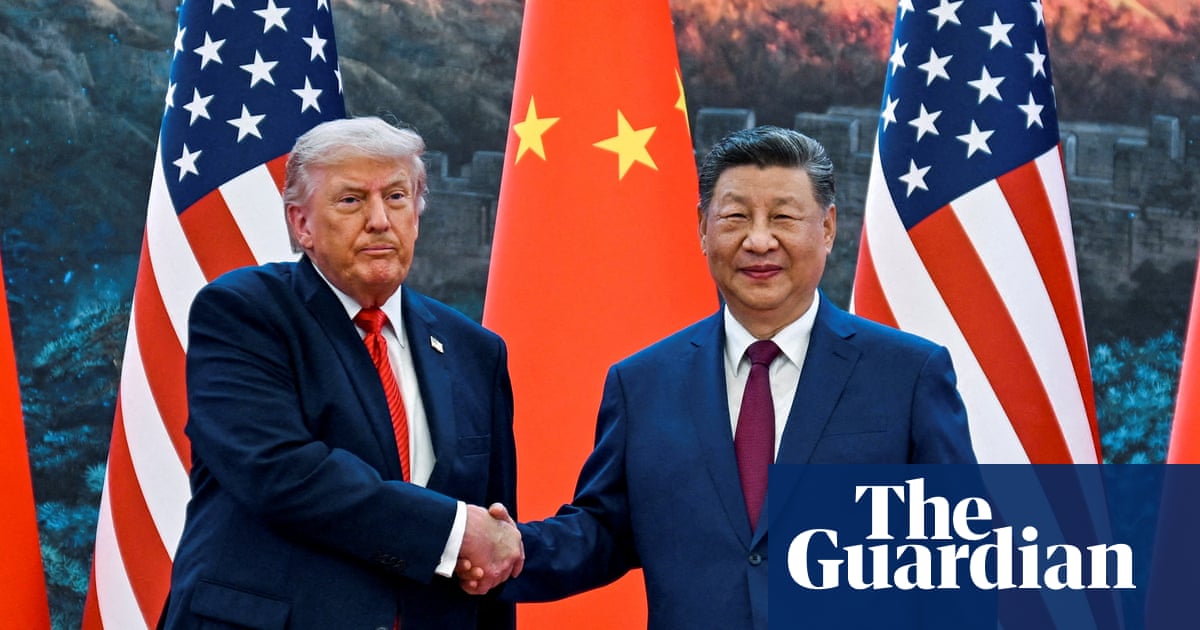

AI looms large over Trump-Xi meeting amid deep distrust between US and China
Fears persist about Trump âÂÂsucking upâ to Xi on Taiwan, but few concrete outcomes anticipated from US meeting
When Xi Jinping, ChinaâÂÂs leader, touches down in Maryland on Wednesday, he will step out into the arms â perhaps a hug, if Donald TrumpâÂÂs wishes come true â of a US president who has shown China more bonhomie than any of his recent predecessors.
The meeting between Xi and Trump this week will be the second time that the leaders of the worldâÂÂs two biggest economies have talked face to face this year. At the previous summit, held in Beijing in May, there was much talk of building a âÂÂstrategic stabilityâ between the two powers. But there was little by way of concrete outcomes: the countries remain at loggerheads over trade, export controls and geopolitics.
Despite the goodwill built in May, few anticipate any major breakthroughs this week when Xi makes his first state visit to the US since 2015. âÂÂExpectations are very low,â said Bonnie Glaser, a managing director at the US thinkthank the German Marshall Fund. âÂÂNobody is using the term âÂÂdeliverablesâÂÂ.âÂÂ
One area in which Trump and Xi may reach some consensus is on artificial intelligence safety. Tech executives including Jeff Bezos of Amazon, Sundar Pichai of Alphabet, Sam Altman of â OpenAI, Tim Cook of Apple, Elon Musk âÂÂof âÂÂTesla, Mark Zuckerberg of Meta and Jensen Huang âÂÂof Nvidia will reportedly âÂÂattend a â state dinner at the White House on Thursday evening.
âÂÂWhoever wins AI, winsâÂÂ
In the past few weeks, the US has been beset by worries that AI is progressing too fast, but that the US must strive to defend its lead over China in the frontier technology â and Trump has pushed back hard against calls to slow its development. âÂÂWeâÂÂre leading China in AI,â Trump said recently. âÂÂAnd frankly, I want to â keep it that way, because whoever wins AI, wins.âÂÂ
On Sunday, Scott Bessent, the US treasury secretary, concluded talks with the Chinese vice-premier He Lifeng by proposing an AI safety mechanism to be established between Washington and Beijing. The mechanism appears to stop short of a major safety agreement.

TuesdayâÂÂs front page of the PeopleâÂÂs Daily, the official newspaper of the Chinese communist party (CCP), ran an article saying that the US and China should âÂÂmake AI a new frontier for China-US cooperationâ and âÂÂmake good use of the intergovernmental dialogue mechanism on AIâÂÂ.
António Guterres, the UN secretary general, called on the two countries to establish a dialogue on AI similar to the communication between the US and the Soviet Union during the cold war. âÂÂGovernments with the greatest AI capabilities have the greatest responsibilities to humanity, to establish channels for dialogue, transparency, trust and cooperation,â Guterres said.
Still, China does not agree with US assessments about the grave threat posed by its AI developments. ChinaâÂÂs foreign ministry responded to an essay by Dario Amodei, the Anthropic chief executive, that called for Washington to impede BeijingâÂÂs progress, by saying âÂÂfearmongering, confrontation and vicious competition will only disrupt the process of global AI governanceâÂÂ.
China has already taken steps to mandate the labelling of AI-generated content, to restrict the ability of children to use AI companions and, in keeping with the CCPâÂÂs desire to keep tight control on all information, to restrict what can be said by chatbots.
China may be more concerned with what it sees as US attempts to limit is growth. Washington has for years restricted ChinaâÂÂs ability to buy the most advanced semiconductors needed for AI development, and this year the US banned the sale of Chinese humanoid robots.
Amanda Hsiao, China director at the Eurasia Group, a political risk consultancy, said: âÂÂChina doesnâÂÂt necessarily see the threat in the same way that the US does. There is a lot of distrust thatâÂÂs in the way of cooperation. The Chinese are inclined to think of every US call for safety standards or calls from companies for pacing the frontier as means of suppressing Chinese development.âÂÂ
Trade tensions persist
Next on the agenda will be trade. Washington and Beijing struck a temporary truce in the trade war last year at a summit in South Korea. That truce â which included a pause on tariffs, as well as an agreement for Beijing to loosen restrictions on the export of rare earths â will expire in November.
Beijing is hoping for a longer-term commitment to banish tariffs, which pose a threat to ChinaâÂÂs export-driven economy. But reports suggest that the US is unwilling to agree to anything that would weaken its future bargaining power.
Glaser, of the German Marshall Fund, said: âÂÂThe US side views this as leverage over China and ensuring that they can get deliveries of the rare earths and magnets that American companies need.âÂÂ
China may not feel the need to negotiate, either. Despite the trade war, ChinaâÂÂs exports have surged, and it is on track to reach a $1tn trade surplus for the second year running.
âÂÂThis is not a G2âÂÂ
One aspect of the relationship that has shifted since May is the issue of Taiwan. After the Beijing summit, Xi secured a major concession from Trump, when he agreed to pause a $14bn package of US arms sales to Taiwan. US presidents have traditionally excluded the issue of arms sales to Taiwan, a self-governing island that China claims as part of its territory, from the US-China relationship.
But Trump has described future weapons sales as a âÂÂvery good negotiating chipâÂÂ. The US is now reportedly considering delaying further sales until after the Apec and G20 summits later this year, where Trump and Xi are expected to meet again.
TuesdayâÂÂs PeopleâÂÂs Daily article said that a stable China-US relationship would âÂÂbring more peace, prosperity, and progress to the worldâÂÂ. But for all the talk in Beijing of âÂÂstrategic stabilityâÂÂ, Scott Kennedy, a senior adviser at the Center for Strategic and International Studies, notes that âÂÂthis is not a G2â alliance of the worldâÂÂs two dominant powers.

âÂÂThey are finding a way to manage the bilateral relationship, but they are not whatsoever working together as co-stewards of the international order,â Kennedy wrote in a recent commentary.
China is IranâÂÂs biggest oil buyer and trading partner. After Trump launched strikes against Iran in February, China reportedly put pressure on Tehran behind the scenes to come to the negotiating table. It also slashed oil imports by nearly one-quarter in the first six months of the war, limiting global inflation.
Da Wei, a professor of international relations at Tsinghua University, wrote in a recent essay that this reflected âÂÂa more confident Chinaâ that âÂÂdid not exploit the difficulties that the United States faced in the war with IranâÂÂ. But Beijing has otherwise done little to resolve the crisis in the Middle East, which it sees as being a mess of TrumpâÂÂs making.
Last month, Bessent announced an âÂÂeconomic D-dayâ against Iran and its enablers. The US treasury secretary subsequently claimed to have had âÂÂvery good private discussionsâ with Chinese officials over ending the countryâÂÂs economic ties with Iran.
When it comes to Ukraine, Beijing has shown unwavering support for Moscow since RussiaâÂÂs president, Vladimir Putin, launched his full-scale invasion in 2022.
Ali Wyne, senior research and advocacy adviser on the US and China at the International Crisis Group, said: âÂÂThe contrast between the worldâÂÂs incumbent power and its principal challenger will be even sharper in Washington than it was in Beijing in May: while the former is mired once more in the Middle East and straining longstanding alliances, the latter is casting itself as a stabilizing counterweight and the leading champion of a more multipolar order.âÂÂ
High vibes, low ambition
The lack of momentum on thorny geopolitical issues, combined with ChinaâÂÂs emphasis on maintaining âÂÂstrategic stabilityâ above all else, means that few expect there to be major breakthroughs at this weekâÂÂs summit.
Hsiao added: âÂÂIt is going to be yet another summit that is high on positive vibes and relatively low ambition in terms of substance.âÂÂ
Democrats in Washington have urged Trump to raise concerns over ChinaâÂÂs treatment of political prisoners, but are already sounding the alarm that he could make too many concessions to Xi.
Senator Tammy Duckworth told an audience at the Center for American Progress thinktank on Tuesday: âÂÂHeâÂÂs not very good at making deals with the PRC [PeopleâÂÂs Republic of China] that they actually follow through on. If you look at the result of the last summit they had, they promised the purchase of 200 Boeing aircraft and $17bn in agricultural products. Neither one of those has come to pass.âÂÂ
âÂÂAt the same time, he violated our longstanding position on Taiwan by engaging in discussions on arms sales to Taiwan with President Xi,â Duckworth added. âÂÂI worry that itâÂÂs going to be a repeat of that and President Trump basically spends too much time sucking up to President Xi. HeâÂÂs very distracted. When he focuses on the Indo-Pacific, itâÂÂs about him cosying up to an authoritarian regime at the expense of our friends and allies in the region.âÂÂ
Additional research by Yu-chen Li