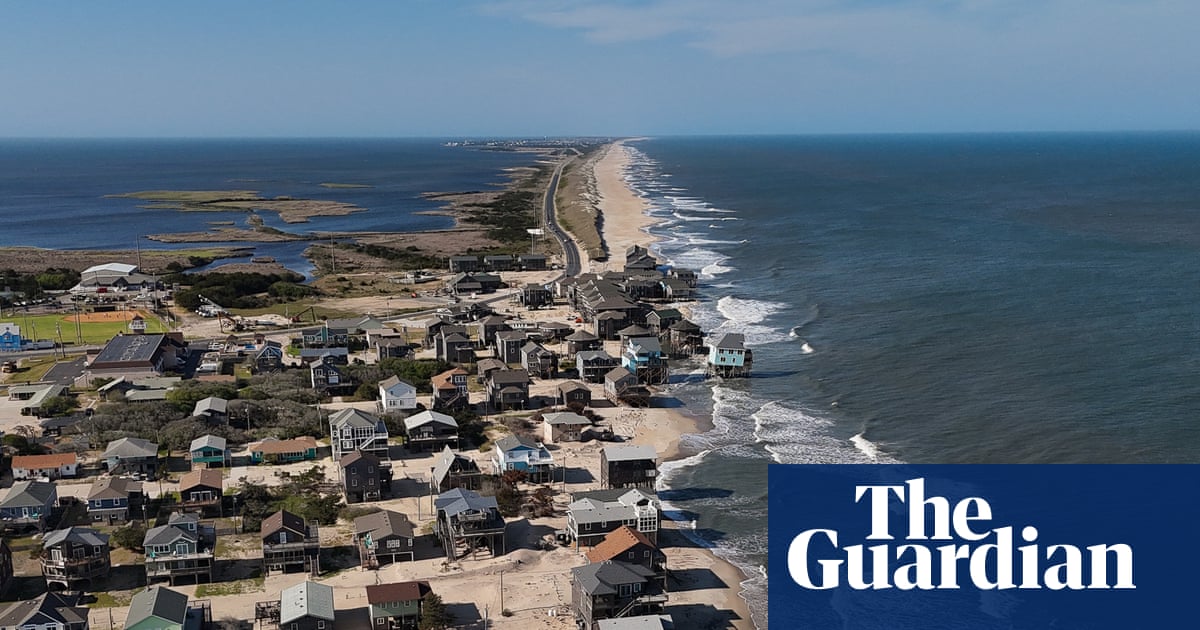

A lackluster response to North Carolina flooding disasters is eroding Republican support in one county
At more than $52m, the race has become the most expensive in US history, but residents are fed up with flooding
Aida Havel mulled her fate over coffee after working the early voting polls all day in Kill Devil Hills, North Carolina. âÂÂWe are trapped,â she concluded.
The Dare county commission candidate lives about 50 miles (80km) south, on Hatteras Island on the stateâÂÂs Outer Banks.
After 8pm, she may as well live on Mars.
Highway 12 is out. Again. Bad storms wash debris onto the road, the detritus of beach houses ruined by climate change, Havel said. Houses collapse because insurers wonâÂÂt cover demolition until theyâÂÂre knocked flat into the sand. Their skeletons trap the living.
Havel fumed. A 45-minute drive has become a four-hour logistical exercise.
âÂÂI got in the ferry line at 8am, and there was an 8am ferry, and I knew I wasnâÂÂt going to make that one,â Havel said. âÂÂBut there was a 9.30 ferry. I didnâÂÂt make that one. I got on the 11.00 ferry, and I was the very last car on, and they told me I had to fold in my my side mirrors, and they just squeezed me on. I took the ferry over to Stumpy Point, and I got off at 1.05. And then I had to drive to Manteo. It was a 30-minute drive to Manteo.â She rented an Airbnb for the week, rather than bother with it again.
The North Carolina coast is called the graveyard of the Atlantic, for the thousands of shipwrecks off Cape Hatteras. Republicans may soon add their ambitions to the seaâÂÂs tally.
The Outer Banks are part of North CarolinaâÂÂs first congressional district, a seat currently held by conservative Democrat Don Davis. He is locked in a tough race against Republican Laurie Buckhout, made even tougher by the state legislature, which redrew congressional maps in their favor last year and packed more conservative voters into the district.

Tar Heel Republicans fare poorly in storms of late. A lackluster response by the Trump administration to Hurricane Helene is contributing mightily to an impending Republican loss in North CarolinaâÂÂs 11th congressional district in the western mountains.
We are trapped. Residents have heard that line before, from people in Spruce Pine and Burnsville and Green Mountain riding out flooding two years ago on a roof in a Buncombe county holler.
The North Carolina coast is a riot of seaside resorts and kitsch tourist spots. Asheville brings in more tourism money. But still. The road outage is killing the business, Havel said.
âÂÂWeâÂÂve already had to cancel two fishing tournaments,â she said. âÂÂThe money that people make in the shoulder season keeps them going throughout the winter. TheyâÂÂre losing every bit of that revenue right now. Not only the restaurants, not only the shops, the house cleaners, you know? I mean, itâÂÂs everybody, it affects everybody and itâÂÂs just a complete economic disaster. Dare county is the fourth-highest tourism driver in North Carolina ⦠but we canâÂÂt get help to fix the road.âÂÂ
Highway 12 might be a state road, but the National Park Service shares jurisdiction over the seashore and the road is essential infrastructure. On 22 October, Fema announced a $101m package of relief measures for North Carolina, some of which will pay for teetering Outer Banks houses to be demolished. But the shoreline is moving in more than 15ft every year, and there is no long-term plan.
Dare county usually votes red. It may still vote for Republicans, despite the federal governmentâÂÂs indifference to the disaster on the other side of the state.
Affordability matters, âÂÂbut it may not be No 1 here,â said Craig Jones, a Republican party activist in Dare county as he was handing out flyers outside the countyâÂÂs polling place. âÂÂWe are polarized here, so a lot of Republicans are afraid of the Democrats taking over and losing individual freedom, taxes going up, socialism,â he said. âÂÂDare has a tendency to be a conservative, family-oriented place. Get a lot of vacationers here, but the locals tend to be Republican, tend to be conservative, and they like their individual freedom.âÂÂ
He said he expects Buckhout to take Dare county: âÂÂThe other counties, I donâÂÂt know. ⦠but for Dare, Laurie Buckhout will win Dare county, and you can take that to the bank.âÂÂ
That was the Republican plan when North Carolina lawmakers redrew congressional districts earlier this year. North Carolina splits its vote almost evenly between Republicans and Democrats. But its congressional delegation has 10 Republicans and four Democrats.
North CarolinaâÂÂs first congressional district voted for Donald Trump by one point in 2024. Davis â the most conservative Democrat left in Congress â prevailed nonetheless, beating Buckhout by about 6,300 votes.
For the rematch, North CarolinaâÂÂs Republican-dominated legislature spooned out Black voters in reliably Democratic counties like Wilson and replaced them with rural Republicans along the Virginia border and the coast. A district that favored Republicans by one point became one that favored them by about 10 points.
At least, that was the plan.
âÂÂWell, they made that area thatâÂÂs too big,â said Robert Thompson, a Tyrrell county commissioner, after voting at the county courthouse last week. Thompson voted for Buckhout. He attributes the closeness of the contest to the geography a Republican candidate is forced to campaign in.

âÂÂTwenty counties. ItâÂÂs a quarter of the state,â Thompson said. âÂÂIâÂÂm not sure if that was a good idea or not ⦠It is a big area to cover. I think thatâÂÂs part of it. I mean, justâÂÂ20 counties is hard to get to, you know.âÂÂ
Democratic voters tend to be concentrated in urban areas, which make them easy to reach. Republican voters tend to be rural and spread out. The redistricting of the first congressional district exacerbates this structural disadvantage for Republicans.
Even when the road isnâÂÂt washed out, a place like Buxton is an all-day trip to plan. The regional airport in New Bern runs about four flights a day. The last Hatteras ferry usually leaves at 6.15pm, though the emergency has prompted later runs.
Davis has been out there five times this year, Havel said.
âÂÂWhen we got gerrymandered into Congressman DavisâÂÂs district, I thought, this is the first good thing thatâÂÂs ever come out of gerrymandering that IâÂÂve ever seen,â she said. Her previous congressman, Greg Murphy, had not once met residents of Hatteras Island in the 11 years she has lived there, she said: âÂÂNot a single time. Not when the houses fell in, not to have a town hall meeting. Nothing.âÂÂ

The islands are unincorporated territory â there are no mayors or city council members advocating for their residents, she said. Hatteras Island and Ocracoke Island are part of the Cape Hatteras national seashore, a federal preserve that merits federal involvement, even though Highway 12 is a state road, she said. âÂÂLaurie Buckhout came once, but she only came to Rodanthe, to my knowledge, and didnâÂÂt go any further,â she added.
BuckhoutâÂÂs campaign did not respond to repeated requests for comment. Davis was also unavailable for comment, his campaign staff said.
Blackwater cypress gum swamps give way to seas of white cotton farmland along Interstate 64 on the road from the coast for Rocky Mount. The rusted red roofs of ramshackle tobacco barns along the way are disappearing with development and tobaccoâÂÂs long decline. But much of eastern North Carolina remains farm country.
Most of those farmers are white. It was not always so. At the turn of the 20th century, a quarter of North CarolinaâÂÂs farmers were Black, concentrated in places like Edgecombe county. That figure has fallen to 3% now, a product of agribusiness consolidation and the legacy of discrimination by the Department of Agriculture and lenders.
Richard Joyner, a pastor, Vietnam veteran and former council member for the city of Rocky Mount, is one of those farmers. He runs a 100-acre (40-hectare) vegetable farm in Conetoe (pronounced kuh-NEE-tuh) providing âÂÂfood as medicineâ in a bid to address health problems in an area of persistent high poverty.
Joyner advocates, loudly, for equity and inclusion as a guide to government policy â dirty words in TrumpâÂÂs America. Joyner is supporting Davis. But the son of a sharecropper is also fairly cynical about it.
âÂÂBrother, if I donâÂÂt get my church, my family doing what we need to do for sustainability on the ground level, and learning how to start investing back and raising the best children, sustaining in our communities, Don ainâÂÂt going to change shit for me,â Joyner said.
He offered a prayer.
âÂÂWhen people like Don and other people get in these places, God, I pray for a sense of holy conscience from our ancestors that will rise up in them. If they donâÂÂt do the right thing, I pray they would whoop their Black ass. And let them have no peace until the people they serve have peace. If there is no justice, there is no peace. Tell those that want to give us handouts to go to hell. We donâÂÂt want no handout. We want equity, we want inclusion, and we want justice. And we wonâÂÂt settle for nothing less.âÂÂ
DavisâÂÂs voting record reflects the competitive nature of his district. He has broken with Democrats on border security, supported the Laken Riley Act, which increased penalties on undocumented immigrants accused of violent crimes, and was one of a handful of Democrats to sign on to a largely symbolic House resolution condemning socialism.
He has allied with agribusiness interests, which has come at times at the expense of environmentalists by voting with Republicans to block environmental mandates. He has been critical of carbon taxes, even while supporting research into carbon sequestration.
This middle ground is rare territory in American politics today. GovTrack ranks Davis as the most conservative Democrat in Congress, more so than some Republicans. That attracts cross-party voters in a state with a split political personality.

âÂÂTo me, the biggest concern is that deficit weâÂÂve [got] going on thatâÂÂs going up a trillion dollars a month,â said William Mand, a retired US Navy sailor, voting in Rocky Mount. Military issues are also top of mind for him, he said. Mand identifies as a Republican, and remains supportive of Donald Trump. But heâÂÂs a split-ticket voter.
Mand said he voted for Davis when early voting began in the state earlier this month. Both Buckhout and Davis are military veterans. âÂÂThey both have enough credentials around military issues to be able to legislate intelligently. I give them a wash there ⦠IâÂÂve seen all the ads on what heâÂÂs done and what sheâÂÂs done, and I had a more positive feeling about him than I did about her.âÂÂ
Before the supreme court blew up the protections of the Voting Rights Act, state lawmakers kept the predominantly Black rural counties in eastern North Carolina in a single district that was safe for Democrats. Black lawmakers have represented North CarolinaâÂÂs Black belt continuously since Eva ClaytonâÂÂs election to the US House in 1992.
Today, Davis must court Republicans to survive politically. This worries Joyner.
âÂÂItâÂÂs past worrying,â he said. âÂÂItâÂÂs already happening ⦠Don is going to do what it takes to keep that seat. And if he thinks that the white people and these white farmers have been the one that helped him to stay there, even though Richard Joyner busts his ass for him ⦠you know, Richard donâÂÂt have the money or the influence he thinks to keep turning this district for him.âÂÂ
Rocky Mount is the Democratic stronghold in the district, and where Davis hangs his hat. The city is predominantly Black and has a poverty rate of about 20%. Recovery from the lethal devastation of Hurricane Floyd in 1999 defined the city for a decade. Though the green shoots of development can be seen in the renovation of Rocky Mount Mills and a well-attended event center downtown, the benefits have flowed unevenly.
A railroad track divides the city between Nash county, which is relatively middle class and at the edge of commuting distance to whatâÂÂs known as the research triangle, and Edgecombe county, which remains underdeveloped.
Rural healthcare access in eastern North Carolina is especially desperate, said Andre Knight, a city council member in Rocky Mount. The 2023 closure of Martin general hospital in Williamston has left some people hours away from emergency medical care. Advocating for economic development has to take priority over the culture war issues, he said.
âÂÂWhether somebody goes in a bathroom or not, when you canâÂÂt even buy gas or put food on your table: what is more important?â Knight said. âÂÂWhen you go to Washington, when you go to represent, thatâÂÂs the kind of thing they need to advocate for.âÂÂ
Roy Cooper, the former Democratic governor now running for US Senate, is from Nash county. He has campaigned across the state on a platform of affordability. That resonates in Rocky Mount and the surrounding area, which has a ring of highly competitive statehouse and state senate districts that may determine the balance of power in state government.

âÂÂWeâÂÂre sort of a purple-ish district in a purple state,â said Lorenza Wilkins, the Democratic nominee for statehouse in congressional district 25, which covers an unusual mix of urban, suburban and rural voters in Nash county. Wilkins is challenging the state representative Allen Chesser in a rematch after a 2024 contest decided by fewer than 500 votes on about 50,000 ballots.
âÂÂYou think about monopolies on good ideas. No party has that,â Wilkins said. âÂÂAffordability continues to be the top concern. Folks are genuinely concerned about how they can continue to afford groceries, how they can afford to have childcare for their young people, how they can afford their utilities. Naturally, gas prices are really pinching all of us at this point. So, folks are just really concerned with the basic everyday needs.âÂÂ