- Senate Majority Chief John Thune filed a cloture movement on the CLARITY Act, maintaining the crypto market construction invoice alive for attainable motion in September.
- The laws nonetheless faces a tough 60-vote threshold, with disputes over authorities ethics, illicit finance guidelines, and stablecoin rewards remaining unresolved.
- Passage might present regulatory certainty for Bitcoin, altcoins, DeFi, and institutional crypto buyers, however failure in September might successfully finish the invoice’s 2026 prospects.
The CLARITY Act has taken its largest procedural step but after Senate Majority Chief John Thune filed a proper cloture movement Saturday morning. The transfer retains the sweeping crypto market construction laws alive after lawmakers did not convey it to a vote earlier than the August recess.
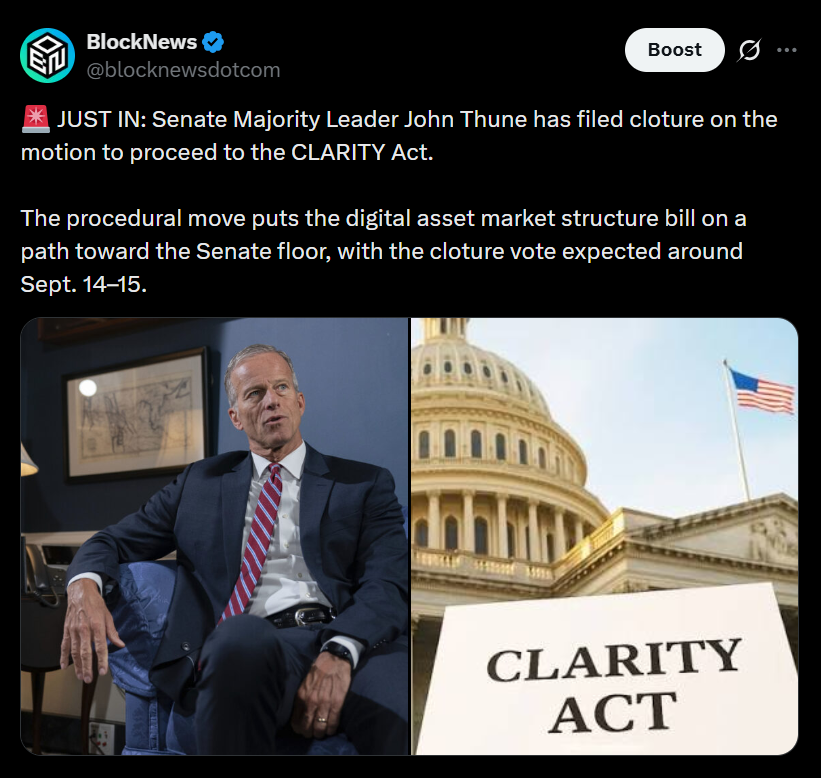
The submitting units up the potential for an early procedural vote when senators return to Washington in September. With Congress dealing with a brief legislative window earlier than consideration shifts towards the November midterm elections, the approaching weeks might decide whether or not america lastly establishes a complete regulatory framework for digital belongings.
What the Senate Cloture Submitting Means
Thune filed cloture on the movement to proceed with the laws, an essential procedural step required earlier than senators can start contemplating the invoice on the ground.
The submitting doesn’t imply the CLARITY Act has handed and even assure a closing vote. As a substitute, it begins a course of designed to beat opposition and transfer laws towards debate.
After the required ready interval, senators can vote on whether or not to invoke cloture. If sufficient lawmakers assist the movement, the Senate can transfer ahead with debate earlier than ultimately contemplating closing passage.
That makes September technically workable. If negotiators resolve their remaining disagreements throughout the recess, lawmakers might transfer by means of the procedural levels inside the Senate’s restricted September session.
Democratic Help Stays the Greatest Problem
The larger downside shouldn’t be the calendar however the votes.
Republicans maintain 53 Senate seats, that means they can’t attain the 60-vote cloture threshold with out Democratic assist even when Republicans stay united.
Authorities ethics guidelines stay some of the tough points. Democrats have pushed for stronger restrictions overlaying senior federal officers and their involvement with cryptocurrency tasks, with President Donald Trump’s crypto pursuits changing into central to the negotiations.
A bipartisan ethics compromise has reportedly been introduced to the White Home. How the administration responds might play an essential position in figuring out whether or not sufficient Democrats in the end assist the laws.
Lawmakers are additionally negotiating provisions overlaying illicit finance, AML and KYC necessities, decentralized finance, and stablecoin rewards.
September Might Determine the CLARITY Act’s Future
The recess offers negotiators extra time to resolve these disagreements earlier than senators return.
One risk is that Republicans, Democrats, and the White Home attain compromises earlier than the procedural vote. That might remodel the cloture vote into a real try and advance the laws towards passage.
The choice is that main disagreements stay unresolved. In that case, the vote might fail to achieve the required threshold, considerably decreasing the probabilities that complete crypto market construction laws turns into regulation in 2026.
With the November elections approaching, one other prolonged negotiating interval would develop into more and more tough.
Why the Invoice Issues for Crypto
The CLARITY Act seeks to ascertain clearer federal guidelines governing cryptocurrency markets whereas defining obligations between the Securities and Trade Fee and Commodity Futures Buying and selling Fee.
Amongst its most essential provisions are guidelines figuring out when digital belongings ought to be handled as securities or commodities. The laws would additionally set up necessities affecting crypto exchanges, decentralized finance, token markets, and different trade members.
For institutional buyers, regulatory certainty might take away one of many largest boundaries stopping bigger allocations to digital belongings.
Bitcoin already advantages from comparatively clear commodity therapy, however a broader market construction framework might give pension funds, endowments, monetary establishments, and different main buyers better confidence when increasing their crypto publicity.
Altcoins might probably see an excellent better influence as a result of uncertainty surrounding SEC and CFTC jurisdiction has traditionally sophisticated institutional participation.
Bitcoin Traders Watch September Catalyst
The renewed legislative momentum arrives as institutional curiosity in Bitcoin exhibits indicators of bettering.
Bitcoin ETF inflows and whale accumulation have strengthened not too long ago, whereas BTC continues making an attempt to ascertain assist across the $65,000 space. Regulatory progress might present one other catalyst if buyers consider complete U.S. crypto guidelines have gotten extra doubtless.
Nevertheless, the cloture submitting itself doesn’t resolve the political disagreements surrounding the laws. An important growth throughout the August recess shall be whether or not negotiators can safe sufficient bipartisan assist to achieve the Senate’s 60-vote threshold.
For now, the largest change is easy: the CLARITY Act nonetheless has a viable path ahead in 2026, and September might decide whether or not that path in the end results in passage.
Disclaimer: BlockNews offers impartial reporting on crypto, blockchain, and digital finance. All content material is for informational functions solely and doesn’t represent monetary recommendation. Readers ought to do their very own analysis earlier than making funding selections. Some articles might use AI instruments to help in drafting, however each piece is reviewed and edited by our editorial workforce of skilled crypto writers and analysts earlier than publication.